CALIDAD & PUREZARecombinant?Recombinant — produced via recombinant expression for defined sequence and consistency. Use for reproducible, animal-free proteins of known origin.ExactAb™?ExactAb™ — Aladdin's antibody line emphasizing precision and validated quality. Use for reliable, specificity-validated antibody applications.Validated?Validated grade — performance confirmed in defined applications before release. Use when you want documented assurance the reagent works as stated.0.5 mg/mL
ExactAb™, Validated, Recombinant, 0.5 mg/mL ExactAb™,Recombinant,Validated para flujos de trabajo cromatográficos y analíticos sensibles que requieren una interferencia mínima de la línea base.
🌡
Almacenamiento y envío
Store at -20°C,Avoid repeated freezing and thawing Envío Ice chest + Ice pads. Consulte el COA específico del lote para conocer las especificaciones exactas.
📋
Documentos de calidad
SDS, COA, ficha técnica y hoja de especificaciones disponibles para descargar. COA específico del lote accesible mediante búsqueda por número de lote.
📚
Prueba documental
Citado en 0 publicaciones revisadas por pares sobre cromatografía, síntesis orgánica y reacciones de acoplamiento cruzado.
Descripción general
Rabbit anti Human eIF4E Antibody, Recombinant, could be used for WB, IHC and so on.
Application:
WB: 1/500-1/1000
IHC: 1/50-1/100
IF/ICC: 1/200
Protein Function
Its translation stimulation activity is repressed by binding to the complex CYFIP1-FMR1 (By similarity). Recognizes and binds the 7-methylguanosine-containing mRNA cap during an early step in the initiation of protein synthesis and facilitates ribosome binding by inducing the unwinding of the mRNAs secondary structures. Component of the CYFIP1-EIF4E-FMR1 complex which binds to the mRNA cap and mediates translational repression. In the CYFIP1-EIF4E-FMR1 complex this subunit mediates the binding to the mRNA cap.
Especificaciones
Product Name
Recombinant eIF4E Antibody - Primary antibody, specific to EIF4E, Rabbit IgG
A synthetic peptide derived from human eIF4E (AA 176-194)
Control positivo
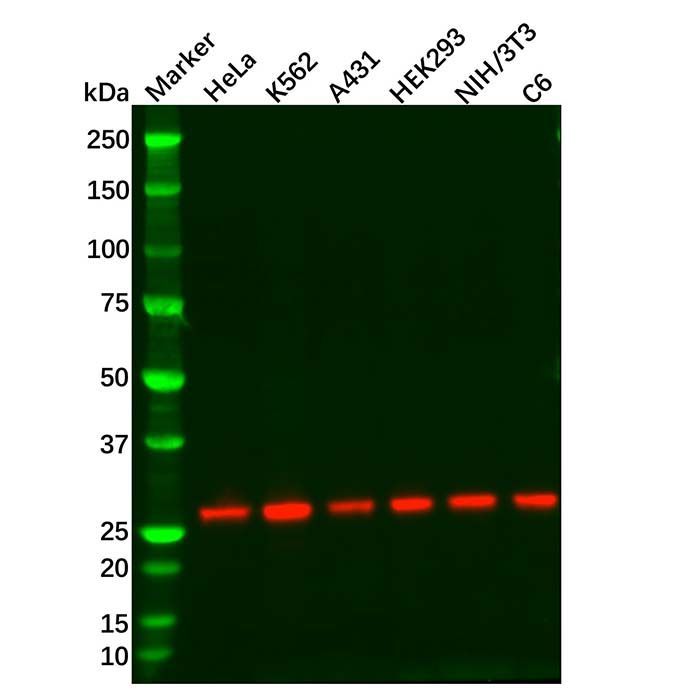
WB: HeLa, K562, A431, HEK293, C6 and NIH/3T3 lysates. IHC: Mouse colon tissue. IF/ICC: HeLa cells.
Conjugación
Unconjugated
Grado
ExactAb™, Recombinant, Validated
Isotipo
Rabbit IgG
SDS-PAGE
150 kDa
Método de purificación
Immunogen affinity purified
Concentración
0.5 mg/mL
Product Line
Productos biológicos
Almacenamiento y envío
Forma
Liquid
Condiciones de almacenamiento de almacenamiento
Store at -20°C,Avoid repeated freezing and thawing
Enviado en
Ice chest + Ice pads
Estabilidad y almacenamiento
Store at 4°C short term (1-2 weeks). Store at -20°C long term (24 months). Upon receipt, it is recommended to aliquot. Avoid freeze/thaw cycle.
Imágenes
Recombinant eIF4E Antibody (Ab101380) - Western Blot All lanes: Recombinant eIF4E Antibody (Ab101380) at 1/1000 dilution Samples: Lysates at 20 µg per lane Secondary: Goat Anti-Rabbit IgG H&L (HRP) (Ab170144) at 1/20000 dilution
Predicted band size: 25 kDa Observed band size: 27 kDa Exposure time: 21.2 s
Recombinant eIF4E Antibody (Ab101380) - IHC Immunohistochemistry analysis of paraffin-embedded mouse colon using Recombinant eIF4E Antibody (Ab101380). High-pressure and temperature Sodium Citrate pH 6.0 was used for antigen retrieval.
Recombinant eIF4E Antibody (Ab101380) - IF/ICC
IF analysis of Recombinant eIF4E Antibody (Ab101380) in HeLa cells. The cells were fixed with 4% PFA for 10 minutes, permeabilized with 0.3% Triton X-100 (I743383) for 10 minutes and then blocked with 5% BSA for 1 hour at room temperature. Cells were stained with Recombinant eIF4E Antibody (Ab101380) at 1/200 dilution in blocking buffer overnight at 4°C, and then incubated with Goat Anti-Rabbit IgG H&L (AF488) (Ab181954) at a dilution of 1/1000 for 1 hour at room temperature in the dark (green). Cells were counterstained with DAPI (blue).
Aplicación
Aplicación
Dilution info
WB
1/500-1/1000
IHC
1/50 - 1/100
IF/ICC
1/200
Documentación
📋 Hoja de datos de seguridad (SDS)
Documento completo sobre peligros, manipulación, almacenamiento y cumplimiento normativo.
Determine the necessary mass, volume, or concentration for preparing a solution.
Dilution Calculator
Determine the dilution needed to prepare a stock solution.
Reconstitution Calculator
Reseñas
Reseñas de cliente
Application Protocols
Tested applications, recommended dilutions, incubation conditions, and positive controls are not specified for this item; refer to the product CoA/Spec Sheet for authoritative protocols.
Note: As a general practice, begin with the manufacturer’s recommended dilutions and adjust based on signal-to-noise in your specific sample type and detection system. However, do not substitute these general notes for the item-specific instructions.
Biological Roles
Target overview (literature, not product-specific claims):
eIF4E (EIF4E) is the 5′ cap-binding subunit of the eIF4F complex, which recruits ribosomes to mRNA during cap-dependent translation initiation. By binding m7GpppN caps, eIF4E facilitates eIF4G/eIF4A assembly and subsequent 43S preinitiation complex joining.
Regulation: eIF4E is regulated by 4E-BP proteins (whose phosphorylation by mTORC1 relieves inhibition) and by phosphorylation at Ser209 by MNK1/2 downstream of MAPK signaling. Its availability and activity are rate-limiting for translation of a subset of mRNAs with structured 5′UTRs.
Cellular pathways: Impacts protein synthesis, cell growth, and stress responses. Overexpression or dysregulation can alter translation of growth-related transcripts (literature context).
Why antibodies to eIF4E are useful (general):
Enable detection/quantification of total eIF4E levels across treatments and model systems.
Facilitate interrogation of translation initiation complexes via IP/Co-IP.
Support studies on mTOR/MNK signaling by monitoring eIF4E abundance alongside phospho-specific readouts (when paired with appropriate antibodies).
Note: The specific epitope, isotype, and species reactivity of SKU Ab101380 are not specified here; consult the CoA/Spec Sheet to align applications with biological questions.
Buffer Applications
Not typically applicable in the classical sense of chemical buffer system design. As a protein reagent, the antibody should be used in standard immunoassay buffers.
Practical notes:
Assay buffers: Commonly PBS or TBS with defined additives (e.g., 0.05% Tween-20 for TBST/PBST) for washing in WB/ELISA; blocking with BSA or non-fat milk depending on assay. These specifics are not provided for this item—refer to the CoA/Spec Sheet or your established lab SOPs.
Storage buffer: The exact storage/reconstitution buffer for SKU Ab101380 is not specified; consult the CoA/Spec Sheet for composition, pH, and any preservatives.
Green Alternatives
Conventional green chemistry solvent substitutions are not directly applicable to antibody reagents. Sustainability considerations instead focus on:
Buffer selection: Use phosphate or Tris buffers prepared with minimal hazardous preservatives. Choose ready-to-use buffers when it reduces waste, or make concentrates to minimize shipping mass.
Cold-chain efficiency: Consolidate shipments and use reusable/recyclable ice packs where permitted. The item ships on ice; consider coordinating orders to reduce shipments.
Waste minimization: Aliquot to reduce freeze–thaw waste. Use low-retention plastics to minimize reagent loss. Follow institutional guidance for protein/biological waste disposal.
Packaging: Recycle secondary packaging and cold-chain materials when feasible.
Tradeoffs:
Preservatives (e.g., azide, ProClin) may aid stability but can add hazards and wastewater concerns. If preservative-free material is required, ensure appropriate sterile technique and shorter storage intervals.
Pharmaceutical Uses
This product is supplied strictly for research use only (as stated). It is not intended for diagnostic, therapeutic, or human/animal administration.
General context (not product-specific claims):
Antibodies can serve as analytical reagents in bioprocess monitoring and in-process controls; however, qualifying an antibody for GMP/QC use requires detailed characterization and documentation (isotype, purity, residual DNA/endotoxin, host cell proteins), which are not specified for this item.
No pharmacopeial monograph is implied for this reagent. Do not use in any clinical or manufacturing setting without appropriate qualification.
For any regulated use, request full documentation (sequence, characterization, stability, impurities) via CoA/Spec Sheet and QA channels.
Physical Properties
Item-specific facts (from Product Data):
Appearance: Not specified for this item; refer to CoA/Spec Sheet.
Concentration/formulation: Not specified for this item; refer to CoA/Spec Sheet.
Molecular weight (antibody): Not specified for this item; refer to CoA/Spec Sheet.
General/literature values for antibodies (for context only):
Typical immunoglobulin (IgG) molecular mass: ~150 kDa (literature), with fragments such as Fab (~50 kDa) or scFv (~25–30 kDa) depending on format.
Solubility: Antibodies are water-soluble proteins in buffered aqueous media; stability depends on pH, salt, and excipients (literature).
pI range: IgGs often exhibit pI ~6–9 depending on sequence and glycosylation (literature).
Temperature sensitivity: Proteins can denature upon repeated freeze–thaw cycles; stability enhanced by cryoprotectants and aliquoting (literature).
Notes for practitioners:
Avoid extremes of pH and temperature. Maintain cold chain on ice during handling.
If lyophilized, reconstitution volume, buffer, and target concentration should be taken from the item’s CoA/Spec Sheet. Do not infer from general data.
Recombinant: The antibody is produced from defined recombinant sequences, enabling high lot-to-lot consistency, reduced background from undefined serum components, and improved supply continuity relative to hybridoma-derived or polyclonal reagents.
ExactAb™: Branding indicates defined sequence and controlled production workflow. This typically implies sequence fidelity, clonality control, and consistency; consult CoA for exact specifications and isotype.
Validated: The product has undergone application-specific testing by the manufacturer; however, specific validated applications, species reactivity, and performance metrics are not specified here. Refer to CoA/Spec Sheet for assay types (e.g., WB, IF, IHC, IP), recommended dilutions, and validation data.
What is NOT specified for this item:
Purity percentage, endotoxin level, host species, isotype, clonality, and preservative profile. Please consult the CoA/Spec Sheet for these critical parameters before experimental use.
Reaction and Applications
This section is adapted to immunoassay applications for an antibody reagent.
General/literature applications of eIF4E antibodies (context; not specific validation for this item):
Western blotting (WB): Detection of total eIF4E or phospho-specific forms following SDS-PAGE of cell lysates to assess translation initiation signaling.
Immunoprecipitation (IP)/Co-IP: Pull-down of eIF4E and associated cap-binding complex components (eIF4G, 4E-BPs) for pathway studies.
Immunofluorescence (IF)/Immunocytochemistry (ICC): Cellular localization of eIF4E in cytoplasm and nucleus under growth factor stimulation or stress.
ELISA: Quantitation in cell/tissue lysates when paired with suitable capture/detection reagents.
ChIP-like approaches (if epitope accessible and crosslinked): Less common; depends strongly on epitope.
Practical considerations (general):
Epitope sensitivity: Denaturing vs native applications may require different antibodies. Confirm whether this ExactAb™ recognizes linear or conformational epitopes (refer to CoA).
Sample prep: For WB, include protease/phosphatase inhibitors if analyzing phosphorylation states (e.g., Ser209 in human eIF4E; literature). For IP, pre-clear lysates and optimize bead systems (Protein A/G) based on isotype.
Important: Specific validated applications, species reactivity, working dilutions, and positive controls for SKU Ab101380 are not specified here and must be confirmed in the CoA/Spec Sheet.
Reaction Conditions
For antibody-based workflows, “reaction conditions” correspond to immunoassay conditions. No item-specific conditions are provided for SKU Ab101380.
General/literature guidance (not product-specific and should be optimized):
Western blot (WB): Blocking with 3–5% BSA or milk in TBST/PBST; primary antibody incubation often 1–16 h at 4–25°C; secondary HRP or fluorescent conjugates per standard practice. Antibody dilution ranges vary widely and must be taken from the CoA for this product.
Immunoprecipitation (IP): Use lysis buffers compatible with preserving protein complexes (e.g., NP-40 or Triton X-100 based). Incubation 1–4 h at 4°C; capture with Protein A/G beads appropriate to the antibody isotype (not specified here).
IF/ICC: Fixative choice (PFA vs methanol) can affect epitope integrity; permeabilization with saponin/Triton-X as appropriate. Validate on positive-control cell lines known to express eIF4E.
Important: Exact dilutions, buffers, incubation times, and positive controls for Ab101380 are not specified for this item; refer to the CoA/Spec Sheet and optimize empirically.
Safety and Handling
Item-specific hazard data:
GHS classification, signal word, pictograms, H-statements: Not specified for this item; refer to SDS.
General guidance for protein antibodies (non-hazard-specific):
PPE: Wear lab coat, gloves, and safety glasses when handling solutions or lyophilizates.
Handling: Work on ice where practical. Avoid aerosol generation and use appropriate biosafety practices for biological reagents.
Incompatibilities: Avoid strong oxidizers and extreme pH conditions that can denature proteins. Do not autoclave.
Freeze–thaw: Product data specifies “Avoid repeated freezing and thawing.” Aliquot upon first thaw to minimize activity loss and aggregation.
First aid (general): In case of skin/eye contact, rinse with water. If inhaled or ingested, seek medical attention. Always follow institutional biosafety procedures.
Preservatives: Presence/absence of sodium azide or other preservatives is not specified for this item; refer to SDS/CoA.
Authoritative source: Always consult the product’s SDS and CoA/Spec Sheet for definitive hazard, composition, and handling instructions specific to SKU Ab101380.
Solvent Selection
Not typically applicable. This is a recombinant antibody reagent formulated for aqueous buffers. Organic solvent selection paradigms (e.g., polarity, dielectric constants) used for small molecules do not apply here.
Practical guidance:
Use manufacturer-provided buffer or recommended reconstitution buffer (if lyophilized). Avoid high percentages of organic solvents (e.g., >10–20% v/v) that can denature proteins unless specifically recommended.
Maintain isotonicity and suitable pH (commonly pH 6.5–8.0 for IgGs) using phosphate or Tris buffers, per CoA/Spec Sheet.
Storage and Reconstitution
Item-specific storage (from Product Data):
Storage Conditions: Store at -20°C. Avoid repeated freezing and thawing.
Shipment: Shipped in an ice chest with ice pads to maintain cold chain.
Practical guidance:
Upon receipt: Inspect for any signs of thawing during transit. Store immediately at -20°C as directed.
Aliquoting: To comply with “avoid repeated freezing and thawing,” divide into single-use aliquots under sterile conditions. Use low-protein-binding tubes.
Thawing: Thaw on ice. Mix gently by inversion—avoid vigorous vortexing to minimize aggregation.
Reconstitution: Not specified for this item; refer to CoA/Spec Sheet for buffer composition, volume, and target concentration if lyophilized.
Short-term handling: Keep on ice during use. For very short-term storage (hours to a day), 2–8°C may be acceptable, but adhere to the CoA for allowable excursions.
Long-term stability: Stability data, preservative content, and recommended storage buffer are not specified; consult the CoA. Do not store at room temperature.
Disposal: Follow institutional guidelines for protein/biological waste. If preservatives (e.g., azide) are present, dispose of solutions accordingly; presence/absence is not specified for this item.
CAS: Not specified for this item; refer to CoA/Spec Sheet.
Molecular formula: Not specified for this item; refer to CoA/Spec Sheet.
Molecular weight: Not specified for this item; refer to CoA/Spec Sheet.
SMILES/InChI/InChIKey: Not applicable for antibodies; not specified for this item.
General/literature information (antibody and target):
Antibody structural features (literature): Typical IgG-class antibodies are Y‑shaped glycoproteins (~150 kDa) with two heavy and two light chains, each containing variable domains (VH/VL) forming the antigen-binding site (paratope) and constant domains (CH/CL). Recombinant antibodies are produced from defined sequences, enabling lot-to-lot consistency.
Target identity (literature): eIF4E (eukaryotic translation initiation factor 4E; gene EIF4E). Human UniProt: P06730 (literature). eIF4E is the 5′ m7G cap-binding protein central to eIF4F complex assembly.
2D/feature description (general):
Functional composition: Protein biotherapeutic reagent; no small-molecule functional groups applicable. Antigen-binding region typically recognizes a linear peptide epitope or a conformational determinant on eIF4E.
Isotype/clone/host: Not specified for this item; refer to CoA/Spec Sheet.
Synthetic Utility
Not applicable. This is a recombinant protein antibody, not a small-molecule building block. It is not used as a reagent or substrate in organic synthesis.
Where relevant, see “Reaction & Applications” for immunoassay-related uses instead.
Target Specificity
Item-specific information required for this section (antigen, clone, epitope, species reactivity, isotype) is not specified for this item; refer to the CoA/Spec Sheet.
General context (literature): eIF4E (EIF4E) is the canonical 5′ cap-binding protein involved in cap-dependent translation. Antibodies can be total eIF4E or modification-specific (e.g., phospho‑Ser209); the specificity class of Ab101380 is not provided here.
Preguntas frecuentes
What does ExactAb? mean?
ExactAb? indicates the product has been validated for use in rigorous antibody validation workflows. Validation may include positive/negative control samples, signal-to-noise testing, and protocol-specific QC. Lot-specific test data is published on the Certificate of Analysis where available.
What does Recombinant mean?
Recombinant is a defined analytical purity tier suitable for workflows requiring a specific validated property. It specifies a minimum assay percentage, controlled limits on common impurities (water, heavy metals, residue on ignition), and lot-to-lot consistency. Recombinant is one of several purity tiers — choose based on the sensitivity and regulatory requirements of your method.
How should this product be stored?
Store at ?20 °C. Avoid repeated freeze–thaw cycles. Aliquot into single-use volumes before freezing.
How is this product shipped?
This product ships in an insulated container with ice pads. Unpack on arrival and transfer it to the storage condition stated above.
What documentation is provided?
Available product documentation, including Certificates of Analysis (COA), Safety Data Sheets (SDS), and specification sheets, is shown in the product document area. Document availability and access follow the current site policy.
Which species reactivity has this antibody been validated against?
Validated reactivity is listed on the PDP and on each lot's datasheet. We validate against the most commonly tested species for the target (Recombinant eIF4E Antibody); cross-reactivity in untested species may exist but is not guaranteed. Contact technical support for specific species inquiries.
¿Necesita ayuda para elegir la calidad?
Nuestra guía de selección de calidades cubre la pureza, el estado del estabilizador y la idoneidad de la aplicación para todas las variantes de nuestro catálogo.
Utilizamos cookies para garantizar el correcto funcionamiento del sitio web y, cuando esté permitido, para mejorar su experiencia. Puede gestionar sus preferencias en cualquier momento en Configuración. Más información en nuestra Política de Cookies.
¿Quieres que te enviemos un mensaje cuando tengamos descuentos disponibles?
Recordármelo más tarde
¡Gracias! Por favor, revisa tu bandeja de entrada de correo electrónico para confirmar.
Products are supplied to verified businesses, institutions, and qualified professionals for research and development use only. Not for use in humans, animals, diagnosis, or therapy.

 ZJ23F1202239