
Angiosperm Flower Patterns and Flower Programs
Angiosperm Flower Patterns and Flower Programs
In order to illustrate in a simple way the structure of a flower, the composition, arrangement and interrelationship of its parts, the parts of a flower can be represented by a formula or a pattern. A formula composed of letters, numbers and symbols to express the number, union and position of the parts of a flower in relation to the ovary is called a flower program. Its advantages are simple and easy to grasp, easy to write, and can more comprehensively reflect the overall characteristics of the flower; the disadvantage is the lack of intuition, and can not show the shape, size or arrangement of the members of the various parts of the relationship. Flower pattern is a cross-section of the flower sketch to indicate the number of parts of the flower, the joint situation, as well as the arrangement of the relationship on the receptacle. Its advantage is more intuitive, can clearly reflect the number of parts, location, arrangement and relative size, at a glance; disadvantage is that it can not reflect the position of the ovary.
Operation method
Angiosperm Flower Patterns and Flower Programs
Materials and Instruments
Equipment and reagents: none Move The basic process of angiosperm flower schema and flower program can be divided into the following steps: (1) ⚤ for hermaphroditic flowers, ♂ for male flowers, ♀ for female flowers. (2) ⚤ for the neat flower (radial symmetry), ♀ for the untidy flower (left-right symmetry). (3) The parts of the flower are represented by the first capital letter of the Latin term for each floral part of the whorl: P, perianth (peri-anth); K, calyx (calyx) (denoted by K to avoid repetition of corolla); C, corolla (corolla); A, stamens (androecium); G, pistil (gynoecium). (4) The number of parts is represented by the number in the lower corner of the letter, 0 for absence; ∞ for majority (indeterminate number greater than 10), and brackets around the number for union. (5) The position of the ovary is indicated by the letter G with a horizontal line. The superior position of the ovary is indicated by a horizontal line below G, the inferior position of the ovary by a horizontal line above G, and the semi-inferior position of the ovary by a horizontal line above and below G. G is followed by three numbers separated by a ":", the first number indicating the number of carpels, the second number indicating the number of chambers of the ovary in each gynoecium, and the third number indicating the number of ovules in each chamber of the ovary. (6) If there is more than one round of a part, the numbers of rounds may be connected by " + "; if there are more than one number of a part, the numbers may be separated by ", ". Flower program for peas: ⚤ K (5)C1 + 2 + (2) A (9) + 1 G (1:1:∞). Flower program of Cruciferae: ⚤ _K~Ksub~M4_~K~Hsub~MC~Ksub~M4~K~Hsub~M_A~Ksub~M2_~D_4~K~Hsub~M_~Kspan~MG~K~Hspan~M~Ksub~M (2: 2: ∞). Liliaceae Flower Program: ⚤ _P~Ksub~M3_~D_3_~K~Hsub~MA~Ksub~M3~D3~K~Hsub~M_~Kspan~MG~K~Hspan~M~Ksub~M (3:3:∞).
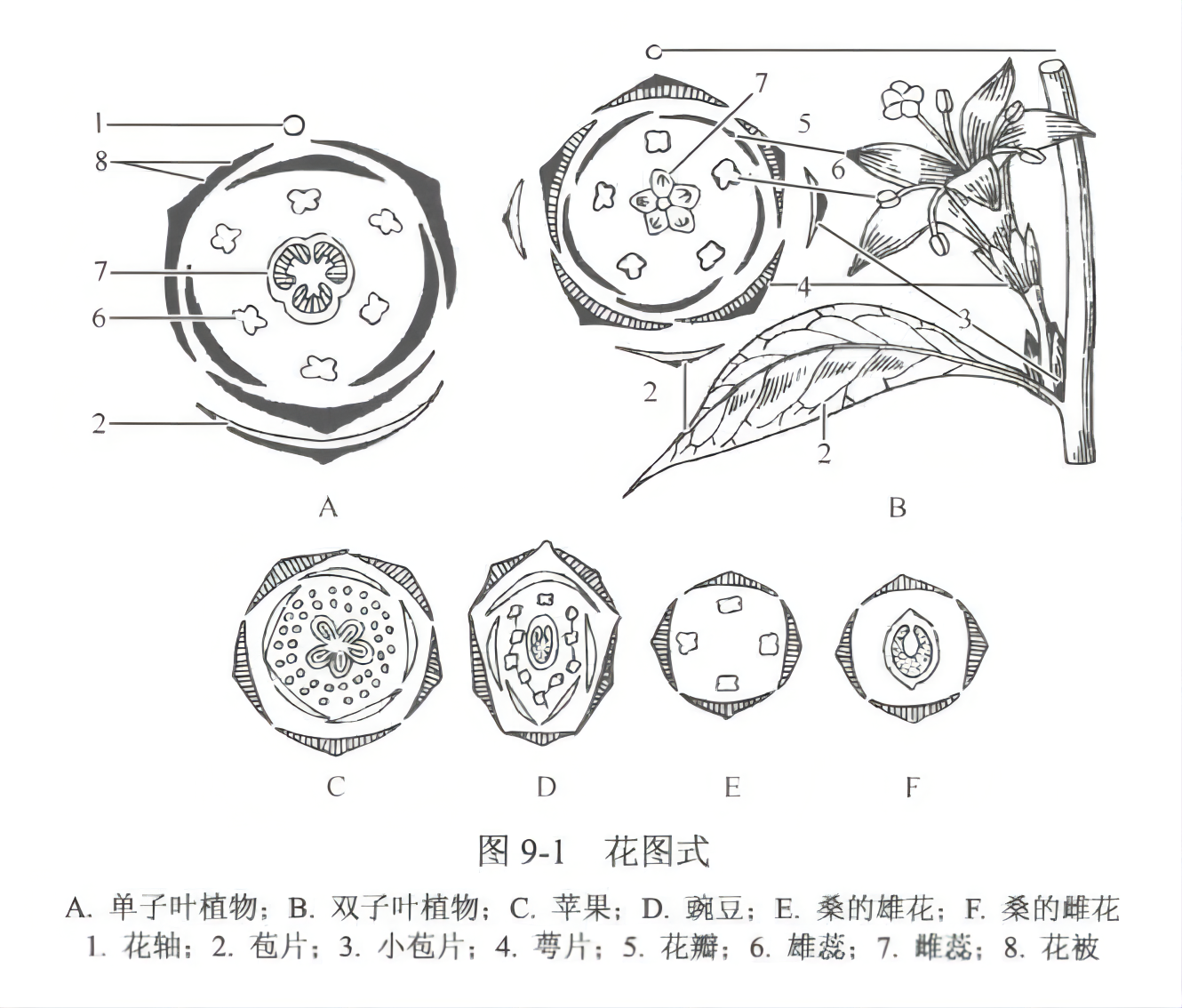
There is no uniform rule for the drawing of floral patterns, and the methods adopted by textbooks are not the same. Common drawing methods are as follows: the floral axis is represented by an "o", which is drawn on the top of the floral pattern; the bracts or bracteoles are represented by crescent-shaped hollow arcs, which are drawn on the other side of the floral axis and on both sides of the floral axis. In the case of terminal flowers, the rachis, bracts and bracteoles need not be drawn. The parts of the flower lie between the rachis and the bracts, the calyx being represented by a crescent-shaped arc with raised and short lines, and the corolla by a solid black arc. When the calyx and corolla are free, the arcs are separated from each other; when they are united, the arcs are connected by dotted or solid lines. Note the arrangement and interrelationship of the whorls of the perianth. If the perianth is spaced, it is indicated by the extension of the arcs. Stamens are shown in cross-section of anthers, and the arrangement and number of rounds of stamens, union or separation, direction of anther dehiscence, and interrelationship with perianth should be drawn, and in the case of staminodes, dotted lines should be used. The pistil is represented by a cross-section of the ovary, which should show the number of carpels, their separation, the number of locules, the type of placentation, and ovule attachment (Figure 9-1).
For more product details, please visit Aladdin Scientific website.