
What Is Thiophene? Structural Features, Application Value, and Research-Oriented Selection Strategies
What Is Thiophene? Structural Features, Application Value, and Research-Oriented Selection Strategies
I. What Is Thiophene?
Thiophene is one of the most representative five-membered sulfur-containing aromatic heterocycles. It is both a classical scaffold in organic synthesis and a high-frequency structural unit in medicinal chemistry, functional materials, conductive polymers, and sensor research. Thiophene was identified by Viktor Meyer in the early 1880s in coal-tar benzene-related systems; in 1883, the compound was isolated from coal-tar benzene and entered systematic study. Today, thiophene has become a highly representative sulfur-containing aromatic heterocyclic scaffold in organic synthesis, medicinal chemistry, and organic electronic materials.
Thiophene is a five-membered heteroaromatic ring with the molecular formula C4H4S and can be understood as a monocyclic heteroaromatic hydrocarbon formed by replacing the oxygen in furan with sulfur. PubChem describes it as one of the simplest sulfur-containing aromatic heterocycles. Structurally, the thiophene ring consists of 4 carbon atoms + 1 sulfur atom. It is not an ordinary saturated five-membered ring, but rather a planar, conjugated, aromatic ring system; this allows it to retain the stability of an aromatic system while also making it more prone than benzene to electrophilic aromatic substitution.
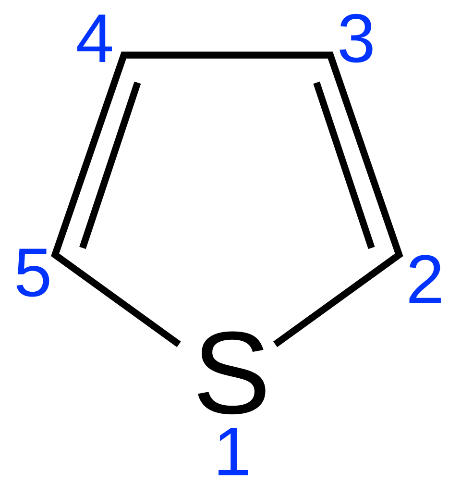
II. What Structural Features Does Thiophene Have?
1) It is a “five-membered sulfur-containing aromatic heterocycle,” not an ordinary thioether ring
The key point about thiophene is not simply that it “contains sulfur,” but that the sulfur atom is embedded in an aromatic conjugated ring. Sulfur has two lone pairs of electrons, one of which participates in the aromatic delocalized system, giving the entire ring aromatic character. This is also the fundamental reason why thiophene behaves so differently from tetrahydrothiophene, ordinary thioethers, and acyclic sulfides.
2) It is planar and conjugated, making it well suited as a charge-transport and optoelectronic scaffold
The planarity and π conjugation of thiophene make it well suited for connection into extended conjugated systems such as bithiophenes, oligothiophenes, and polythiophenes. For materials researchers, this means that thiophene is not merely “a ring,” but an extendable π-conjugated unit. This is precisely why thiophene-based materials are so common in organic electronics.
3) Its positional reactivity follows clear patterns, making directed modification easier
Thiophene is commonly divided into α positions (2/5 positions) and β positions (3/4 positions). In classical electrophilic aromatic substitution, the α positions usually react more readily, so the 2- and 5-positions are often the preferred sites for modification. In metal-catalyzed C–H functionalization, however, regioselectivity can also be affected by substituents, directing effects, and the catalytic system, so the specific route must be judged together with the reaction type. This point is highly practical for researchers designing building blocks, because it directly determines where a new fragment can be attached, how conjugation can be extended, and which position is most likely to be functionalized.
4) It combines “aromatic stability” with “tunable electronic properties”
Compared with benzene, thiophene is still an aromatic ring, but it is usually more reactive toward electrophilic substitution. Compared with purely carbocyclic aromatic rings used in materials chemistry, the sulfur atom in thiophene also alters molecular polarizability, energy levels, and intermolecular interactions. This combination of being both stable and tunable is exactly why thiophene is popular in both medicinal and materials chemistry.
Summary Table of Structural Features
Structural Feature | Chemical Meaning | Direct Value for Research Applications |
Five-membered sulfur-containing aromatic heterocycle | The sulfur atom participates in aromatic delocalization | Combines aromatic stability with tunable electronic properties |
Planar conjugation | Readily forms continuous π-systems | Well suited for organic semiconductors, luminescent, and photovoltaic scaffolds |
Clearly defined α/β positions | The 2/5 positions are often key reaction sites | Facilitates directed substitution, coupling, and polymer design |
Expandable from a single ring to fused rings/polymers | Extensible from small molecules to macromolecules | Suitable for multi-scenario development in drugs, materials, and sensing |
III. What Role Does the Thiophene Ring Play in P3HT?
From the perspective of materials chemistry, poly(3-hexylthiophene) (P3HT) is a representative example for understanding the structural role of thiophene. P3HT is one of the most classical polythiophene materials and is widely used in organic electronics, optoelectronic devices, OFETs, OPVs, bioelectronics, and sensing research.
In P3HT, the thiophene ring forms a 2,5-connected conjugated main chain and is the foundation for light absorption and charge transport. In this material, the thiophene ring primarily plays the following roles:
1. The core unit of the conjugated backbone
The thiophene ring provides a continuous π-conjugated framework, which is the basis for the material’s ability to absorb light, transport charge, and exhibit semiconducting behavior.
2. Extends conjugation through 2,5-linkage
Thiophene rings preferentially connect at the 2- and 5-positions, helping conjugation extend continuously along the polymer backbone and thereby forming relatively efficient charge-transport pathways.
3. Regulates molecular packing and solid-state semiconductor behavior
Sulfur-containing aromatic heterocycles influence not only the electronic structure of the main chain, but also intermolecular interactions, chain-packing modes, and film microstructure; all of these factors are closely related to carrier-transport performance.
4. Works with the side chain to balance electronic performance and processability
In P3HT, the hexyl side chain at the 3-position significantly improves the polymer’s solubility, film-forming ability, and processing adaptability while preserving the conjugated backbone, making it more suitable for solution-processed film fabrication and device preparation.
P3HT is a classic representative among polythiophene materials not simply because it “contains a thiophene ring,” but also because the hexyl side chain at the 3-position provides good processability, while higher head-to-tail regioregularity favors the coordinated optimization of chain packing, crystallization behavior, and charge transport. Accordingly, the performance of P3HT is not determined solely by whether it contains thiophene, but jointly by the thiophene backbone, side-chain design, and regioregularity.
From the pharmaceutical side, clopidogrel belongs to the thienopyridine class of antiplatelet drugs, whereas raloxifene belongs to the benzothiophene class of selective estrogen receptor modulators. This shows that thiophene-containing systems are not limited to “materials scaffolds”; they can also enter mature drug molecules.
IV. Common Application Areas of Thiophene and Their Roles
Application Area | Common Thiophene Forms | Distinctive Role of Thiophene Therein |
Medicinal chemistry | Thiophene, benzothiophene, thienopyridine | Provides a compact aromatic scaffold, tunes electronic properties and hydrophobic interactions, and participates in pharmacophore design |
Organic electronics/optoelectronics | Bithiophenes, oligothiophenes, polythiophenes, P3HT, PEDOT-type frameworks | Builds conjugated backbones that support charge transport, light absorption, emission, and device film formation |
Organic synthesis building blocks | Halogenated thiophenes, aminothiophenes, carboxy-/aldehyde-/boronate-thiophenes | Efficient heteroaromatic building units for further coupling, substitution, and condensation |
Sensing/bioelectronics | Polythiophene derivatives, conductive polymers | Integrates molecular recognition, ion/electron transport, and signal output |
Natural products/biologically related systems | Reduced sulfur-containing five-membered rings related to thiophene, biotin, etc. | Shows that thiophene-related five-membered sulfur ring systems are not confined to synthetic systems; however, the relevant ring in biotin is a tetrahydrothiophene-related system rather than an aromatic thiophene nucleus. |
Note: Recent medicinal-chemistry reviews have reported that, within their search scope, a total of 26 USFDA-approved drugs contain thiophene ring systems; this number may vary with the time of retrieval and the inclusion criteria. Meanwhile, polythiophenes and related systems have long been important semiconductor scaffolds in organic electronics, indicating that thiophene has stable, sustained value across disciplines.
V. How Can Thiophene Compounds Be Classified?
Classification Approach | Representative Types | Typical Way to Understand Them |
Parent nucleus and simple substituted thiophenes | Thiophene, methylthiophenes, alkylthiophenes | Understand the properties of the parent ring and use them for basic substitution and monomer design |
Functionalized thiophene building blocks | Halo-, amino-, carboxy-, aldehyde-, boronate-, and cyano-thiophenes | Suitable for coupling, condensation, and further functionalization |
Fused thiophenes | Benzothiophene, thienopyridine, etc. | Suitable for strengthening drug scaffolds or increasing material rigidity |
Oligo-/polythiophenes | Bithiophene, terthiophene, P3HT, other polythiophenes | Suitable for organic electronics, sensing, and optoelectronic materials |
Reduced or oxidized derivatives | Tetrahydrothiophene, thiophene dioxides, etc. | Their properties are clearly different and cannot simply be treated as equivalent to the aromatic thiophene nucleus |
VI. When Should Thiophene Compounds Be Given Priority?
When you need a heterocyclic scaffold that is relatively small, aromatically stable, and clearly capable of tuning electronic properties, thiophene is often worth prioritizing. Compared with many purely carbocyclic aromatic rings, it is easier to derivatize further; compared with some more reactive heterocycles, it is also easier to balance stability and processability.
The following tasks are especially common:
1. For conjugation extension or organic semiconductor design, thiophene is a high-frequency choice;
2. For rapid introduction of new fragments through the 2/5 positions, thiophene building blocks are highly practical;
3. For introducing a compact sulfur-containing aromatic fragment into drug molecules, fused systems such as benzothiophenes and thienopyridines are often considered;
4. For balancing film formation and electronic performance in conductive polymers, optoelectronic systems, or sensing systems, the polythiophene family is often a mature starting point.
VII. Points to Note When Selecting or Using Thiophene Compounds
1) First distinguish between “thiophene” and related systems that are not the thiophene nucleus itself
These molecular names may appear similar (thiophene/benzothiophene/thienopyridine/tetrahydrothiophene), but their properties are not the same. Benzothiophene is a fused aromatic system; thienopyridine contains an additional nitrogen-containing ring; and tetrahydrothiophene is no longer the aromatic thiophene nucleus. This distinction is very important when reading the literature or selecting products.
2) Pay attention to positional selectivity, because different positions directly change subsequent synthetic routes
The α and β positions of thiophene directly affect substitution position, coupling outcome, the direction of conjugation extension, and final performance. When designing monomers, building blocks, or polymers, positional design is often critical to success or failure.
3) In materials research, it is not enough to look only at whether a molecule contains a thiophene ring; the overall structure must also be considered
In materials systems, performance is usually not determined simply by whether “this molecule contains thiophene,” but by how the thiophene units are connected, whether the system is fused, how the side chains are arranged, what the regioregularity is, and how the film packs. P3HT became a classic not only because it contains thiophene, but also because its regular backbone, side-chain design, and solid-state organization together determine device performance.
4) In drug research, pay extra attention to metabolic activation and potential structural alerts
Thiophene is an important scaffold in medicinal chemistry, but its metabolic behavior requires case-by-case analysis. The literature shows that some thiophene-containing drugs can undergo CYP450-mediated S-oxidation or epoxidation to form reactive intermediates; however, this is a matter of specific structure and metabolic pathway and does not mean that “containing thiophene automatically means high risk.” What truly needs to be evaluated are the substitution pattern, exposure level, metabolic route, and detoxification capacity. Thiophene is therefore better regarded as a structural fragment that requires careful assessment together with metabolic data, rather than being simply classified as a universally high-risk alert scaffold.
5) When handling the parent thiophene itself in the laboratory, pay attention to flammability and irritation
PubChem and occupational health information both indicate that parent thiophene is a flammable liquid and may irritate the skin, eyes, and respiratory tract. Experimental use should avoid ignition sources, be carried out under ventilation, and follow the specific SDS.
VIII. Thiophene-Related Product Selection Guide: Quickly Locate Tables 1–5 by Research Task
Research Task / Experimental Need | Table to Check First | Why It Should Be Prioritized | Representative Product Directions |
Need conductive thin films, transparent electrodes, hole-transport layers, flexible electronics, or printed electronics | Table 1 | Table 1 concentrates PEDOT:PSS, P3HT, EDOT, ProDOT, and polythiophene materials—the product group in the thiophene family most directly oriented toward conductive polymers and device film fabrication. If the goal is to “make films first, build devices first, or first compare conductivity grades and processing forms,” this is usually the table to start with. | Various PEDOT:PSS grades, P3HT, EDOT, ProDOT, bromine-terminated polythiophene |
Need to screen organic semiconductor scaffolds, design conjugated structures, build optoelectronic molecules, or compare fused thiophene skeletons | Table 2 | Table 2 mainly contains “scaffold-type” products such as bithiophene, terthiophene, thienothiophene, benzothiophene, and dibenzothiophene. It is better suited to studying structure–property relationships from the molecular scaffold itself rather than starting directly from processable polymers. | 2,2'-Bithiophene, terthiophene, thieno[3,2-b]thiophene, thieno[2,3-b]thiophene, benzo[b]thiophene |
Need Suzuki/Stille coupling, coupling-library construction, monomer chain extension, or conjugated polymer synthesis | Table 3 | Table 3 collects the most typical “synthetic-entry building blocks,” including halothiophenes, thiophene boronic acids, organotin monomers, bifunctional monomers, and alkylated dibromothiophenes. If the experimental goal is to “attach thiophene fragments,” “continue coupling to enlarge the scaffold,” or “synthesize polymer monomers,” this table is usually the most critical. | 2-Bromothiophene, 3-Bromothiophene, 2-Iodothiophene, thiophene-2-boronic acid, thiophene-3-boronic acid, 2,5-dibromothiophene, 2,5-bis(stannyl)thiophene |
Need downstream derivatization of carboxylic acids/aldehydes/esters/ketones/nitriles, such as amidation, condensation, reductive amination, Knoevenagel reactions, Schiff-base formation, or synthesis of fused-ring precursors | Table 4 | Table 4 focuses on functional-group intermediates and is suitable when thiophene is used as a fragment bearing a functional handle. If the goal is not to begin with coupling, but to exploit acids, aldehydes, esters, nitriles, amino groups, etc. for subsequent chemical transformations, this table is the most practical. | Thiophene-2-carboxylic acid, 3-thiophenecarboxylic acid, thiophene-2-carboxaldehyde, 2-acetylthiophene, 2-cyanothiophene, aminothiophene intermediates |
Need 2-aminothiophene derivatives, fused heterocycles, medicinal-chemistry lead expansion, or positional-isomer comparison | Table 4 | Table 4 includes active 2-aminothiophene ester and nitrile intermediates, which are common in the design of fused heterocycles and medicinal-chemistry precursors. If the goal is to progress from “active intermediates” toward more complex heterocycles, starting with Table 4 is more direct than starting with Table 2 or Table 3. | Ethyl 3-aminothiophene-2-carboxylate, Ethyl 2-aminothiophene-3-carboxylate, 2-aminothiophene-3-carbonitrile |
Need alkyl side-chain tuning, polythiophene monomer design, or screening of P3AT/P3HT-type material precursors | Table 3, then Table 1 | If the main experimental focus is to synthesize monomers or polymer precursors first, begin with the alkylated dibromothiophenes in Table 3. If the focus is to use mature polymers directly for devices or controls, then turn to the P3HT entries in Table 1. This sequence better matches the material-development workflow. | 2,5-dibromo-3-hexylthiophene, 2,5-dibromo-3-decylthiophene; P3HT in different molecular-weight grades |
Need to introduce fused heteroarenes while covering both medicinal and materials-scaffold uses | Table 2 or Table 3 | If you want to use the fused parent scaffolds directly for property studies, start with Table 2. If you want to couple fused thiophene fragments onto other scaffolds, start with benzothiophene boronic acid and related coupling building blocks in Table 3. | Benzo[b]thiophene, thienothiophene, benzothiophene-2-boronic acid |
Need symmetric bifunctional molecules, bidirectional extension, D–A molecules, or COF/conjugated-network precursor design | Table 3 or Table 4 | If the goal is further chain extension via dihalides / boronic acids / stannyl groups, prioritize Table 3. If the goal is to use dialdehydes for condensation networks, Schiff bases, or chromophore construction, prioritize Table 4. | 2,5-dibromothiophene, 5,5'-dibromo-2,2'-bithiophene, 5-bromo-2-thiopheneboronic acid, thieno[3,2-b]thiophene-2,5-dicarboxaldehyde |
Need sulfur-containing fuel model compounds, desulfurization-related studies, or analytical-standard method development | Table 2 | Dibenzothiophene in Table 2 is not the first choice for routine materials work, but it is highly important in sulfur-containing fuel model compounds, hydrodesulfurization, biodesulfurization, and analytical standards. For analysis or catalysis, go directly to Table 2. | Dibenzothiophene |
Need high-boiling polar reaction media, sulfur-containing saturated ring precursors, or masked butadiene equivalents, but not necessarily aromatic thiophene materials | Table 5 | Table 5 separately lists products that are related to thiophene but are not the aromatic thiophene nucleus, avoiding confusion with conjugated thiophene materials. If the task leans toward solvents, special intermediates, Diels–Alder routes, or gas-odorization-related applications, Table 5 should be checked first. | Sulfolane, tetrahydrothiophene, 3-sulfolene |
Table 1 | Conductive Polymers, Polythiophene Materials, and Dioxythiophene Monomers
Category | CAS No. | Aladdin Catalog No. | Name | Specification / Purity | Product Features and Applications |
Polythiophene conjugated polymer (model polymer / end-group modifiable) | 25233-34-5 | Poly(thiophene-2,5-diyl), bromine terminated | Powder | Bromine-terminated polythiophene; can serve as a model conjugated polymer material and is also suitable for end-group modification, grafting, or interfacial chemistry studies. | |
Dioxythiophene material monomer (core monomer for PEDOT) | 126213-50-1 | 3,4-Ethylenedioxythiophene(EDOT) | ≥99% | Core monomer of PEDOT; suitable for oxidative chemical polymerization or electropolymerization to prepare highly stable conductive films and interfacial layers. | |
Dihalogenated dioxythiophene monomer (EDOT-derived polymerizable monomer) | 174508-31-7 | 2,5-Dibromo-3,4-ethylenedioxythiophene | ≥98% | EDOT-derived dibromo monomer; suitable for cross-coupling copolymerization or for use as a functional conductive-polymer monomer. | |
Dioxythiophene material monomer (ProDOT type) | 155861-77-1 | 3,4-Propylenedioxythiophene | ≥97% | ProDOT-type conductive-polymer monomer; commonly used in electrochromic materials, conductive polymer films, sensors, and flexible-electronics design. | |
PEDOT:PSS conductive polymer (high-conductivity aqueous dispersion) | 155090-83-8 | Poly(3,4-ethylenedioxythiophene)-poly(styrenesulfonate)(PEDOT:PSS) | 1%–1.3% in water, conductivity ≥850 S/cm | High-conductivity PEDOT:PSS aqueous dispersion; commonly used for transparent conductive films, flexible electrodes, hole-transport layers, and highly conductive coatings. | |
PEDOT:PSS conductive polymer (dry / redispersible grade) | 155090-83-8 | Poly(3,4-ethylenedioxythiophene)-poly(styrenesulfonate)(PEDOT:PSS) | DRY; redispersible granules | Dry, redispersible PEDOT:PSS; convenient for formulation development, transport, storage, and on-demand re-dispersion, and suitable for materials development and process screening. | |
PEDOT:PSS conductive polymer (standard aqueous dispersion) | 155090-83-8 | Poly(3,4-ethylenedioxythiophene)-poly(styrenesulfonate)(PEDOT:PSS) | PEDOT:PSS = 1:6, 1.5% in water | PEDOT:PSS dispersion with a standard ratio; commonly used for interfacial layers, antistatic films, conductive composites, and device pre-treatment. | |
PEDOT:PSS conductive polymer (screen-printing ink grade) | 155090-83-8 | Poly(3,4-ethylenedioxythiophene)-poly(styrenesulfonate)(PEDOT:PSS) | 5.0 wt.%, conductive screen-printing ink | Conductive-ink-grade PEDOT:PSS for screen printing; suitable for printed electronics, flexible circuits, sensing electrodes, and large-area patterned film fabrication. | |
PEDOT:PSS conductive polymer (standard conductive grade) | 155090-83-8 | Poly(3,4-ethylenedioxythiophene)-poly(styrenesulfonate)(PEDOT:PSS) | 1% PEDOT/PSS | Standard conductive PEDOT:PSS system; suitable for conductive coatings, composite films, device interfacial layers, and baseline performance control experiments. | |
PEDOT:PSS conductive polymer (low-conductivity grade) | 155090-83-8 | Poly(3,4-ethylenedioxythiophene)-poly(styrenesulfonate)(PEDOT:PSS) | 2.8 wt% dispersed in H₂O, low-conductivity grade | Low-conductivity PEDOT:PSS; more suitable as an interfacial modification layer, binder/film-forming component, sensing substrate, or antistatic material rather than as the main layer of a high-conductivity electrode. | |
P3HT semiconductor polymer (medium molecular weight) | 104934-50-1 | Poly(3-hexylthiophene-2,5-diyl)(P3HT) | regioregular, average Mw 25000–50000 | Regioregular P3HT semiconductor polymer; commonly used in OFET, OPV, photodetection, and fundamental organic electronics research. A medium molecular weight helps balance solubility and film-forming ability. | |
P3HT semiconductor polymer (high molecular weight) | 104934-50-1 | Poly(3-hexylthiophene-2,5-diyl)(P3HT) | regioregular, average Mw 85000–100000 | High-molecular-weight regioregular P3HT; commonly used to study the effects of chain entanglement, crystallization, carrier mobility, and film morphology on device performance. | |
P3HT semiconductor polymer (relatively high molecular weight) | 104934-50-1 | Poly(3-hexylthiophene-2,5-diyl)(P3HT) | regioregular, average Mw 50000–75000 | Relatively high-molecular-weight regioregular P3HT; suitable for comparative studies of film formation, crystallization, and charge transport across different molecular-weight windows. |
Table 2 | Conjugated Electronic Scaffolds and Fused Thiophene Core Fragments
Category | CAS No. | Aladdin Catalog No. | Name | Specification / Purity | Product Features and Applications |
Oligothiophene electronic scaffold (high-conjugation monomer) | 1081-34-1 | 2,2′:5′,2′′-Terthiophene | ≥99% | A classic oligothiophene scaffold; commonly used in organic semiconductors, optoelectronic molecules, electropolymerization, and sensing-material research. | |
Oligothiophene electronic scaffold (basic bithiophene unit) | 492-97-7 | 2,2'-Bithiophene | ≥98% | The most fundamental bithiophene π-conjugated fragment; often used as a starting scaffold for organic electronics, luminescent molecules, sensing probes, and further coupling-based extension. | |
Fused thiophene electronic scaffold (high planarity) | 251-41-2 | Thieno[3,2-b]thiophene | ≥98% | A fused thiophene scaffold with strong rigidity and planarity; commonly used in high-mobility organic semiconductors, D–A conjugated scaffolds, and crystal-engineering research. | |
Fused thiophene electronic scaffold (isomeric fused scaffold) | 250-84-0 | thieno[2,3-b]thiophene | ≥97% | An isomeric fused thiophene scaffold; used in the design of conjugated molecules and polymers to modulate planarity, packing, and charge transport. | |
Polycyclic aromatic sulfur heterocycle (analytical standard / desulfurization model compound) | 132-65-0 | Dibenzothiophene | Analytical standard | A classic polycyclic organosulfur model compound; commonly used in sulfur analysis of fuels, hydrodesulfurization/biodesulfurization studies, and analytical method development. | |
Fused aromatic thiophene scaffold (common parent scaffold for medicinal chemistry and materials) | 95-15-8 | Benzo[b]thiophene | ≥97% | An important fused heteroaromatic parent scaffold; widely used in medicinal-chemistry lead design, functional molecules, and organic-material scaffold research. |
Table 3 | Cross-Coupling, Polymerization, and Sequential-Synthesis Building Blocks
Category | CAS No. | Aladdin Catalog No. | Name | Specification / Purity | Product Features and Applications |
Dihalogenated bithiophene coupling monomer | 4805-22-5 | 5,5'-Dibromo-2,2'-bithiophene | ≥99% | A dibrominated bithiophene building block; suitable for extending conjugated oligomers and polymers, and a common difunctional monomer in organic-electronic materials synthesis. | |
Organotin coupling monomer (Stille donor) | 86134-26-1 | 2,5-Bis(trimethylstannyl)thiophene | ≥98% (NMR) | A typical Stille-coupling donor monomer used to introduce thiophene fragments and rapidly construct D–A conjugated small molecules and polymers. | |
Thiophene boronic acid coupling monomer (2-position) | 6165-68-0 | 2-Thienylboronic acid(contains varying amounts of Anhydride) | ≥98% | A classical Suzuki-coupling thiophene donor used to efficiently introduce 2-thiophenyl groups into aryl or heteroaryl scaffolds. | |
Halothiophene electrophilic building block (2-bromo) | 1003-09-4 | 2-Bromothiophene | ≥98% | One of the most commonly used 2-halothiophenes; suitable for cross-coupling, post-metalation transformations, and multistep thiophene derivatization. | |
Thiophene boronic acid coupling monomer (3-position) | 6165-69-1 | 3-Thienylboronic Acid (contains varying amounts of Anhydride) | ≥98% | A 3-position isomeric boronic acid suitable for regioisomeric comparisons and construction of 3-substituted thiophene scaffolds. | |
Benzothiophene boronic acid coupling monomer (fused heteroaryl) | 98437-23-1 | 1-Benzothiophen-2-ylboronic acid(contains varying amounts of Anhydride) | ≥98% | A fused heteroaryl boronic acid suitable for introducing benzothiophene fragments through Suzuki coupling for both medicinal-chemistry and materials development. | |
Halothiophene electrophilic building block (2-iodo) | 3437-95-4 | 2-Iodothiophene | ≥97%, copper stabilizer added | A highly reactive iodinated thiophene suitable for coupling or metalation-related synthesis under relatively mild conditions. | |
Alkylated dibromothiophene materials monomer (long side-chain tuning) | 158956-23-1 | 2,5-Dibromo-3-decylthiophene | ≥97% (GC) | A typical alkylated dibromothiophene materials monomer used to build long-side-chain polythiophenes and improve solubility, film processability, and phase-separation behavior. | |
Alkylated dibromothiophene materials monomer (P3AT precursor) | 116971-11-0 | 2,5-Dibromo-3-hexylthiophene | ≥97% | A key monomer for constructing P3HT/P3AT-type polymers; commonly used to study the relationships among side chains, regioregularity, and electrical properties. | |
Organotin coupling monomer (Stille donor, higher hydrophobicity) | 145483-63-2 | 2,5-Bis(tributylstannyl)thiophene | ≥97% | A typical organotin donor monomer used in Stille coupling to construct thiophene-conjugated main chains, commonly seen in polymer-semiconductor synthesis. | |
Halothiophene electrophilic building block (3-bromo) | 872-31-1 | 3-Bromothiophene | ≥97% | A 3-position halogenated entry point suitable for obtaining thiophene regioisomers with connection patterns different from those of 2-substituted analogues. | |
Bifunctional thiophene building block (bromo + aldehyde) | 4701-17-1 | 5-Bromo-2-thiophenecarboxaldehyde | ≥97% | Contains both bromine and aldehyde reactive sites; suitable for sequential synthesis strategies such as “coupling first, then condensation/reduction/oxidation.” | |
Substituted thiophene boronic acid coupling monomer (methyl electronic tuning) | 162607-20-7 | 5-Methyl-2-thiopheneboronic Acid (contains varying amounts of Anhydride) | ≥97% | A boronic-acid building block bearing a methyl group for electronic and hydrophobic tuning; suitable for fine structural optimization of substituted thiophenes. | |
Symmetric dihalothiophene monomer | 3141-27-3 | 2,5-Dibromothiophene | ≥96% | The most fundamental 2,5-dihalothiophene monomer; suitable for symmetrical chain extension, polymerization, and bidirectional functionalization. | |
Halothiophene electrophilic building block (2-chloro) | 96-43-5 | 2-Chlorothiophene | ≥96% | A chlorinated thiophene electrophilic unit. It is less reactive than bromo- or iodo-thiophenes, but in some catalytic systems it can support more economical coupling routes. | |
AB-type bifunctional coupling monomer (bromo + boronic acid) | 162607-17-2 | 5-Bromo-2-thienylboronic acid(contains varying amounts of Anhydride) | ≥95% | An AB-type building block containing both boronic acid and bromine sites; suitable for iterative Suzuki coupling, sequential assembly, and some polycondensation strategies. |
Table 4 | Functionalized Thiophene Intermediates and Active 2-Aminothiophene Precursors
Category | CAS No. | Aladdin Catalog No. | Name | Specification / Purity | Product Features and Applications |
Thiophene ketone intermediate (acylation product) | 88-15-3 | 2-Acetylthiophene | ≥99% | A typical thiophene methyl ketone; commonly used in aldol/Claisen–Schmidt condensation, oxime/hydrazone formation, reductive amination, and medicinal-chemistry lead modification. | |
Thiophene carboxylic-acid intermediate (3-position acid) | 88-13-1 | 3-Thenoic Acid | ≥99% | A commonly used 3-position carboxylic-acid entry point; suitable for amidation, esterification, and construction of 3-substituted thiophene bioactive molecules. | |
Thiophene carboxylic-acid intermediate (2-position acid) | 527-72-0 | 2-Thiophenecarboxylic acid | ≥99% | One of the most common 2-position carboxylic-acid intermediates; suitable for amide libraries, ester libraries, and expansion into other carboxylic-acid derivatives. | |
Thiophene alcohol intermediate (benzylic-type alcohol) | 636-72-6 | 2-Thiophenemethanol | ≥98% (GC) | A benzylic-type alcohol containing thiophene; often used for further oxidation to aldehydes/acids, esterification, or conversion into a leaving group for continued extension. | |
Thiophene nitrile intermediate (polar building block) | 1003-31-2 | 2-Cyanothiophene | ≥98% (GC) | The nitrile group provides an entry to subsequent conversion into amides, acids, amines, or fused heterocycles; commonly used in medicinal chemistry and small-molecule functional materials synthesis. | |
Fused thiophene aldehyde intermediate | 3541-37-5 | Benzo[b]thiophene-2-carboxaldehyde | ≥98% (GC) | A fused thiophene aldehyde suitable for condensation, reductive amination, and construction of benzothiophene-series molecules in medicinal chemistry and materials research. | |
Thiophene acetic-acid intermediate (extended side-chain carboxylic acid) | 1918-77-0 | 2-Thiopheneacetic acid | ≥98% | Compared with the direct carboxylic acid, this compound adds one methylene spacer and is commonly used to tune spatial distance, flexibility, and donor/acceptor connection modes. | |
Thiophene aldehyde intermediate (2-position aldehyde) | 98-03-3 | 2-Thiophenecarboxaldehyde | ≥98% | One of the most classical thiophene aldehydes; commonly used in Knoevenagel condensations, Schiff bases, thiophene chromophores, and medicinal-chemistry molecule construction. | |
Thiophene ester intermediate (methyl ester) | 5380-42-7 | Methyl 2-Thiophenecarboxylate | ≥97% (GC) | A commonly used protected/activated form of a carboxylic acid; useful for further hydrolysis, hydrazide formation, or side-chain extension. | |
2-Aminothiophene active intermediate (amino ester type) | 31823-64-0 | Ethyl 3-aminothiophene-2-carboxylate | ≥98% | A typical 2-aminothiophene ester intermediate; suitable for the construction of fused heterocycles, amidated derivatives, and medicinal-chemistry lead expansion. | |
2-Aminothiophene active intermediate (amino ester regioisomer) | 31891-06-2 | Ethyl2-Aminothiophene-3-carboxylate | ≥98% | A regioisomer of the compound above; suitable for bioactivity comparison of positional isomers and for designing different fused-ring annulation directions. | |
2-Aminothiophene active intermediate (amino nitrile type) | 4651-82-5 | 2-Aminothiophene-3-carbonitrile | ≥97% (GC) | Contains dual reactive sites—an amino group and a nitrile group—and is commonly used to construct fused nitrogen-containing heterocycles, drug-screening scaffolds, and diversity-oriented synthesis. | |
Fused thiophene dialdehyde intermediate (symmetric dual reactive sites) | 37882-75-0 | Thieno[3,2-b]thiophene-2,5-dicarboxaldehyde | ≥96% | A fused thiophene dialdehyde suitable for building symmetric π-conjugated systems, Schiff-base networks, COFs/chromophores, or D–A molecular scaffolds. |
Table 5 | Five-Membered Sulfur Ring Systems Related to Thiophene but Not the Aromatic Thiophene Nucleus
Category | CAS No. | Aladdin Catalog No. | Name | Specification / Purity | Product Features and Applications |
Thiophene-related non-aromatic five-membered sulfur ring (oxidized sulfone solvent) | 126-33-0 | Sulfolane | Chemically pure (CP), ≥98% | A high-boiling, strongly polar sulfone solvent; commonly used as a high-temperature polar reaction medium, in studies related to aromatic extraction/natural-gas purification, and also in electrolyte or materials-processing systems. | |
Thiophene-related non-aromatic five-membered sulfur ring (saturated thioether ring) | 110-01-0 | Tetrahydrothiophene | ≥99% | A saturated five-membered thioether ring; often used as a sulfur-containing intermediate or coordination-chemistry precursor, and because of its strong odor it is also used in gas odorization-related systems. | |
Thiophene-related non-aromatic five-membered sulfur ring (masked butadiene precursor) | 77-79-2 | 3-Sulfolene | ≥98% (GC) | A stable “masked butadiene/butadiene sulfone” precursor; it can release butadiene upon heating and is commonly used in Diels–Alder reactions and in synthetic routes requiring butadiene equivalents. |
Note: The products listed above are representative Aladdin products. For additional specifications, please refer to the product list at the end of the article or search the Aladdin website using the product name/CAS/catalog number.
For more related articles, please see below: