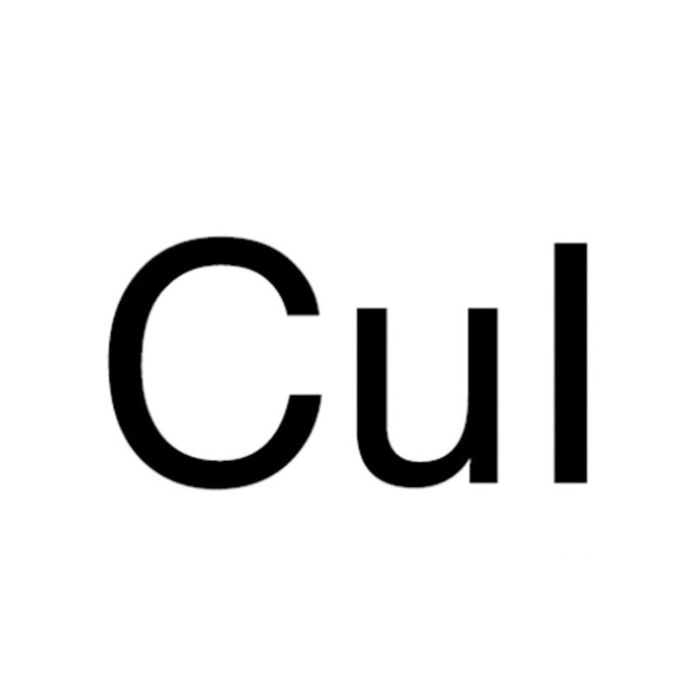
Copper iodide - Ultra dry, ≥99.95% metals basis , CAS No.7681-65-4

CAS: 7681-65-4 Cat. No.: C283982 Formula: CuI Molecular Weight: 190.45 EC Number: 231-674-6 PubChem CID: 24350
AVAILABLE TO ORDER
GRADE & PURITY Ultra dry ? Ultra-dry grade with extremely low water content, packaged to exclude moisture. Use for moisture-sensitive reactions and air-free chemistry. ≥99.95% metals basis
Synonyms
Copper (I) iodide, Trace metals grade 99.999% | Copper(1+) iodide; Copper(I) iodide; Cuprous iodide; Cuprous iodide (CuI) | Copper (I) iodide, Trace metals grade 99.95% | BCP29314 | AKOS015902661 | Copper(I) iodide, 99.999% trace metals basis | BP-12683 |
Storage
Protected from light,Room temperature,Desiccated
Shipped In
Normal
★
Size
USA
Germany (EU)*
Price
Qty
5g
C283982-5g
3 In stock
—
$199.90
Enter a quantity for the sizes you want to add.
🧪
Why this grade

Ultra dry, ≥99.95% metals basis Ultra dry for sensitive chromatographic and analytical workflows requiring minimal baseline interference.

🌡

Storage & shipping

Protected from light,Room temperature,Desiccated Ships Normal Check lot-specific COA for exact specifications.

📋

Quality documents

SDS, COA, datasheet, and spec sheet available for download. Lot-specific COA accessible via lot number lookup.

📚

Literature proof

Cited in 363 peer-reviewed publications across chromatography, organic synthesis, and cross-coupling reactions.

Overview

Copper iodide (I) can be combined with cesium fluoride to promote Stille coupling reaction. It can also mediate the interaction of alkene mercaptan ions with different molecules in hexamethylphosphoryltriamine


Non activated aryl iodide reacts to form aryl sulfide.

Specifications

Synonyms
Copper (I) iodide, Trace metals grade 99.999% | Copper(1+) iodide; Copper(I) iodide; Cuprous iodide; Cuprous iodide (CuI) | Copper (I) iodide, Trace metals grade 99.95% | BCP29314 | AKOS015902661 | Copper(I) iodide, 99.999% trace metals basis | BP-12683 |
Specifications & Purity
Ultra dry, ≥99.95% metals basis
Storage
Protected from light,Room temperature,Desiccated
Shipped In
Normal
Grade
Ultra dry
Purity
≥99.95% metals basis
Names and Identifiers
Canonical Smiles
[Cu]I;[I-].[Cu+]
InChIKey
LSXDOTMGLUJQCM-UHFFFAOYSA-M
INCHI
1S/Cu.HI/h;1H/q+1;/p-1
Isomeric SMILES
[Cu]I
WGK Germany
3
Alternate CAS
1335-23-5
PubChem CID
24350
UN Number
3077
Packing Group
III
Molecular Weight
190.45

Documentation

📋 Safety Data Sheet (SDS)

Comprehensive hazard, handling, storage, and regulatory compliance document.

Download SDS →

✅ Certificate of Analysis (COA)

Lot-specific quality data. Enter your lot number to retrieve the exact COA.

Look up COA →

📊 Datasheet

Quick-reference summary of product specifications and applications.

View datasheet →

🔬 Specification Sheet

Full quality attributes and acceptance criteria for this grade.

View spec sheet →

Advanced Data

Taxonomic Classification

Taxonomy Tree

KingdomInorganic compounds
SuperclassMixed metal/non-metal compounds
ClassTransition metal salts
SubclassTransition metal iodides
Intermediate Tree Nodes Not available
Direct ParentTransition metal iodides
Alternative Parents Inorganic salts  
Molecular FrameworkNot available
Substituents Transition metal iodide - Inorganic salt
DescriptionThis compound belongs to the class of inorganic compounds known as transition metal iodides. These are inorganic compounds in which the largest halogen atom is Iodine, and the heaviest metal atom is a transition metal.
External Descriptors Not available
Certificates(CoA,COO,BSE/TSE and Analysis Chart)
C of A & Other Certificates(BSE/TSE, COO):
Analytical Chart:

Find and download the COA for your product by matching the lot number on the packaging.

1 results found

Lot NumberCertificate TypeDateItem
F2103025Certificate of AnalysisSep 03, 2026 C283982
Chemical and Physical Properties
SensitivitySensitive to light
Boil Point(°C)1290°C
Melt Point(°C)605°C
Molecular Weight190.450 g/mol
XLogP3
Hydrogen Bond Donor Count0
Hydrogen Bond Acceptor Count0
Rotatable Bond Count0
Exact Mass189.834 Da
Monoisotopic Mass189.834 Da
Topological Polar Surface Area0.000 Ų
Heavy Atom Count2
Formal Charge0
Complexity2.000
Isotope Atom Count0
Defined Atom Stereocenter Count0
Undefined Atom Stereocenter Count0
Defined Bond Stereocenter Count0
Undefined Bond Stereocenter Count0
The total count of all stereochemical bonds0
Covalently-Bonded Unit Count1
Documents & Articles
Diethyl azodicarboxylate (DEAD)
Ultra-Dry Grade: The Moisture-First Standard for Sensitive Chemistry
Strategies and Progress in the Asymmetric Catalytic Synthesis of Chiral 1,2-Bis(boronic) Esters: Route Types, Selectivity Challenges, and Sequential Site Utilization (with Product Selection Navigator and Tables 1–4)
A Practical Guide to Small-Molecule Chemical Probes: Concept Clarification, Causal Validation, and Experimental Selection (with Product Navigation and Tables A–D)
OSF/ASF Dual-Channel Toolbox: Divergent Reactions of Four-Membered Ring Sulfonyl Fluorides, Condition “Knobs,” and Selection Navigation
From Piperidine to Pyridine: The “Most Common N-Heterocycle” Shift in FDA Small-Molecule New Drugs (2013–2023) and a Selection Guide (Tables 1–4)
Perovskite PV/PeLED Precursor Guide: Selecting Metal Halide Salts, Key Conditions, and Reproducible Performance (including Product Tables 1–4 and a Selection Navigation Guide)
Transition-Metal Salts/Precursor Selection Guide: How “Different Salts of the Same Metal” Start from Different Chemical Realities—and How to Reproduce Results (including a Selection Navigator and Product Tables 1–5)
Haloheterocycles and Cross-Coupling: A Research-Oriented Selection Framework from Substrate Identification to Bond-Forming Routes (Including Product Navigation and Tables 1–5)
How to Construct Nitriles: Route Selection Across Direct Introduction, Precursor Dehydration, Oxidation/Dehydrogenation, and Cyanide-Free Processes
Experimental Selection Logic for C-C Bond Construction: Understanding Fragment Coupling, Carbonyl Chain Extension, Olefination, and Late-Stage Bond-Forming Pathways by Bond-Forming Task
Reaction Selection in Small-Molecule Synthesis: From Transformation-Type Assessment to Experimental Route Screening
Experimental Decision-Making for Cross-Coupling Reactions: Target Bond Type, Substrate Combination, and Catalytic System Selection
Structural Features, Property Modulation, and Typical Applications of Triazole Compounds
Synthetic Application Logic of Triazoles and Related Compounds: Structural Introduction, Reactive Sites, and Target Molecule Construction
Medicinal Chemistry Design of the Indazole Scaffold: Tautomerism, Molecular Recognition, Substitution-Site Design, and Synthetic Strategies
Build the Three-Membered Ring First, or Form the Carbon–Nitrogen Bond First?—Retrosynthetic Strategies, Route Selection, and Stereochemical Control in Cyclopropylamine Synthesis
Route Selection for Thiol Synthesis: C–S Bond Construction, Sulfur Source Forms, and Thiol Release
Citations of This Product
Solution Calculators
Reviews

Customer Reviews

Shall we send you a message when we have discounts available?

Remind me later

Thank you! Please check your email inbox to confirm.

Oops! Notifications are disabled.