Determine the necessary mass, volume, or concentration for preparing a solution.
| Activity Type | Activity Value -log(M) | Mechanism of Action | Activity Reference | Publications (PubMed IDs) |
|---|

Moligand™, 10mM in DMSO Moligand™ for sensitive chromatographic and analytical workflows requiring minimal baseline interference.
Store at -80°C Ships Dry ice packs + Cold packs Check lot-specific COA for exact specifications.
SDS, COA, datasheet, and spec sheet available for download. Lot-specific COA accessible via lot number lookup.
Cited in 0 peer-reviewed publications across chromatography, organic synthesis, and cross-coupling reactions.
Information
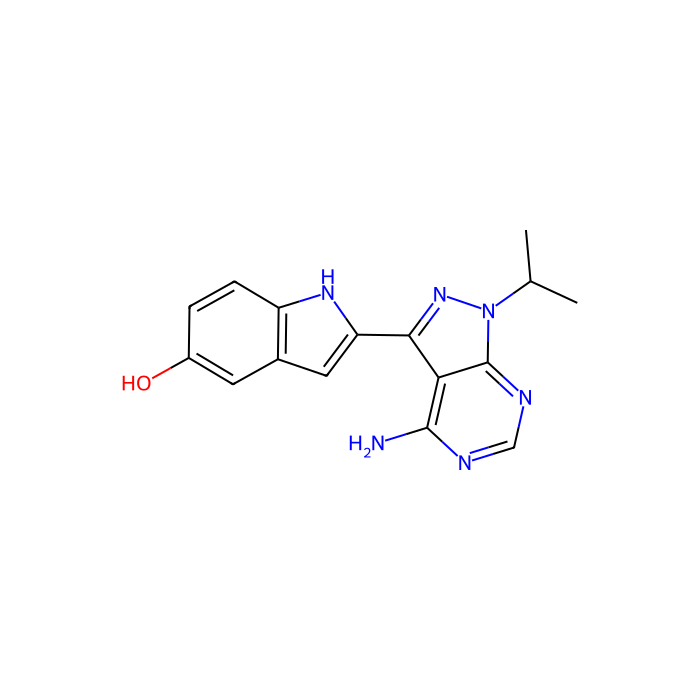
Torkinib (PP242) Torkinib (PP242) is a selective mTOR inhibitor with IC50 of 8 nM in cell-free assays; targets both mTOR complexes with >10- and 100-fold selectivity for mTOR than PI3Kδ or PI3Kα/β/γ, respectively. Torkinib (PP242) induces mitophagy and
In vitro
PP242 exhibits potent selectivity for mTOR over other PI3K family kinases such as p110α, p110β, p110γ, p110δ, and DNA-PK with IC50 of 1.96 μM, 2.2 μM, 1.27 μM, 0.102 μM, and 0.408 μM, respectively. PP242 displays some inhibitory activity against Ret, PKCα, PKCβ, and JAK2, while exhibits remarkable selectivity against 215 other protein kinases. Unlike rapamycin, PP242 inhibits both mTORC1 and mTORC2. In BT549 cells, PP242 treatment (0.04-10 μM) inhibits the phosphorylation of Akt, the mTOR substrate p70S6K, and its downstream target S6 in a dose-dependent manner. PP242 potently inhibits PKCα with IC50 of 49 nM. Low concentrations of PP242 inhibit the phosphorylation of Akt S473 and higher concentrations partially inhibit Akt T308-P in addition to S473-P. As PP242 is a more effective mTORC1 inhibitor than rapamycin, PP242 inhibits the proliferation of primary MEFs, and the phosphorylation of 4EBP1 at T36/45 and S65, more potently than rapamycin. PP242 but not rapamycin potently inhibits cap-dependent translation, by causing a higher level of binding between 4EBP1 and eIF4E than rapamycin. PP242 potently inhibits the proliferation of p190-transformed murine BM, SUP-B15, and K562 cells with GI50 of 12 nM, 90 nM, and 85 nM, respectively. PP242 also inhibits the growth of solid tumor cell lines such as SKOV3, PC3, 786-O, and U87 with GI50 of 0.49 μM, 0.19 μM, 2.13 μM, and 1.57 μM, respectively. PP242 is also more effective than rapamycin in achieving cytoreduction and apoptosis in multiple myeloma (MM) cells.
In vivo
Administration of PP242 is able to completely inhibit the phosphorylation of Akt at S473 and T308 in fat and liver of mice. PP242 only partially inhibits the phosphorylation of Akt in skeletal muscle and is more effective at inhibiting the phosphorylation of T308 than S473, despite able to fully inhibit the phosphorylation of 4EBP1 and S6. Oral administration PP242 potently delays the leukemia onset in the mice model, and induces leukemia regression by inhibiting mTORC2 and mTORC1 activation that correlates with loss in cell size. PP242 treatment potently inhibits the growth of 8226 cells in mice.
Cell Data
cell lines:Different tumor cell lines including NCI-H460, MDA-MB231, MES-SA, NCI-H460 PTX, MDA-MB-231 PTX, MES-SA Dx5, and HCT-15.
Concentrations:Dissolved in DMSO, final concentrations ~10 μM
Incubation Time:72 hours
Powder Purity:≥97%
Comprehensive hazard, handling, storage, and regulatory compliance document.
Download SDS →Lot-specific quality data. Enter your lot number to retrieve the exact COA.
Look up COA →Full quality attributes and acceptance criteria for this grade.
View spec sheet →| Activity Type | Activity Value -log(M) | Mechanism of Action | Activity Reference | Publications (PubMed IDs) |
|---|
| Activity Type | Activity Value -log(M) | Mechanism of Action | Activity Reference | Publications (PubMed IDs) |
|---|
| Activity Type | Activity Value -log(M) | Mechanism of Action | Activity Reference | Publications (PubMed IDs) |
|---|
| Activity Type | Activity Value -log(M) | Mechanism of Action | Activity Reference | Publications (PubMed IDs) |
|---|
| Activity Type | Activity Value -log(M) | Mechanism of Action | Activity Reference | Publications (PubMed IDs) |
|---|
| Activity Type | Activity Value -log(M) | Mechanism of Action | Activity Reference | Publications (PubMed IDs) |
|---|
| Activity Type | Activity Value -log(M) | Mechanism of Action | Activity Reference | Publications (PubMed IDs) |
|---|
| Activity Type | Activity Value -log(M) | Mechanism of Action | Activity Reference | Publications (PubMed IDs) |
|---|
| Activity Type | Activity Value -log(M) | Mechanism of Action | Activity Reference | Publications (PubMed IDs) |
|---|
| Activity Type | Activity Value -log(M) | Mechanism of Action | Activity Reference | Publications (PubMed IDs) |
|---|
| Activity Type | Activity Value -log(M) | Mechanism of Action | Activity Reference | Publications (PubMed IDs) |
|---|
| Activity Type | Activity Value -log(M) | Mechanism of Action | Activity Reference | Publications (PubMed IDs) |
|---|
| Activity Type | Activity Value -log(M) | Mechanism of Action | Activity Reference | Publications (PubMed IDs) |
|---|
Find and download the COA for your product by matching the lot number on the packaging.
| Lot Number | Certificate Type | Datum | Artikel |
|---|---|---|---|
 H2426080 H2426080 | Certificate of Analysis | Jul 13, 2026 | T409136 |
Only manufacturer-verified protocols and recommended conditions are listed here. For this SKU, validated application protocols are not specified.
General reminder: End users should optimize assay conditions (vehicle percentage, dosing regimen, exposure time, and readouts) empirically for their specific system.
Research context (literature/general; for research use only):
Pathway and readouts (typical biochemical markers):
Use cases in chemical biology (examples):
Important notes:
This item is a discrete small-molecule inhibitor and is not a buffering agent. Buffer formulation guidance is therefore not directly applicable.
Practical note (general): If preparing assay solutions, dilute DMSO stocks into pre-equilibrated assay buffer (e.g., HEPES-, Tris-, or phosphate-based buffers) with vigorous mixing to mitigate precipitation. Validate final DMSO percentage and buffer composition for your specific biological system.
Green chemistry comparison is not typically applicable to this product because it is a discrete bioactive small molecule, not a solvent or bulk reagent with interchangeable options.
Note: There is no “green substitute” for the active compound itself since its bioactivity is structure-specific.
This product is supplied for laboratory research only and is not an excipient, API, or GMP material.
Formulation/context in research (general):
Regulatory note:
Item-specific physicochemical specifications have not been provided.
Practical notes (general research guidance, not item-specific):
What Moligand™ signifies (program context, general description):
Item-specific quality notes:
Analytical verification (recommended user checks):
Stabilizers/inhibitors:
This compound is supplied as a finished small-molecule research tool and is not typically employed as a reagent or catalyst in synthetic transformations.
For research usage, see the “Biological Roles” section which is more relevant to this product’s application space.
This section is not typically applicable: the product is used as a finished research tool compound, not as a reagent in chemical reactions.
There are no item-specific reaction condition recommendations for this SKU.
Hazard classification for this specific item is not provided.
General laboratory safety guidance (not a substitute for the SDS):
Always consult the item-specific SDS for authoritative hazard, toxicological, and disposal information.
This product is a research-grade small-molecule tool. Solvent choice is typically driven by assay format and required concentration.
General solvent guidance for hydrophobic kinase inhibitors (literature/general):
Considerations when choosing among solvents:
Note: Item-specific solubility limits and solvent compatibility are not specified for this item; refer to CoA/Spec Sheet or perform a small solubility screen.
Handling and stability notes:
Reconstitution:
Short-term storage of solutions (general guidance):
Always consult the lot-specific CoA and SDS for authoritative guidance.
This product is the research tool compound Torkinib (PP242), a small-molecule inhibitor supplied for screening and chemical biology.
Structural features (general knowledge for PP242, not item-specific):
2D structure in words (literature/general):
As supplied, Torkinib (PP242) is a final bioactive small molecule rather than a synthetic building block.
For most users, the relevant value of this product lies in its role as a reference standard in biochemical assays rather than as a starting material for synthetic campaigns.
Only product-data–derived, experimentally verified target details may be listed here. For this SKU, target specificity parameters are not specified.
Note: While PP242 is widely discussed in the literature in the context of mTOR pathway research, item-specific validated specificity data are not provided here.
Our grade selection guide covers purity, stabilizer status, and application suitability for all variants in our catalog.
View Moligand™ grade guide →