
Determine the necessary mass, volume, or concentration for preparing a solution.
| Activity Type | Activity Value -log(M) | Mechanism of Action | Activity Reference | Publications (PubMed IDs) |
|---|
Moligand™, 10mM in DMSO Moligand™ for sensitive chromatographic and analytical workflows requiring minimal baseline interference.
Store at -80°C Ships Dry ice packs + Cold packs Check lot-specific COA for exact specifications.
SDS, COA, datasheet, and spec sheet available for download. Lot-specific COA accessible via lot number lookup.
Cited in 12 peer-reviewed publications across chromatography, organic synthesis, and cross-coupling reactions.
Information
In vitro
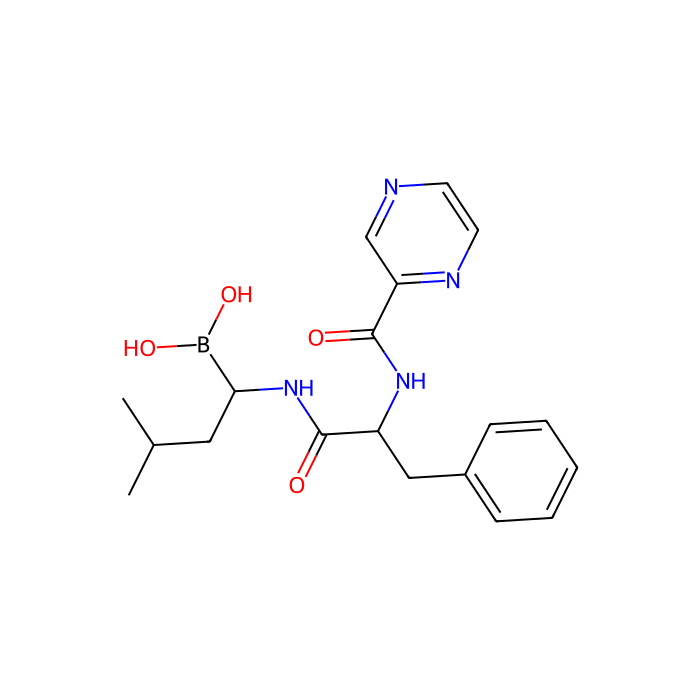
Bortezomib, a boronic acid dipeptide, is a highly selective, reversible inhibitor of the 26S proteasome which primarily functions in the degradation of mis-folded proteins and is essential for the regulation of the cell cycle. Exposure to Bortezomib has been shown to stabilize p21, p27, and p53, as well as the proapoptotic Bid and Bax proteins, caveolin-1, and inhibitor κB-α, which prevents activation of nuclear factor κB-induced cell survival pathways. Bortezomib also promotes the activation of the proapoptotic c-Jun-NH2 terminal kinase, as well as the endoplasmic reticulum stress response. Alteration of the levels of these cellular proteins leads to inhibition of proliferation, migration, and promotion of apoptosis of cancer cells. Bortezomib is shown to penetrate into cells and inhibit proteasome-mediated intracellular proteolysis of long-lived proteins with a concentration that inhibits 50% of the proteolysis of ∼0.1 μM. The average growth inhibition of 50% value for Bortezomib across the entire panel of 60 cancer cell lines derived from multiple human tumors from the US National Cancer Institute (NCI) is 7 nM. Treatment of PC-3 cells with Bortezomib (100 nM) for 8 h results in the accumulation of cells in G2-M, with a corresponding decrease in the number of cells in G1. Bortezomib kills PC-3 cells at 24 and 48 hr with IC50 of 100 and 20 nM, respectively. Bortezomib induces nuclear condensation at 16–24 hr after treatment. Bortezomib treatment leads to PARP cleavage in a time-dependent manner with concentrations as low as 100 nM being effective at 24 hr.
In vivo
The anticancer effects of bortezomib as a single agent have been demonstrated in xenograft models of multiple myeloma, adult T-cell leukemia, lung, breast, prostate, pancreatic, head and neck, and colon cancer, and in melanoma. Oral bortezomib 1.0 mg/ kg daily for 18 days causes tumor growth delays, as well as a decrease in the number of metastases in the Lewis lung cancer model. Bortezomib at a single dose of up to 5 mg/kg significantly decreased the surviving fraction of breast tumor cells. Bortezomib 1.0 mg/kg administrated weekly for 4 weeks reduces tumor growth by 60% in murine xenograft models of prostate cancer. 1.0 mg/kg Bortezomib administration for 4 weeks results in a 72% or 84% reduction in pancreatic cancer murine xenografts growth, as well as an increase in tumor cell apoptosis. 1.0 mg/kg Bortezomib treatment results in significant inhibition of human plasmacytoma xenograft growth, increase in tumor cells apoptosis and overall survival, and a decrease in tumor angiogenesis.
Cell Data
cell lines:Chronic lymphocytic leukemia (CLL)
Concentrations:~10 μM
Incubation Time:2 days
Powder Purity:≥99%
| Isomeric SMILES | B([C@H](CC(C)C)NC(=O)[C@H](CC1=CC=CC=C1)NC(=O)C2=NC=CN=C2)(O)O |
|---|---|
| Alternate CAS | 1610526-91-4,179324-69-7 |
| NSC Number | 681239 |
| MeSH Entry Terms | 341, PS;bortezomib;LDP 341;LDP-341;LDP341;PS 341;PS-341;PS341;Velcade |
| Molecular Weight | 384.24 |
| Reaxy-Rn | 23876496 |
| Reaxys-RN_link_address | https://www.reaxys.com/reaxys/secured/hopinto.do?context=S&query=IDE.XRN=23876496&ln= |
Comprehensive hazard, handling, storage, and regulatory compliance document.
Download SDS →Lot-specific quality data. Enter your lot number to retrieve the exact COA.
Look up COA →Full quality attributes and acceptance criteria for this grade.
View spec sheet →| Activity Type | Activity Value -log(M) | Mechanism of Action | Activity Reference | Publications (PubMed IDs) |
|---|
| Activity Type | Activity Value -log(M) | Mechanism of Action | Activity Reference | Publications (PubMed IDs) |
|---|
| Activity Type | Activity Value -log(M) | Mechanism of Action | Activity Reference | Publications (PubMed IDs) |
|---|
| Activity Type | Activity Value -log(M) | Mechanism of Action | Activity Reference | Publications (PubMed IDs) |
|---|
| Activity Type | Activity Value -log(M) | Mechanism of Action | Activity Reference | Publications (PubMed IDs) |
|---|
| Activity Type | Activity Value -log(M) | Mechanism of Action | Activity Reference | Publications (PubMed IDs) |
|---|
| Activity Type | Activity Value -log(M) | Mechanism of Action | Activity Reference | Publications (PubMed IDs) |
|---|
| Activity Type | Activity Value -log(M) | Mechanism of Action | Activity Reference | Publications (PubMed IDs) |
|---|
| Activity Type | Activity Value -log(M) | Mechanism of Action | Activity Reference | Publications (PubMed IDs) |
|---|
| Activity Type | Activity Value -log(M) | Mechanism of Action | Activity Reference | Publications (PubMed IDs) |
|---|
| Activity Type | Activity Value -log(M) | Mechanism of Action | Activity Reference | Publications (PubMed IDs) |
|---|
| Activity Type | Activity Value -log(M) | Mechanism of Action | Activity Reference | Publications (PubMed IDs) |
|---|
| Solubility | Solubility (25°C) In vitro DMSO: 27 mg/mL (201.28 mM); Water: 27 mg/mL (201.28 mM); Ethanol: 27 mg/mL (201.28 mM); |
|---|---|
| Refractive Index | 1.56 |
| Boil Point(°C) | 684.30° C |
| Melt Point(°C) | 139-143°C |
| 1. Jianhao Liu, Xiaoman Xu, Yanying Li, Jingxia Xu, Ruogang Zhao, Siwei Liu, Jingliang Wu, Li Zhang, Bo Zhang. (2023) Bortezomib-loaded mixed micelles realize a “three-in-one” effect for enhanced breast cancer treatment. Biomaterials Science, 11 (14): (4890-4906). [PMID:37306225] [10.1039/D3BM00254C] |
| 2. Chong Shi, Guo-Bin Zhang, Shu-Wang Yin. (2015) Effect of bortezomib on migration and invasion in cervical carcinoma HeLa cell. Asian Pacific Journal of Tropical Medicine, [PMID:26194835] [10.1016/j.apjtm.2015.05.004] |
| 3. Naikuan Fu, Yinan Zeng, Jing Zhang, Peng Zhang, Hong Zhang, Shicheng Yang, Jianhua Zhang. (2024) A Facile Strategy for PEGylated Nanoprodrug of Bortezomib with Improved Stability, Enhanced Biocompatibility, pH-Controlled Disassembly, and Release. MACROMOLECULAR BIOSCIENCE, [PMID:39401274] [10.1002/mabi.202400383] |
| 4. Feifei Wang, Dianlong Jia, Qingcui Song, Xiaomeng Lu, Guozi Xia, Jun Li, Xiaodong Jia, Mingliang Gu, Fengjiao Yuan, Zhengping Wang, Zhangyong Xia. (2025) Co-delivery of TRAIL and bortezomib via liposomes demonstrates enhanced antitumor efficacy in vivo. JOURNAL OF DRUG DELIVERY SCIENCE AND TECHNOLOGY, [PMID:] [10.1016/j.jddst.2025.106602] |
| 5. Yuanying Li, Han Shao, Yunxiu Zhang, Qiang Liu, Changhan Yan, Xiyin Liu, Yaolan Tao, Renhao Nie, Jianhong Zhang, Qingyan Jia, Peng Li. (2025) Extracellular barrier via in situ cross-linked catechol for blocking tumor mass transport and synergistic chemotherapy. CHEMICAL ENGINEERING JOURNAL, [PMID:] [10.1016/j.cej.2025.159880] |
| 6. Chu Xiufeng, Zhang Ting, Bukhari Ihtisham, Hu Mei, Xu Jixuan, Xing Yamin, Liang Xinfeng, Zhang Zisen, Zheng Pengyuan. (2025) Ubiquitination of gasdermin D N-terminal domain directs its membrane translocation and pore formation during pyroptosis. Cell Death & Disease, 16 (1): (1-11). [PMID:40097387] [10.1038/s41419-025-07475-6] |
| 7. Naikuan Fu, Ao Li, Jing Zhang, Peng Zhang, Hong Zhang, Shicheng Yang, Jianhua Zhang. (2025) Zwitterionic Polycatechols for Covalent Conjugation With Bortezomib and pH-Triggered Release. MACROMOLECULAR CHEMISTRY AND PHYSICS, [PMID:] [10.1002/macp.202400469] |
| 8. Huang Wei-Qiang, You Wei, Zhu Ya-Qi, Gao Fan, Wu Zhi-Zhi, Chen Guang, Xiao Jun, Shao Qi, Wang Long-Hai, Nie Xuan, Zhang Ze, Hong Chun-Yan, You Ye-Zi. (2025) Autophagosomes coated in situ with nanodots act as personalized cancer vaccines. Nature Nanotechnology, [PMID:39753731] [10.1038/s41565-024-01826-8] |
| 9. Zongyuan Zheng, Lirong Sun, Yuanyuan Li, Shuxin Wang, Pu Wang, Shuang Qiu, Yang Tian, Hao Chen. (2025) Gelatin-dopamine-based dual-responsive nanogels for tumor-targeted bortezomib delivery: Minimizing systemic toxicity and enhancing breast cancer therapy. INTERNATIONAL JOURNAL OF BIOLOGICAL MACROMOLECULES, [PMID:40494466] [10.1016/j.ijbiomac.2025.145084] |
| 10. Xiaoman Xu, Yunmei Song, Mingli Li, Fengxi Liu, Huiwen Zhang, Jingxia Xu, Juwei Gao, Yanna Lv, Bo Zhang, Sanjay Garg. (2025) Biomimetic tumor cell membrane-camouflaged nanomicelles for synergistic chemo-immunotherapy of Triple-negative breast cancer. Materials Today Bio, [PMID:40677402] [10.1016/j.mtbio.2025.102012] |
| 11. Hui Liu, Huanxiang Chen, Heng Li, Yanchang Li, Jiaxing Dai, Bendong Yang, Hongtao Wen, Yonghong Wang, Lei Chang, Ping Xu. (2025) A high-throughput method for specific, rapid, precise and efficient detection of protein ubiquitination using ThUBD-coated high-density 96-well plates. TALANTA, [PMID:41197384] [10.1016/j.talanta.2025.129077] |
| 12. Pengfei Tang, Ze Zheng, Mengmeng Yu, Danyang Zhang, Zhiqi Xiao, Lingyi Kong, Jun Luo. (2026) Trishizukaol A alleviates chronic kidney disease by restraining P2X7/PSME3-driven 20S proteasome hyperactivation. JOURNAL OF ETHNOPHARMACOLOGY, [PMID:41679361] [10.1016/j.jep.2026.121357] |
Our grade selection guide covers purity, stabilizer status, and application suitability for all variants in our catalog.
View Moligand™ grade guide →