GRADE & PURITYMoligand™?Moligand™ — Aladdin's line of ligands and bioactive small molecules. Use for receptor, pathway, and binding studies needing defined small-molecule tools.≥90%(HPLC)
Moligand™, ≥90%(HPLC) Moligand™ for sensitive chromatographic and analytical workflows requiring minimal baseline interference.
🌡
Storage & shipping
Store at -20°C Ships Ice chest + Ice pads Check lot-specific COA for exact specifications.
📋
Quality documents
SDS, COA, datasheet, and spec sheet available for download. Lot-specific COA accessible via lot number lookup.
📚
Literature proof
Cited in 4 peer-reviewed publications across chromatography, organic synthesis, and cross-coupling reactions.
Overview
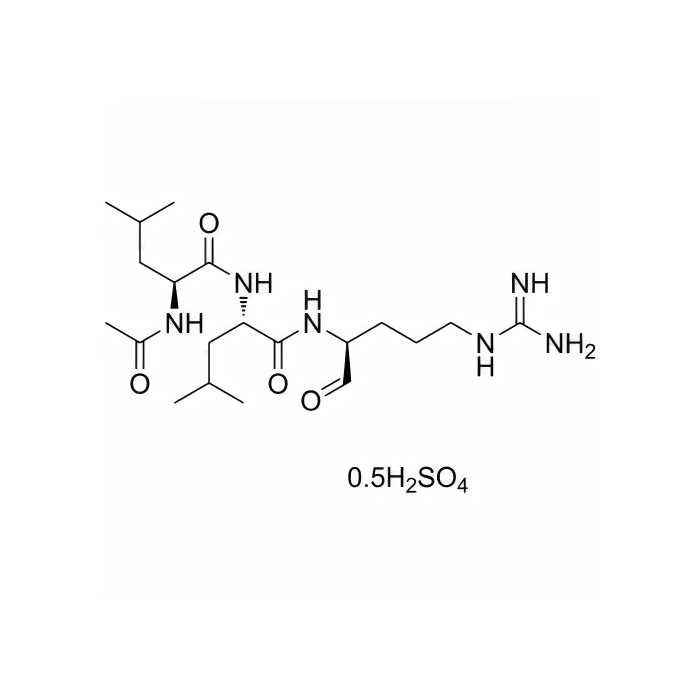
Leupeptin, or N-acetyl-L-leucyl-L-leucyl-L-argininal, is a naturally occurring tripeptide that acts particularly as a serine protease inhibitor and as a cysteine protease inhibitor. Its mechanism of action involves structurally similar covalent binding reactions:
In the active site of serine proteases, leupeptin forms a covalent hemiacetal adduct between the aldehyde group of leupeptin and the hydroxyl group of a serine residue in the enzyme active site.
In the active site of cysteine proteases, the electrophilic (aldehyde) carbon of leupeptin forms a comparable bond with the sulfur atom of a cysteine residue in the enzyme active site.
Reversible, competitive serine/cysteine protease inhibitor. Inhibits cathepsins B, H, L and S, calpain and trypsin. Orally active. Antioxidant and anti-inflammatory agent. Active in vivo and in vitro .
Storage
Store at -20°C
Shipped In
Ice chest + Ice pads
This product requires cold chain shipping. Ground and other economy services are not available.
Grade
Moligand™
Note
Wherever possible, you should prepare and use solutions on the same day. However, if you need to make up stock solutions in advance, we recommend that you store the solution as aliquots in tightly sealed vials at -20°C. Generally, these will be useable for up to one week. Before use, and prior to opening the vial we recommend that you allow your product to equilibrate to room temperature for at least 1 hour. Toxic, refer to SDS for further information. Need more advice on solubility, usage and handling? Please visit our frequently asked questions (FAQ) page for more details.
This compound belongs to the class of organic compounds known as dipeptides. These are organic compounds containing a sequence of exactly two alpha-amino acids joined by a peptide bond.
External Descriptors
Not available
1. Djoumbou Feunang Y, Eisner R, Knox C, Chepelev L, Hastings J, Owen G, Fahy E, Steinbeck C, Subramanian S, Bolton E, Greiner R, and Wishart DS. ClassyFire: Automated Chemical Classification With A Comprehensive, Computable Taxonomy. Journal of Cheminformatics, 2016, 8:61.
1.Jing Jin, Qiao‑Yun Hu, Wen‑Wen Xu, Wen‑Jia Zhu, Bei Liu, Jing Liu, Wei Wang, Hui‑Fang Zhou. (2019) Tanshinone IIA attenuates estradiol‑induced polycystic ovarian syndrome in mice by ameliorating FSHR expression in the ovary. Experimental and Therapeutic Medicine, 17 (5):(3501-3508). [PMID:30988730][10.3892/etm.2019.7352]
2.Yunhua Zhang, Jinyun Ji, Xiao Zhao, Ruoheng Jin, Jianhong Li, Hu Wan. (2017) Expression, purification and enzymatic properties of a β-N-acetylhexosaminidase from brown planthopper, Nilaparvata lugens. JOURNAL OF ASIA-PACIFIC ENTOMOLOGY, [PMID:][10.1016/j.aspen.2017.10.005]
3.Rongrong He, Ziwei Lv, Yinan Li, Shuchao Ren, Jiaqi Cao, Jun Zhu, Xinrong Zhang, Huimin Wu, Lihao Wan, Ji Tang, Shutong Xu, Xiao-Lin Chen, Zhipeng Zhou. (2024) tRNA-m1A methylation controls the infection of Magnaporthe oryzae by supporting ergosterol biosynthesis. DEVELOPMENTAL CELL, [PMID:39191251][10.1016/j.devcel.2024.08.002]
4.Bangbang Li, Yanchen Wang, Pengzhao Chang, Hao Chen, Yangang Zhu, Nanxin Zhao, Zhimou Yang, Jingjing Li. (2025) In situ enzyme instructed peptide assembly favoring a three-target sequentially responsive fluorescence probe for the early identification of atherosclerotic plaque in vivo. CHEMICAL ENGINEERING JOURNAL, [PMID:][10.1016/j.cej.2025.167162]
Solution Calculators
Molarity Calculator
Determine the necessary mass, volume, or concentration for preparing a solution.
Dilution Calculator
Determine the dilution needed to prepare a stock solution.
Reconstitution Calculator
Reviews
Customer Reviews
Need help choosing the grade?
Our grade selection guide covers purity, stabilizer status, and application suitability for all variants in our catalog.
We use cookies to ensure the website functions properly and, where permitted, to improve your experience. You can manage your preferences at any time in Settings. Learn more in our Cookie Policy.
Shall we send you a message when we have discounts available?
Remind me later
Thank you! Please check your email inbox to confirm.
Products are supplied to verified businesses, institutions, and qualified professionals for research and development use only. Not for use in humans, animals, diagnosis, or therapy.

 H2205278