
Determine the necessary mass, volume, or concentration for preparing a solution.
| Activity Type | Activity Value -log(M) | Mechanism of Action | Activity Reference | Publications (PubMed IDs) |
|---|
10mM in DMSO for sensitive chromatographic and analytical workflows requiring minimal baseline interference.
Store at -80°C Ships Dry ice packs + Cold packs Check lot-specific COA for exact specifications.
SDS, COA, datasheet, and spec sheet available for download. Lot-specific COA accessible via lot number lookup.
Cited in 3 peer-reviewed publications across chromatography, organic synthesis, and cross-coupling reactions.
Information
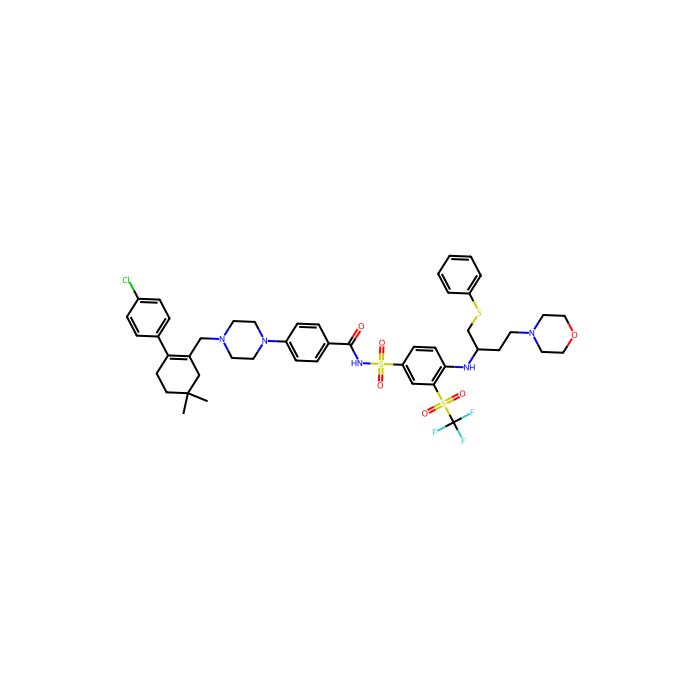
Navitoclax (ABT-263) is a potent inhibitor ofBcl-xL,Bcl-2andBcl-wwithKiof ≤ 0.5 nM, ≤1 nM and ≤1 nM in cell-free assays, but binds more weakly to Mcl-1 and A1. Phase 2.
In vitro
ABT-263 is structurally related to ABT-737; it is a disruptor of Bcl-2/Bcl-xL interactions with pro-apoptotic proteins. Overexpression of the prosurvival Bcl-2 family members is commonly associated with tumor maintenance, progression, and chemoresistance. ABT-263 displays the protection afforded by overexpression of Bcl-2 or Bcl-xL with EC50 values of 60 nM and 20 nM, respectively. A wide range of cellular activity is observed with ABT-263 having a 50% growth inhibition (EC50) of 110 nM against the most sensitive line (H146), whereas its activity in the least sensitive line (H82) results in an EC50 at 22 μM. All four cell lines with EC50 values of <400 nM (H146, H889, H1963, and H1417) are also highly sensitive to ABT-737, and the two most resistant lines (H1048 and H82) are similarly resistant to ABT-263.
In vivo
When ABT-263 is administered at 100 mg/kg/day in the H345 xenograft model, significant antitumor efficacy is observed with 80% TGI and 20% of treated tumors indicating at least a 50% reduction in tumor volume. Oral administration of ABT-263 alone causes complete tumor regressions in xenograft models of small-cell lung cancer and acute lymphoblastic leukemia. In xenograft models of aggressive B-cell lymphoma and multiple myeloma where ABT-263 displays modest or no single agent activity, it significantly enhances the efficacy of clinically relevant therapeutic regimens.
Cell Data
cell lines:
Concentrations:0-1 μM
Incubation Time:48 hours
Powder Purity:≥98%
| ALogP | 9.6 |
|---|
| Isomeric SMILES | CC1(CCC(=C(C1)CN2CCN(CC2)C3=CC=C(C=C3)C(=O)NS(=O)(=O)C4=CC(=C(C=C4)N[C@H](CCN5CCOCC5)CSC6=CC=CC=C6)S(=O)(=O)C(F)(F)F)C7=CC=C(C=C7)Cl)C |
|---|---|
| Molecular Weight | 974.61 |
| Reaxy-Rn | 15630714 |
| Reaxys-RN_link_address | https://www.reaxys.com/reaxys/secured/hopinto.do?context=S&query=IDE.XRN=15630714&ln= |
Comprehensive hazard, handling, storage, and regulatory compliance document.
Download SDS →Lot-specific quality data. Enter your lot number to retrieve the exact COA.
Look up COA →Full quality attributes and acceptance criteria for this grade.
View spec sheet →| Activity Type | Activity Value -log(M) | Mechanism of Action | Activity Reference | Publications (PubMed IDs) |
|---|
| Activity Type | Activity Value -log(M) | Mechanism of Action | Activity Reference | Publications (PubMed IDs) |
|---|
| Activity Type | Activity Value -log(M) | Mechanism of Action | Activity Reference | Publications (PubMed IDs) |
|---|
| Activity Type | Activity Value -log(M) | Mechanism of Action | Activity Reference | Publications (PubMed IDs) |
|---|
| Activity Type | Activity Value -log(M) | Mechanism of Action | Activity Reference | Publications (PubMed IDs) |
|---|
| Solubility | Solubility (25°C) In vitro DMSO: 64 mg/mL (197.3 mM); Water: Insoluble; Ethanol: Insoluble; |
|---|
| 1. Yun Zhou, Ke Li, Fan Li, Shuang Han, Yang Wang, Xueping Li, Yonghua Zhan. (2019) Doxorubicin and ABT-199 Coencapsulated Nanocarriers for Targeted Delivery and Synergistic Treatment against Hepatocellular Carcinoma. Journal of Nanomaterials, [PMID:] [10.1155/2019/5274598] |
| 2. Ming Zhang, Yamei Wang, Yao Dai, Yan Hu, Wanting Fu, Yuhao Zhao, Hanyu Ma, Di Zhang, Ying Chen, Yixuan Zhou, Lei Du, Jing Chang, Fang Liu, Shuyan Chen, Fei Wang, Dongdong Xiao, Zhen Li. (2025) Senolytic-Loaded Asymmetric Wound Dressing for Targeted Senescent Cell Clearance in Diabetic Wound Healing. Materials Today Bio, [PMID:41560809] [10.1016/j.mtbio.2025.102741] |
| 3. Jing Zhang, Xinghua Li, Ping Wang, Xin Liu, Wuqi Guo, Jia Si, Qiang Huo, Ming Xu, Yang Liu, Yimin Niu. (2026) Disrupting the Senescence-Associated Secretory Phenotype–M1Macrophage Feedback Loop in Synovitis Using Dual Nano-Switches To Restore Joint Homeostasis. ACS Nano, [PMID:41636104] [10.1021/acsnano.5c15543] |