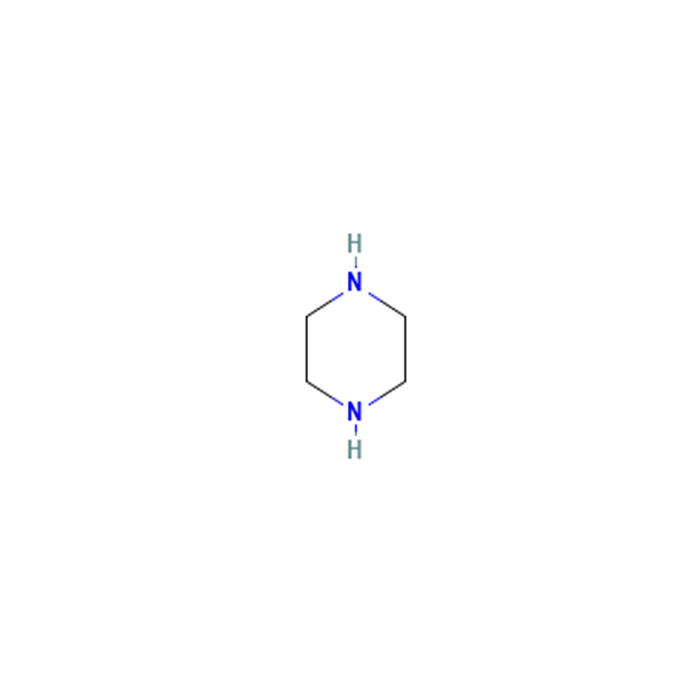
Piperazine - UltraBio™, anhydrous, ≥99%(T) , CAS No.110-85-0

CAS: 110-85-0 Cat. No.: P755827 Formula: C4H10N2 Molecular Weight: 86.14 Beilstein Registry Number: 102555 EC Number: 203-808-3
AVAILABLE TO ORDER
GRADE & PURITY Anhydrous Grade ? Anhydrous grade — water removed and packaged dry for moisture-sensitive chemistry. Use in reactions where even trace water would interfere or quench. UltraBio™ ? UltraBio™ — Aladdin's line for molecular-biology applications. Use for nuclease-free, high-consistency reagents across molecular workflows. ≥99%(T)
Storage
Protected from light,Room temperature,Argon charged
Shipped In
FedEx DG Service
★
Size
USA
Germany (EU)*
Price
Qty
25g
P755827-25g
Made to order · 8–12 wks
$179.90
100g
P755827-100g
Made to order · 8–12 wks
$383.90
500g
P755827-500g
Made to order · 8–12 wks
$1,487.90
Enter a quantity for the sizes you want to add.

Specifications

Specifications & Purity
UltraBio™, anhydrous, ≥99%(T)
Storage
Protected from light,Room temperature,Argon charged
Shipped In
FedEx DG Service
Grade
Anhydrous Grade, UltraBio™
Purity
≥99%(T)
Names and Identifiers
PH
11.0-12.5 (25 °C, 0.1 M in H 2 O)
SMILES
C1CNCCN1
IUPAC Name
piperazine
InChIKey
GLUUGHFHXGJENI-UHFFFAOYSA-N
InChI
1S/C4H10N2/c1-2-6-4-3-5-1/h5-6H,1-4H2
Isomeric SMILES
C1CNCCN1
WGK Germany
1
RTECS
TK7800000
UN Number
2579
Packing Group
III
Molecular Weight
86.14
Beilstein
102555
Reaxys
102555
Reaxys-RN_link_address
https://www.reaxys.com/reaxys/secured/hopinto.do?context=S&query=IDE.XRN=102555&ln=

Advanced Data

Taxonomic Classification

Taxonomy Tree

KingdomOrganic compounds
SuperclassOrganoheterocyclic compounds
ClassDiazinanes
SubclassPiperazines
Intermediate Tree Nodes Not available
Direct ParentPiperazines
Alternative Parents Dialkylamines  Azacyclic compounds  Organopnictogen compounds  Hydrocarbon derivatives  
Molecular FrameworkAliphatic heteromonocyclic compounds
Substituents Piperazine - Azacycle - Secondary amine - Secondary aliphatic amine - Organic nitrogen compound - Organopnictogen compound - Hydrocarbon derivative - Organonitrogen compound - Amine - Aliphatic heteromonocyclic compound
DescriptionThis compound belongs to the class of organic compounds known as piperazines. These are compounds containing a piperazine ring, which is a saturated aliphatic six-member heterocyclic with two nitrogen atoms at positions 1 and 4, as well as four carbon atoms.
External Descriptors azacycloalkane - saturated organic heteromonocyclic parent - piperazines
3D Structure
Interactive Chemical Structure Model


Certificates (CoA,COO,BSE/TSE and Analysis Chart)
C of A & Other Certificates(BSE/TSE, COO):
Analytical Chart:

Find and download the COA for your product by matching the lot number on the packaging.

3 results found

Lot NumberCertificate TypeDateItem
J2522307J2522307Certificate of AnalysisApr 08, 2026 P755827
J2522306J2522306Certificate of AnalysisOct 27, 2025 P755827
J2522305J2522305Certificate of AnalysisOct 27, 2025 P755827
Chemical and Physical Properties
SolubilityH 2 O: 0.1 M at 20 °C, clear, colorless
Flash Point190°F
Flash Point88℃
Boil Point147°C
Melt Point112℃
Molecular Weight86.14
XLogP3-1.500
Hydrogen Bond Donor Count2
Hydrogen Bond Acceptor Count2
Rotatable Bond Count0
Exact Mass86.0844 Da
Monoisotopic Mass86.0844 Da
Topological Polar Surface Area24.100 Ų
Heavy Atom Count6
Formal Charge0
Complexity26.500
Isotope Atom Count0
Defined Atom Stereocenter Count0
Undefined Atom Stereocenter Count0
Defined Bond Stereocenter Count0
Undefined Bond Stereocenter Count0
The total count of all stereochemical bonds0
Covalently-Bonded Unit Count1
Safety and Hazards(GHS)
Pictogram(s)
GHS05,   GHS07,   GHS08
Signal
Danger
Hazard Statements

H303:May be harmful if swallowed

H314:Causes severe skin burns and eye damage

H317:May cause an allergic skin reaction

H334:May cause allergy or asthma symptoms or breathing difficulties if inhaled

H361:Suspected of damaging fertility or the unborn child

H402:Harmful to aquatic life

Precautionary Statements

P201:Obtain special instructions before use.

P202:Do not handle until all safety precautions have been read and understood.

P260:Do not breathe dust/fume/gas/mist/vapors/spray.

P264:Wash hands [and …] thoroughly after handling.

P272:Contaminated work clothing should not be allowed out of the workplace.

P273:Avoid release to the environment.

P280:Wear protective gloves/protective clothing/eye protection/face protection.

P310:Immediately call a POISON CENTER or doctor/physician.

P301+P330+P331:IF SWALLOWED: Rinse mouth. Do NOT induce vomiting.

P303+P361+P353:IF ON SKIN (or hair): Take off Immediately all contaminated clothing. Rinse SKIN with water [or shower].

P304+P340:IF INHALED: Remove person to fresh air and keep comfortable for breathing.

P305+P351+P338:IF IN EYES: Rinse cautiously with water for several minutes. Remove contact lenses if present and easy to do - continue rinsing.

P333+P313:IF SKIN irritation or rash occurs: Get medical advice/attention.

P362+P364:Take off contaminated clothing and wash it before reuse.

P405:Store locked up.

P501:Dispose of contents/container to an approved waste disposal plant.

WGK Germany
1
RTECS
TK7800000
Reaxys
102555
Reaxys-RN_link_address
https://www.reaxys.com/reaxys/secured/hopinto.do?context=S&query=IDE.XRN=102555&ln=
Class
8
Merck Index
7464
Documents & Articles
UltraBio™: Defining Excellence in Molecular Biology Applications
The Guide to Anhydrous Grade for Reagents
OSF/ASF Dual-Channel Toolbox: Divergent Reactions of Four-Membered Ring Sulfonyl Fluorides, Condition “Knobs,” and Selection Navigation
Piperazine Selection Guide: Using a “Six-Membered Diaza Ring” to Make Salt Forms and Linking Strategies More Controllable (Appendix Tables 1–4 Product Navigator)
Haloheterocycles and Cross-Coupling: A Research-Oriented Selection Framework from Substrate Identification to Bond-Forming Routes (Including Product Navigation and Tables 1–5)
Low Racemization in Peptide Synthesis Is Not Just About Reagent Choice: Stereochemical Risk During the Activation Stage and Practical Strategies for Experimental Control
Formulation Design and Selection of Amine Curing Agents in Epoxy Systems
Understanding Amine Curing Agents: Structure, Types, and Application Selection
What Are Polyamines? Structural Features, Classification and Representative Compounds, Applications, and Synthetic Strategies
Rationale for Applying Spirocyclic Building Blocks in Drug Molecule Optimization: Three-Dimensionalization, Conformational Control, and Property Trade-offs
Medicinal Chemistry Value of Heteroatom-Containing Small-Ring Spirocycles: Classical Heterocycle Replacement and Three-Dimensional Exit Vector Remodeling
1,8-Naphthyridine-Based Aldose Reductase Inhibitors: Scaffold Construction, In Vitro Inhibitory Activity, and Directions for Structural Optimization
From 459,000 Recorded Ring Systems to 3,902 Candidate Ring Systems: Selection Patterns of Clinically Relevant Ring Systems
Citations of This Product
Solution Calculators
Reviews

Customer Reviews

Frequently Asked Questions

How is this product shipped?
This product is classified as dangerous goods and ships via FedEx DG Service. Ground and other economy services are not available, and delivery to some destinations or address types may be restricted.
What does UltraBio? mean?
UltraBio? indicates that the product has been processed and tested for biological and biochemical applications. Specifications may include endotoxin limits, microbial controls, sterility, low DNase/RNase/protease activity, and verified biological activity where relevant.
What does Anhydrous Grade mean?
Anhydrous Grade indicates that the material has been processed and tested for moisture-sensitive chemistry. Specifications focus on the impurities that affect performance in that application — for example, metal content for electronics, particle size for batteries, refractive index for optics, or moisture content for moisture-sensitive processes.
How should this product be stored?
Store at room temperature, protected from light, under argon. It is supplied under an argon blanket; reseal under inert gas after each use.
What are the CAS number, molecular formula and molecular weight?
The CAS Number is 110-85-0, the molecular formula is C4H10N2, and the molecular weight is 86.14 g/mol. InChIKey GLUUGHFHXGJENI-UHFFFAOYSA-N.
What documentation is provided?
Available product documentation, including Certificates of Analysis (COA), Safety Data Sheets (SDS), and specification sheets, is shown in the product document area. Document availability and access follow the current site policy.

Shall we send you a message when we have discounts available?

Remind me later

Thank you! Please check your email inbox to confirm.

Oops! Notifications are disabled.