
Determine the necessary mass, volume, or concentration for preparing a solution.
| Activity Type | Relation | Activity value | Units | Action Type | Journal | PubMed Id | doi | Assay Aladdin ID |
|---|
≥99% for sensitive chromatographic and analytical workflows requiring minimal baseline interference.
Room temperature,Argon charged,Desiccated Ships FedEx DG Service Check lot-specific COA for exact specifications.
SDS, COA, datasheet, and spec sheet available for download. Lot-specific COA accessible via lot number lookup.
Cited in 1378 peer-reviewed publications across chromatography, organic synthesis, and cross-coupling reactions.
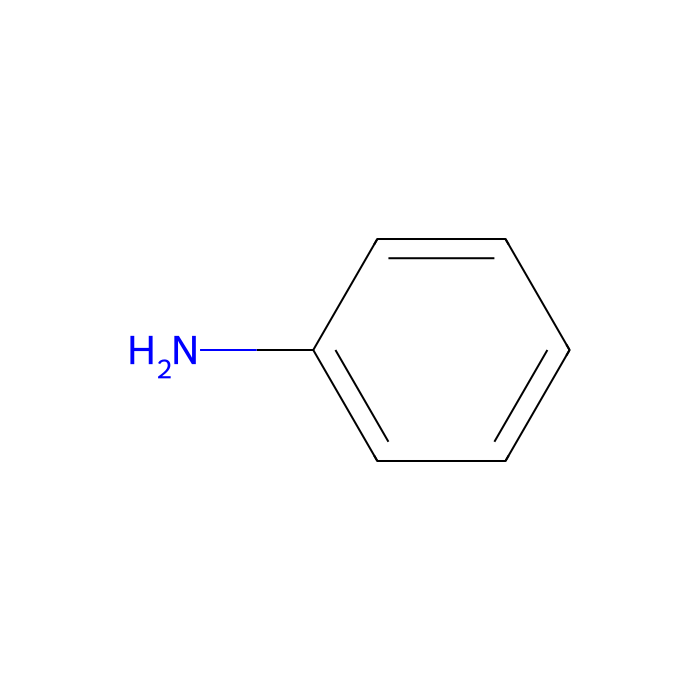
Aniline may be used in the preparation of azobenzene.
Comprehensive hazard, handling, storage, and regulatory compliance document.
<<<<<<< HEAD Download SDS → ======= Download SDS → >>>>>>> release248-p3Lot-specific quality data. Enter your lot number to retrieve the exact COA.
Look up COA →Full quality attributes and acceptance criteria for this grade.
View spec sheet →Taxonomy Tree
| Kingdom | Organic compounds |
|---|---|
| Superclass | Benzenoids |
| Class | Benzene and substituted derivatives |
| Subclass | Aniline and substituted anilines |
| Intermediate Tree Nodes | Not available |
| Direct Parent | Aniline and substituted anilines |
| Alternative Parents | Primary amines Organopnictogen compounds Hydrocarbon derivatives |
| Molecular Framework | Aromatic homomonocyclic compounds |
| Substituents | Aniline or substituted anilines - Organic nitrogen compound - Organopnictogen compound - Hydrocarbon derivative - Primary amine - Organonitrogen compound - Amine - Aromatic homomonocyclic compound |
| Description | This compound belongs to the class of organic compounds known as aniline and substituted anilines. These are organic compounds containing an aminobenzene moiety. |
| External Descriptors | an arylamine |
| Activity Type | Relation | Activity value | Units | Action Type | Journal | PubMed Id | doi | Assay Aladdin ID |
|---|
| Activity Type | Relation | Activity value | Units | Action Type | Journal | PubMed Id | doi | Assay Aladdin ID |
|---|
| Activity Type | Relation | Activity value | Units | Action Type | Journal | PubMed Id | doi | Assay Aladdin ID |
|---|
| Activity Type | Relation | Activity value | Units | Action Type | Journal | PubMed Id | doi | Assay Aladdin ID |
|---|
| Activity Type | Relation | Activity value | Units | Action Type | Journal | PubMed Id | doi | Assay Aladdin ID |
|---|
| Activity Type | Relation | Activity value | Units | Action Type | Journal | PubMed Id | doi | Assay Aladdin ID |
|---|
| Activity Type | Relation | Activity value | Units | Action Type | Journal | PubMed Id | doi | Assay Aladdin ID |
|---|
| Activity Type | Relation | Activity value | Units | Action Type | Journal | PubMed Id | doi | Assay Aladdin ID |
|---|
| Activity Type | Relation | Activity value | Units | Action Type | Journal | PubMed Id | doi | Assay Aladdin ID |
|---|
| Activity Type | Relation | Activity value | Units | Action Type | Journal | PubMed Id | doi | Assay Aladdin ID |
|---|
| Activity Type | Relation | Activity value | Units | Action Type | Journal | PubMed Id | doi | Assay Aladdin ID |
|---|
| Activity Type | Relation | Activity value | Units | Action Type | Journal | PubMed Id | doi | Assay Aladdin ID |
|---|
| Activity Type | Relation | Activity value | Units | Action Type | Journal | PubMed Id | doi | Assay Aladdin ID |
|---|
Find and download the COA for your product by matching the lot number on the packaging.
| Lot Number | Certificate Type | Date | Item |
|---|---|---|---|
 I2624199 | Certificate of Analysis | Sep 15, 2026 | A283803 |
| I2624198 | Certificate of Analysis | Sep 15, 2026 | A283803 |
| I2624197 | Certificate of Analysis | Sep 15, 2026 | A283803 |
| K2229146 | Certificate of Analysis | Sep 02, 2026 | A283803 |
| K2229134 | Certificate of Analysis | Sep 02, 2026 | A283803 |
| F2622201 | Certificate of Analysis | Jun 25, 2026 | A283803 |
| F2622200 | Certificate of Analysis | Jun 25, 2026 | A283803 |
| F2622199 | Certificate of Analysis | Jun 25, 2026 | A283803 |
| E2129043 | Certificate of Analysis | Mar 04, 2025 | A283803 |
| E2129042 | Certificate of Analysis | Mar 04, 2025 | A283803 |
| C2611068 | Certificate of Analysis | Jul 27, 2024 | A283803 |
| C2611060 | Certificate of Analysis | Jul 27, 2024 | A283803 |
| J2423535 | Certificate of Analysis | Jul 27, 2024 | A283803 |
| J2423534 | Certificate of Analysis | Jul 27, 2024 | A283803 |
| L2508159 | Certificate of Analysis | Jul 10, 2024 | A283803 |
| K2225177 | Certificate of Analysis | Nov 29, 2022 | A283803 |
| K2229135 | Certificate of Analysis | Nov 18, 2022 | A283803 |
| G2212076 | Certificate of Analysis | Jul 15, 2022 | A283803 |
| B2228060 | Certificate of Analysis | Mar 31, 2022 | A283803 |
| H2406068 | Certificate of Analysis | Feb 21, 2022 | A283803 |
| J2514090 | Certificate of Analysis | Feb 21, 2022 | A283803 |
| C2519372 | Certificate of Analysis | Feb 21, 2022 | A283803 |
| C2203024 | Certificate of Analysis | Feb 21, 2022 | A283803 |
| C2203023 | Certificate of Analysis | Feb 21, 2022 | A283803 |
| C2203016 | Certificate of Analysis | Feb 21, 2022 | A283803 |
| B2217111 | Certificate of Analysis | Feb 18, 2022 | A283803 |
| Solubility | Miscible with water. |
|---|---|
| Sensitivity | light & Moisture sensitive |
| Refractive Index | 1.5863 |
| Flash Point(°C) | 76℃ |
| Boil Point(°C) | 184-186°C |
| Melt Point(°C) | -6°C |
| Molecular Weight | 93.130 g/mol |
| XLogP3 | 0.900 |
| Hydrogen Bond Donor Count | 1 |
| Hydrogen Bond Acceptor Count | 1 |
| Rotatable Bond Count | 0 |
| Exact Mass | 93.0578 Da |
| Monoisotopic Mass | 93.0578 Da |
| Topological Polar Surface Area | 26.000 Ų |
| Heavy Atom Count | 7 |
| Formal Charge | 0 |
| Complexity | 46.100 |
| Isotope Atom Count | 0 |
| Defined Atom Stereocenter Count | 0 |
| Undefined Atom Stereocenter Count | 0 |
| Defined Bond Stereocenter Count | 0 |
| Undefined Bond Stereocenter Count | 0 |
| The total count of all stereochemical bonds | 0 |
| Covalently-Bonded Unit Count | 1 |