This product is an aqueous protein conjugate, not a small-molecule reagent. Traditional solvent selection (e.g., choosing organic reaction solvents) is not typically applicable.
Practical buffer considerations (general guidance)
- Primary diluent: Phosphate-buffered saline (PBS, pH ~7.2–7.4) is standard for IgG–APC conjugates.
- Additives: Carrier proteins (e.g., 0.1–1% BSA) and mild detergents (e.g., 0.05% Tween 20) can reduce nonspecific binding in staining buffers. Verify compatibility with your cells/assay.
- Preservatives: Sodium azide (0.02–0.1%) may be present in stock buffers; avoid if using live cells with azide-sensitive processes (e.g., respiration) or enzymatic amplification.
- Avoid: Alcohols, acetone, and high chaotrope concentrations (urea, guanidine) that denature proteins; DMSO is not recommended as a solvent for APC–IgG stocks.
Panel design and detection (general)
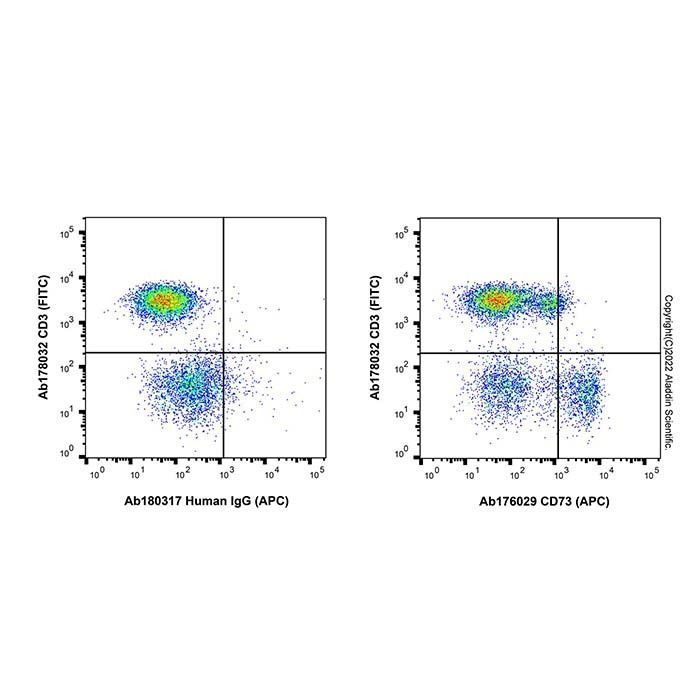
- Excitation: Use 633–647 nm lasers. Detection filters: ~660/20–40 nm for PE-Cy5 competitors; for APC, typical filters are 660/20 or 670/30 nm. Confirm with instrument configuration.
If your workflow requires special conditions (e.g., fixation/permeabilization), verify that APC fluorescence is retained under your chosen fixative (some APC signal can diminish with strong aldehydes). Conduct pilot tests with your exact buffers.

 ZJ24F0707757