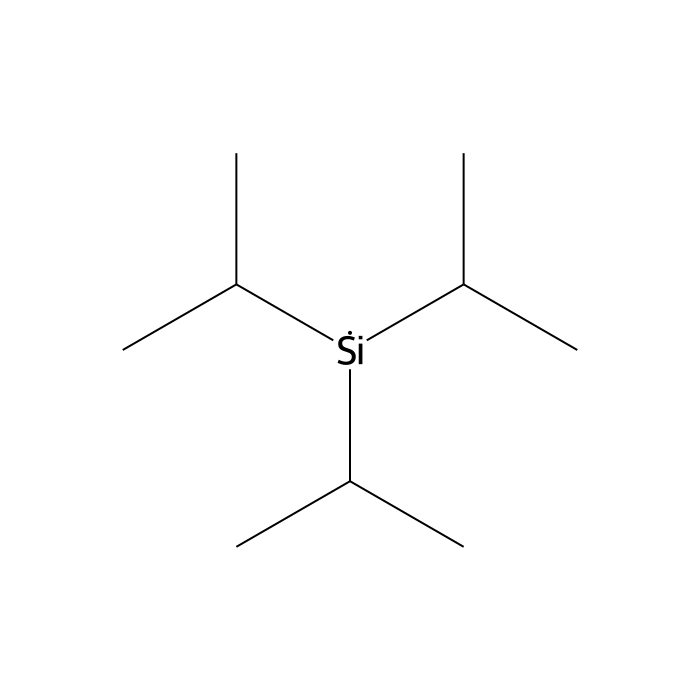
Triisopropylsilane(TIPS) - ≥98.5% , CAS No.6485-79-6

CAS: 6485-79-6 Cat. No.: T420182 Formula: C9H22Si Molecular Weight: 158.36 Beilstein Registry Number: 1733718 EC Number: 464-880-1
AVAILABLE TO ORDER
GRADE & PURITY ≥98.5%
Synonyms
tris(propan-2-yl)silane|Aksci Bulk ReagentTriisopropylsilane|Benzenesulfonic acid,5-[(4-amino-1-naphthalenyl)azo]-2-[2-[4-[(2-hydroxy-1-naphthalenyl)azo]-2-sulfophenyl]ethenyl]-,disodium salt (9CI)|triisopropylsilicon|tri(propan-2-yl)silicon|Triisopropylsilane|Tris(1-methylethyl)silane|Triisopropylhydrosilane|TIS
Storage
Room temperature,Argon charged
Shipped In
Normal
★
Size
USA
Germany (EU)*
Price
Qty
5ml
T420182-5ml
In stock ≥10
7 In stock

$9.90

$10.90
Save $1.00 (9.17%)
25ml
T420182-25ml
9 In stock
7 In stock
$29.90
100ml
T420182-100ml
In stock ≥10
7 In stock
$79.90
500ml
T420182-500ml
1 In stock
—
$279.90
Enter a quantity for the sizes you want to add.

Overview

Triisopropylsilane (TIPS) is an organosilicon compound used as a reducing agent in organic synthesis due to its relatively low toxicity, ease of handling, and its ability to selectively reduce various functional groups. It is used in the presence of a Lewis acid such as titanium (IV) chloride to selectively reduce ketones and aldehydes to their corresponding alkanes and selective reduction of epoxides to the corresponding alcohols.
Purpose
Triisopropylsilane can be used as a reducing agent:
To synthesize 4-pyrrole phenylacyl peptide during solid-phase peptide synthesis. 
In transition metal complex-catalyzed reaction of amides with hydrosilanes. 
For the selective reduction of C-arylglucosides into β-C-aryl glucosides.
To facilitate the cleavage of acetamidomethyl (Acm), 4-methoxybenzyl (Mob), and tert-butyl (But) protecting groups from cysteine (Cys) residues in the presence of trifluoroacetic acid.
For the reduction of amides to corresponding amines in the presence of transition-metal catalysts.

Specifications

Synonyms
tris(propan-2-yl)silane | Aksci Bulk ReagentTriisopropylsilane | Benzenesulfonic acid,5-[(4-amino-1-naphthalenyl)azo]-2-[2-[4-[(2-hydroxy-1-naphthalenyl)azo]-2-sulfophenyl]ethenyl]-,disodium salt (9CI) | triisopropylsilicon | tri(propan-2-yl)silicon | Triisopropylsilane | Tris(1-methylethyl)silane | Triisopropylhydrosilane | TIS
Specifications & Purity
≥98.5%
Storage
Room temperature,Argon charged
Shipped In
Normal
Purity
≥98.5%
Names and Identifiers
Pubchem Sid
Pubchem Sid Url
https://pubchem.ncbi.nlm.nih.gov/substance/508811475
SMILES
CC(C)[Si](C(C)C)C(C)C
InChIKey
ZGYICYBLPGRURT-UHFFFAOYSA-N
InChI
1S/C9H21Si/c1-7(2)10(8(3)4)9(5)6/h7-9H,1-6H3
Isomeric SMILES
CC(C)[Si](C(C)C)C(C)C
WGK Germany
3
UN Number
1993
Molecular Weight
158.36
Beilstein
1733718
Reaxys
1733718

Advanced Data

Taxonomic Classification

Taxonomy Tree

KingdomOrganic compounds
SuperclassHydrocarbon derivatives
ClassNot available
SubclassNot available
Intermediate Tree Nodes Not available
Direct ParentHydrocarbon derivatives
Alternative Parents Organosilicon compounds  
Molecular FrameworkAliphatic acyclic compounds
Substituents Hydrocarbon derivative - Organosilicon compound - Organic metalloid moeity - Aliphatic acyclic compound
DescriptionThis compound belongs to the class of organic compounds known as hydrocarbon derivatives. These are derivatives of hydrocarbons obtained by substituting one or more carbon atoms by an heteroatom. They contain at least one carbon atom and heteroatom.
External Descriptors Not available
3D Structure
Interactive Chemical Structure Model


Certificates (CoA,COO,BSE/TSE and Analysis Chart)
C of A & Other Certificates(BSE/TSE, COO):
Analytical Chart:

Find and download the COA for your product by matching the lot number on the packaging.

46 results found

Lot NumberCertificate TypeDateItem
L2404568L2404568Certificate of AnalysisSep 04, 2026 T420182
J2630084J2630084Certificate of AnalysisJun 08, 2026 T420182
F2616482F2616482Certificate of AnalysisJun 08, 2026 T420182
F2616481F2616481Certificate of AnalysisJun 08, 2026 T420182
F2616480F2616480Certificate of AnalysisJun 08, 2026 T420182
F2616479F2616479Certificate of AnalysisJun 08, 2026 T420182
F2616476F2616476Certificate of AnalysisJun 08, 2026 T420182
J2509726J2509726Certificate of AnalysisSep 19, 2025 T420182
J2509725J2509725Certificate of AnalysisSep 19, 2025 T420182
D2601060D2601060Certificate of AnalysisSep 19, 2025 T420182
D2601061D2601061Certificate of AnalysisSep 19, 2025 T420182
D2601062D2601062Certificate of AnalysisSep 19, 2025 T420182
J2509724J2509724Certificate of AnalysisSep 19, 2025 T420182
J2509723J2509723Certificate of AnalysisSep 19, 2025 T420182
L2404578L2404578Certificate of AnalysisNov 21, 2024 T420182
L2404577L2404577Certificate of AnalysisNov 21, 2024 T420182
E2522013E2522013Certificate of AnalysisNov 21, 2024 T420182
F2427358F2427358Certificate of AnalysisJun 19, 2024 T420182
F2427359F2427359Certificate of AnalysisJun 19, 2024 T420182
F2427360F2427360Certificate of AnalysisJun 19, 2024 T420182
F2427356F2427356Certificate of AnalysisJun 19, 2024 T420182
F2427357F2427357Certificate of AnalysisJun 19, 2024 T420182
K2425008K2425008Certificate of AnalysisJun 19, 2024 T420182
F2222388F2222388Certificate of AnalysisMar 21, 2024 T420182
F2222393F2222393Certificate of AnalysisMar 21, 2024 T420182
F2222394F2222394Certificate of AnalysisMar 21, 2024 T420182
F2222395F2222395Certificate of AnalysisMar 21, 2024 T420182
D2429453D2429453Certificate of AnalysisFeb 29, 2024 T420182
D2429454D2429454Certificate of AnalysisFeb 29, 2024 T420182
D2429455D2429455Certificate of AnalysisFeb 29, 2024 T420182
D2429456D2429456Certificate of AnalysisFeb 29, 2024 T420182
D2429457D2429457Certificate of AnalysisFeb 29, 2024 T420182
D2429452D2429452Certificate of AnalysisFeb 29, 2024 T420182
J2319539J2319539Certificate of AnalysisOct 13, 2023 T420182
J2319540J2319540Certificate of AnalysisOct 13, 2023 T420182
J2319541J2319541Certificate of AnalysisOct 13, 2023 T420182
I2315262I2315262Certificate of AnalysisSep 09, 2023 T420182
I2315087I2315087Certificate of AnalysisSep 09, 2023 T420182
I2315086I2315086Certificate of AnalysisSep 09, 2023 T420182
I2315085I2315085Certificate of AnalysisSep 09, 2023 T420182
H23031214H23031214Certificate of AnalysisJul 15, 2023 T420182
H23031185H23031185Certificate of AnalysisJul 15, 2023 T420182
H23031072H23031072Certificate of AnalysisJul 15, 2023 T420182
H23031070H23031070Certificate of AnalysisJul 15, 2023 T420182
H23031040H23031040Certificate of AnalysisJul 15, 2023 T420182
F2222398F2222398Certificate of AnalysisJul 01, 2022 T420182
Chemical and Physical Properties
SolubilityImmiscible with water.
SensitivityMoisture sensitive.
Refractive Index1.434
Flash Point100.4 °F
Flash Point38 °C
Boil Point84-86 °C/35 mmHg (lit.)
Molecular Weight157.35
XLogP3
Hydrogen Bond Donor Count0
Hydrogen Bond Acceptor Count0
Rotatable Bond Count3
Exact Mass157.141 Da
Monoisotopic Mass157.141 Da
Topological Polar Surface Area0.000 Ų
Heavy Atom Count10
Formal Charge0
Complexity65.700
Isotope Atom Count0
Defined Atom Stereocenter Count0
Undefined Atom Stereocenter Count0
Defined Bond Stereocenter Count0
Undefined Bond Stereocenter Count0
The total count of all stereochemical bonds0
Covalently-Bonded Unit Count1
Safety and Hazards(GHS)
Pictogram(s)
GHS02,   GHS07
Signal
Warning
Hazard Statements

H225:Highly Flammable liquid and vapor

H226:Flammable liquid and vapor

H315:Causes skin irritation

H319:Causes serious eye irritation

H335:May cause respiratory irritation

Precautionary Statements

P210:Keep away from heat, hot surface, sparks, open flames and other ignition sources. - No smoking.

P233:Keep container tightly closed.

P240:Ground/bond container and receiving equipment.

P241:Use explosion-proof [electrical/ventilating/lighting/.../] equipment.

P242:Use only non-sparking tools.

P243:Take precautionary measures against static discharge.

P261:Avoid breathing dust/fume/gas/mist/vapors/spray.

P264:Wash hands [and …] thoroughly after handling.

P271:Use only outdoors or in a well-ventilated area.

P280:Wear protective gloves/protective clothing/eye protection/face protection.

P321:Specific treatment (see ... on this label).

P302+P352:IF ON SKIN: wash with plenty of water.

P303+P361+P353:IF ON SKIN (or hair): Take off Immediately all contaminated clothing. Rinse SKIN with water [or shower].

P304+P340:IF INHALED: Remove person to fresh air and keep comfortable for breathing.

P305+P351+P338:IF IN EYES: Rinse cautiously with water for several minutes. Remove contact lenses if present and easy to do - continue rinsing.

P362+P364:Take off contaminated clothing and wash it before reuse.

P370+P378:In case of fire: Use ... to extinguish.

P405:Store locked up.

P403+P233:Store in a well-ventilated place. Keep container tightly closed.

P403+P235:Store in a well-ventilated place. Keep cool.

P501:Dispose of contents/container to an approved waste disposal plant.

P264+P265:Wash hands [and …] thoroughly after handling. Do not touch eyes.

P337+P317:If eye irritation persists: Get medical help.

P332+P317:If skin irritation occurs: Get medical help.

P319:Get medical help if you feel unwell.

WGK Germany
3
Reaxys
1733718
Documents & Articles
Protection Reagents
A Complete Guide to Choosing Resins for SPPS (Solid-Phase Peptide Synthesis): Fmoc/Boc Routes, C-Terminal Acid/Amide, and a Key-Parameter Navigator
From Analytical Instrument to Synthetic Platform: A New Strategy for Reconstructing Automated Flow Solid-Phase Peptide Synthesis with Standard Analytical HPLC
New Progress in the Solid-Phase Synthesis of Sterically Hindered Peptides: Background, Core Breakthroughs, and Implications for Automation Compatibility of the RMMR Strategy
Low Racemization in Peptide Synthesis Is Not Just About Reagent Choice: Stereochemical Risk During the Activation Stage and Practical Strategies for Experimental Control
Decision Logic for Peptide Synthesis Routes: Applicability and Criteria for Choosing among SPPS, LPPS, and Recombinant Expression
Boc₂O Selection Cannot Be Judged by Protection Installation Alone: Experimental Decision-Making from Substrate Nucleophilicity and Medium Effects to Deprotection Pathways
How to Troubleshoot Abnormal Impurities in Peptide Synthesis? Locating Process Issues Through Amino-Related Side Reactions
Peptide Intermediates Difficult to Dissolve and Separate? Route Design and Workup Strategies for Tag-Assisted Liquid-Phase Peptide Synthesis (TAG-LPPS)
Formation and Control of Carboxyl- and Hydroxyl-Related Impurities in Peptide Synthesis — Using Asp/Glu and Ser/Thr Residue Side Reactions as Examples
Citations of This Product
Solution Calculators
Reviews

Customer Reviews

Shall we send you a message when we have discounts available?

Remind me later

Thank you! Please check your email inbox to confirm.

Oops! Notifications are disabled.