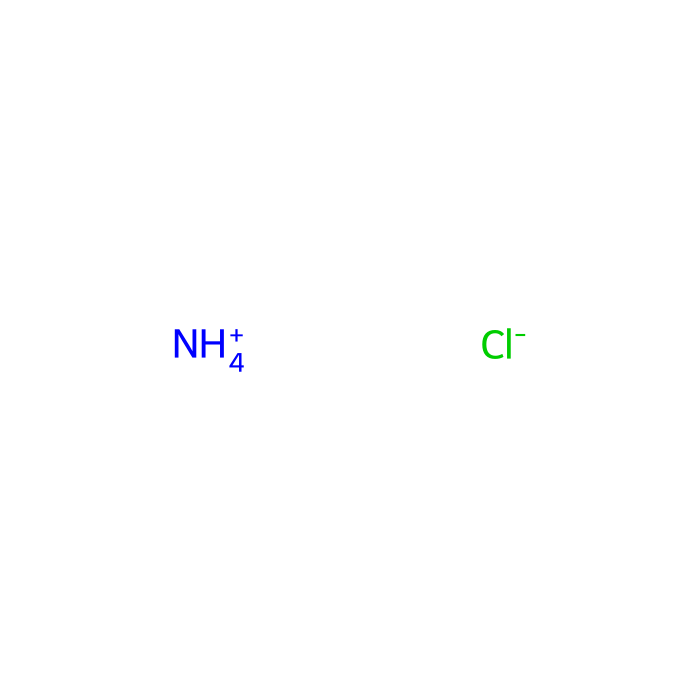
Ammonium chloride - for cell culture , CAS No.12125-02-9

CAS: 12125-02-9 Cat. No.: A116373 Formula: NH4Cl Molecular Weight: 53.49 EC Number: 235-186-4
AVAILABLE TO ORDER
GRADE & PURITY for Cell culture ? Cell-culture grade — low endotoxin and contaminants to support viable cell growth. Use in mammalian/other cell culture media and supplements.
Synonyms
Ammonium Chloratum|ammonium chloride salt|Ammoniumchlorid [German]|ammonium chlorid|AMMONIUM CHLORIDE (MART.)|Ammonium chloride, biochemical grade|AMMONIUM CHLORIDE (USP-RS)|Pesticide Code: 129014.|Chlorammonic|Conclyte-A (TN)|Ammoniac, Sal|azanium chloride|Dytuss|AMMONIUM CHLORIDE [VANDF]|Conclyte-A|Ins no.510|AMMONIUM CHLORIDE (II)|Chloride, Ammonium|ammonia hydrochloride|ammonia hydrochloride-|Ammonium chloride fume|Ammonium chloride (JAN/USP)|Ammonium chloride - $-beta|AMMONIUM CHLORIDE [WHO-DD]|Chlorid amonny [Czech]|Ammonium chloride ((NH4)Cl)|AMMONIUM CHLORIDE [II]|AMMONIUM CHLORIDE [ORANGE BOOK]|Ammonium-15N chloride|AMMONIUM CHLORIDE (EP MONOGRAPH)|AMMONIUM CHLORIDE [EP MONOGRAPH]|Amoklor|AMMONIUM CHLORIDE [FCC]|AMMONIUM CHLORIDE [JAN]|Chlorammonic [France]|AMMONIUM CHLORIDE [HSDB]|AMMONIUM MURIATICUM [HPUS]|Darammon|AMMONIUM CHLORIDE [USP MONOGRAPH]|ammonium cloride|ammoniurn chloride|Chlorid amonny|AMMONIUM CHLORIDE (NH4CL)|AMMONIUM CHLORIDE [MI]|Ammoniumklorid|Ammonium chloride (USP:JAN)|AMMONIUM CHLORIDE [MART.]|Ammonium chloride in plastic container|ammonium choride|Chloramon|Elektrolyt|AMCHLORIDE|Ammon Chlor|COLDS COUGHS|Sal ammonia|Sal ammoniac|AMMONIUM CHLORIDE [GREEN BOOK]|Ammonium muriaticum|ammoniumchloride|Ammoniumchlorid|Ammoneric|AMMONIUM CHLORIDE (USP MONOGRAPH)|Ammonium Chloride Injection|Ammonium muriate|Ammonium-15N,d4 chloride|Chlorid ammonia|Cloruro de Amonio|FUS-SOL|Salammonite|Ammonii Chloridum|AMMONIUM CHLORIDE [USP-RS]|Salmiac|Quelidrine|amrnonium chloride|arnmonium chloride|Ammonchlor|Muriate of Ammonia|Salammoniacus|AMMONIUM CHLORIDE|Ammonium chloride [USP:JAN]|AMMONIUM CHLORIDE [INCI]|Pectomed|Ammonium chloride (NH4)(HCl2))|Ammonium Chloride Tablets|amonium chloride|Catalyst rd
Storage
Room temperature,Argon charged,Desiccated
Shipped In
Normal
★
Size
USA
Germany (EU)*
Price
Qty
100g
A116373-100g
3 In stock
—
$28.90
500g
A116373-500g
2 In stock
1 In stock
$82.90
Enter a quantity for the sizes you want to add.

Specifications

Synonyms
Ammonium Chloratum | ammonium chloride salt | Ammoniumchlorid [German] | ammonium chlorid | AMMONIUM CHLORIDE (MART.) | Ammonium chloride, biochemical grade | AMMONIUM CHLORIDE (USP-RS) | Pesticide Code: 129014. | Chlorammonic | Conclyte-A (TN) | Ammoniac, Sal | azanium chloride | Dytuss | AMMONIUM CHLORIDE [VANDF] | Conclyte-A | Ins no.5 Show more
Specifications & Purity
for cell culture
Storage
Room temperature,Argon charged,Desiccated
Shipped In
Normal
Grade
for Cell culture
Names and Identifiers
Pubchem Sid
SMILES
[NH4+].[Cl-]
IUPAC Name
azanium;chloride
InChIKey
NLXLAEXVIDQMFP-UHFFFAOYSA-N
InChI
1S/ClH.H3N/h1H;1H3
Isomeric SMILES
[NH4+].[Cl-]
WGK Germany
1
Molecular Weight
53.49
Reaxys
3547232
Reaxys-RN_link_address
https://www.reaxys.com/reaxys/secured/hopinto.do?context=S&query=IDE.XRN=3547232&ln=

Advanced Data

Taxonomic Classification

Taxonomy Tree

KingdomInorganic compounds
SuperclassHomogeneous non-metal compounds
ClassOther non-metal halides
SubclassNot available
Intermediate Tree Nodes Not available
Direct ParentOther non-metal halides
Alternative Parents Inorganic chloride salts  
Molecular FrameworkNot available
Substituents Other non-metal halide - Inorganic chloride salt - Inorganic salt
DescriptionThis compound belongs to the class of inorganic compounds known as other non-metal halides. These are inorganic compounds containing 'other non-metals' and halogen.
External Descriptors ammonium salt - inorganic chloride
3D Structure
Interactive Chemical Structure Model


Associated Targets(Human)
TRPA1 Tclin Transient receptor potential cation channel subfamily A member 1 (0 Activities)
Activity TypeActivity Value -log(M)Mechanism of ActionActivity ReferencePublications (PubMed IDs)
Certificates (CoA,COO,BSE/TSE and Analysis Chart)
C of A & Other Certificates(BSE/TSE, COO):
Analytical Chart:

Find and download the COA for your product by matching the lot number on the packaging.

12 results found

Lot NumberCertificate TypeDateItem
F2615092F2615092Certificate of AnalysisJul 01, 2026 A116373
F2615104F2615104Certificate of AnalysisJul 01, 2026 A116373
L2519112L2519112Certificate of AnalysisDec 24, 2025 A116373
L2519216L2519216Certificate of AnalysisDec 24, 2025 A116373
D2523345D2523345Certificate of AnalysisApr 24, 2025 A116373
D2523346D2523346Certificate of AnalysisApr 24, 2025 A116373
E2124094E2124094Certificate of AnalysisMar 04, 2025 A116373
J2429174J2429174Certificate of AnalysisNov 05, 2024 A116373
J2429175J2429175Certificate of AnalysisOct 31, 2024 A116373
L2017013L2017013Certificate of AnalysisOct 09, 2024 A116373
F2228039F2228039Certificate of AnalysisJun 11, 2022 A116373
F2228040F2228040Certificate of AnalysisJun 11, 2022 A116373
Chemical and Physical Properties
SensitivityHygroscopic
Boil Point520 °C
Melt Point338°C(dec.)(lit.)
Molecular Weight53.49
XLogP3
Hydrogen Bond Donor Count1
Hydrogen Bond Acceptor Count1
Rotatable Bond Count0
Exact Mass53.0032 Da
Monoisotopic Mass53.0032 Da
Topological Polar Surface Area1.000 Ų
Heavy Atom Count2
Formal Charge0
Complexity0.000
Isotope Atom Count0
Defined Atom Stereocenter Count0
Undefined Atom Stereocenter Count0
Defined Bond Stereocenter Count0
Undefined Bond Stereocenter Count0
The total count of all stereochemical bonds0
Covalently-Bonded Unit Count2
Safety and Hazards(GHS)
Pictogram(s)
Signal
Warning
Hazard Statements

H302:Harmful if swallowed

H319:Causes serious eye irritation

Precautionary Statements

P264:Wash hands [and …] thoroughly after handling.

P270:Do not eat, drink or smoke when using this product.

P280:Wear protective gloves/protective clothing/eye protection/face protection.

P330:Rinse mouth.

P305+P351+P338:IF IN EYES: Rinse cautiously with water for several minutes. Remove contact lenses if present and easy to do - continue rinsing.

P501:Dispose of contents/container to an approved waste disposal plant.

P264+P265:Wash hands [and …] thoroughly after handling. Do not touch eyes.

P301+P317:IF SWALLOWED: Get medical help.

P337+P317:If eye irritation persists: Get medical help.

WGK Germany
1
Reaxys
3547232
Reaxys-RN_link_address
https://www.reaxys.com/reaxys/secured/hopinto.do?context=S&query=IDE.XRN=3547232&ln=
Merck Index
509
Documents & Articles
For Cell Culture
Eight Common Lysis Buffers
General Principles of Antibody Labeling with NHS-Activated Esters, F/P Calculation, and Troubleshooting Guide
Fundamentals and Applications of Etching Solutions: Using Metallic Copper / PCB Etching as an Example
Installing a Redox Switch on Biomolecules: Principles, Conjugation Essentials, and an Application Guide for ATTO MB2 NHS ester
Calcium Gluconate: Physicochemical Properties, Pharmacopoeial Quality Control, and Application Guidelines
A Practical Guide to Organozinc Reagents for Synthesis (Organozinc Reagents): Structural Features, Key Reactions, and a Practical Selection Navigation (Including Aladdin Product Tables)
Furin: A Review of Its Structural Features, Substrate Recognition, and Research Applications
Tissue Dissociation for Single-Cell Preparation: Sample Handling and Quality Control Strategies
Coupling Mechanisms Between Terminal Reducing-Power Allocation in Photosynthetic Electron Transport and Metabolic Demand
Application Differences Among Glutaraldehyde, Paraformaldehyde, and Formalin in Tissue and Cell Sample Fixation
Capable of Swelling, Adsorption, and Cation Exchange: What Makes Montmorillonite Clay Different?
Comparison of Urea Detection Methods: Reaction Mechanisms, Interference Factors, and Application Scenarios of the Urease Method and Diacetyl Monoxime Method
Autophagy Signaling Pathways and Selective Autophagy Research
Membrane Transporters and Ion Channels: How Transmembrane Substance Flux Drives Cellular Signaling and Functional Regulation
Thietanes: Promising Small-Ring Building Blocks with Tunable Physicochemical Properties through Sulfur Oxidation-State Control
Discovery and Structural Optimization of the Noncovalent 3CL Protease Inhibitor S-217622
Citations of This Product
Solution Calculators
Reviews

Customer Reviews

Need help choosing the grade?

Our grade selection guide covers purity, stabilizer status, and application suitability for all variants in our catalog.

View for Cell culture grade guide →

Shall we send you a message when we have discounts available?

Remind me later

Thank you! Please check your email inbox to confirm.

Oops! Notifications are disabled.