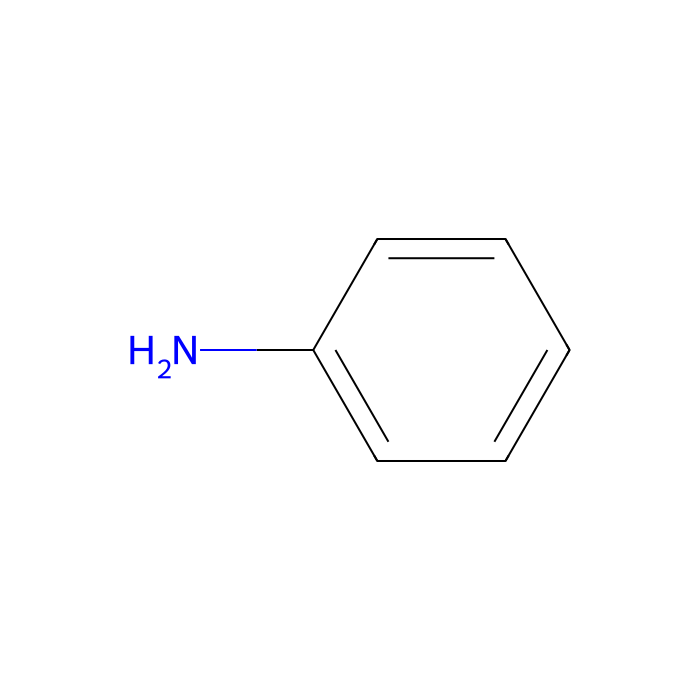
Aniline - AR, ≥99.5% , CAS No.62-53-3

CAS: 62-53-3 Cat. No.: A112120 Formula: C6H5NH2 Molecular Weight: 93.13 Beilstein Registry Number: 605631 EC Number: 200-539-3
AVAILABLE TO ORDER
GRADE & PURITY AR ? Analytical Reagent grade — high-purity chemicals meeting strict assay limits for lab analysis. Use when accuracy matters and trace impurities could skew results. ≥99.5%
Synonyms
Fentanyl impurity F | A833829 | ANILINE [USP-RS] | Aniline, JIS special grade, >=99.0% | NCGC00091297-01 | Anilinum | Anyvim | SR-01000944923-1 | UN 1547 | Aniline, ACS reagent, >=99.5% | DTXCID9090 | NCGC00257899-01 | Rcra waste number U012 | Trimethopri
Storage
Room temperature,Argon charged
Shipped In
FedEx DG Service
★
Size
USA
Germany (EU)*
Price
Qty
100ml
A112120-100ml
8 In stock
—

$11.90

$14.90
Save $3.00 (20.13%)
500ml
A112120-500ml
1 In stock
—

$21.90

$25.90
Save $4.00 (15.44%)
12×500ml
A112120-12×500ml
Made to order · 8–12 wks

$213.90

$279.90
Save $66.00 (23.58%)
Enter a quantity for the sizes you want to add.
🧪
Why this grade

AR, ≥99.5% AR for sensitive chromatographic and analytical workflows requiring minimal baseline interference.

🌡

Storage & shipping

Room temperature,Argon charged Ships FedEx DG Service Check lot-specific COA for exact specifications.

📋

Quality documents

SDS, COA, datasheet, and spec sheet available for download. Lot-specific COA accessible via lot number lookup.

📚

Literature proof

Cited in 1366 peer-reviewed publications across chromatography, organic synthesis, and cross-coupling reactions.

Overview

Aniline is an aromatic primary amine used as a reactant in the synthesis of organic intermediates such as 3-chloro-N-phenylpyridin-2-amine, (Z)-methyl 3-(phenylamino)but-2-enoic acid, 2-iodo-N-phenylbenzamide, 2,4-dichloroquinoline, and N-(2-propyl)aniline.

Specifications

Synonyms
Fentanyl impurity F | A833829 | ANILINE [USP-RS] | Aniline, JIS special grade, >=99.0% | NCGC00091297-01 | Anilinum | Anyvim | SR-01000944923-1 | UN 1547 | Aniline, ACS reagent, >=99.5% | DTXCID9090 | NCGC00257899-01 | Rcra waste number U012 | Trimethopri
Specifications & Purity
AR, ≥99.5%
Biochemical and Physiological Mechanisms
The acute toxicity of aniline involves its activation in vivo to 4-hydroxyaniline and adduct formation with hemoglobin. In erythrocytes, this is associated with the release of iron and accumulation of methemoglobin and the development of hemolytic anemia
Storage
Room temperature,Argon charged
Shipped In
FedEx DG Service
Grade
AR
Purity
≥99.5%
Names and Identifiers
Pubchem Sid
Canonical Smiles
C1=CC=C(C=C1)N
IUPAC Name
aniline
InChIKey
PAYRUJLWNCNPSJ-UHFFFAOYSA-N
INCHI
1S/C6H7N/c7-6-4-2-1-3-5-6/h1-5H,7H2
Isomeric SMILES
C1=CC=C(C=C1)N
WGK Germany
1
UN Number
1547
Packing Group
II
Molecular Weight
93.13
Beilstein
605631
Reaxy-Rn
605631
Reaxys-RN_link_address
https://www.reaxys.com/reaxys/secured/hopinto.do?context=S&query=IDE.XRN=605631&ln=

Documentation

📋 Safety Data Sheet (SDS)

Comprehensive hazard, handling, storage, and regulatory compliance document.

Download SDS →

✅ Certificate of Analysis (COA)

Lot-specific quality data. Enter your lot number to retrieve the exact COA.

Look up COA →

📊 Datasheet

Quick-reference summary of product specifications and applications.

View datasheet →

🔬 Specification Sheet

Full quality attributes and acceptance criteria for this grade.

View spec sheet →

Advanced Data

Taxonomic Classification

Taxonomy Tree

KingdomOrganic compounds
SuperclassBenzenoids
ClassBenzene and substituted derivatives
SubclassAniline and substituted anilines
Intermediate Tree Nodes Not available
Direct ParentAniline and substituted anilines
Alternative Parents Primary amines  Organopnictogen compounds  Hydrocarbon derivatives  
Molecular FrameworkAromatic homomonocyclic compounds
Substituents Aniline or substituted anilines - Organic nitrogen compound - Organopnictogen compound - Hydrocarbon derivative - Primary amine - Organonitrogen compound - Amine - Aromatic homomonocyclic compound
DescriptionThis compound belongs to the class of organic compounds known as aniline and substituted anilines. These are organic compounds containing an aminobenzene moiety.
External Descriptors an arylamine
3D Structure
Interactive Chemical Structure Model


Associated Targets(Human)
TSHR Tclin Thyroid stimulating hormone receptor (29986 Activities)
Activity TypeRelationActivity valueUnitsAction TypeJournalPubMed IddoiAssay Aladdin ID
MAOA Tclin Monoamine oxidase A (11911 Activities)
Activity TypeRelationActivity valueUnitsAction TypeJournalPubMed IddoiAssay Aladdin ID
MAOB Tclin Monoamine oxidase B (8835 Activities)
Activity TypeRelationActivity valueUnitsAction TypeJournalPubMed IddoiAssay Aladdin ID
CYP1B1 Tchem Cytochrome P450 1B1 (1148 Activities)
Activity TypeRelationActivity valueUnitsAction TypeJournalPubMed IddoiAssay Aladdin ID
CYP1A1 Tchem Cytochrome P450 1A1 (1169 Activities)
Activity TypeRelationActivity valueUnitsAction TypeJournalPubMed IddoiAssay Aladdin ID
UGT1A4 Tbio UDP-glucuronosyltransferase 1A4 (288 Activities)
Activity TypeRelationActivity valueUnitsAction TypeJournalPubMed IddoiAssay Aladdin ID
CYP2E1 Tchem Cytochrome P450 2E1 (2174 Activities)
Activity TypeRelationActivity valueUnitsAction TypeJournalPubMed IddoiAssay Aladdin ID
Associated Targets(non-human)
Plasmodium falciparum (966862 Activities)
Activity TypeRelationActivity valueUnitsAction TypeJournalPubMed IddoiAssay Aladdin ID
Lithobates pipiens (29 Activities)
Activity TypeRelationActivity valueUnitsAction TypeJournalPubMed IddoiAssay Aladdin ID
HT-22 (3261 Activities)
Activity TypeRelationActivity valueUnitsAction TypeJournalPubMed IddoiAssay Aladdin ID
E Lysozyme (95 Activities)
Activity TypeRelationActivity valueUnitsAction TypeJournalPubMed IddoiAssay Aladdin ID
Plasma (328 Activities)
Activity TypeRelationActivity valueUnitsAction TypeJournalPubMed IddoiAssay Aladdin ID
Colon (26 Activities)
Activity TypeRelationActivity valueUnitsAction TypeJournalPubMed IddoiAssay Aladdin ID
Mechanisms of Action
Certificates(CoA,COO,BSE/TSE and Analysis Chart)
C of A & Other Certificates(BSE/TSE, COO):
Analytical Chart:

Find and download the COA for your product by matching the lot number on the packaging.

14 results found

Lot NumberCertificate TypeDateItem
F2604605Certificate of AnalysisJun 25, 2026 A112120
B2602448Certificate of AnalysisFeb 25, 2026 A112120
J2510381Certificate of AnalysisOct 21, 2025 A112120
F2512005Certificate of AnalysisJul 12, 2025 A112120
C2510415Certificate of AnalysisMar 21, 2025 A112120
H2407727Certificate of AnalysisAug 26, 2024 A112120
C2427177Certificate of AnalysisApr 25, 2024 A112120
L2321265Certificate of AnalysisJan 04, 2024 A112120
F2326224Certificate of AnalysisJul 06, 2023 A112120
C2331004Certificate of AnalysisApr 07, 2023 A112120
K2230758Certificate of AnalysisOct 19, 2022 A112120
F2216063Certificate of AnalysisJun 10, 2022 A112120
F2216084Certificate of AnalysisJun 10, 2022 A112120
F2216178Certificate of AnalysisJun 10, 2022 A112120
Chemical and Physical Properties
SolubilityMiscible with water.
SensitivityAir & Light Sensitive,Hygroscopic
Refractive Index1.5863
Flash Point(°C)76℃
Boil Point(°C)184-186°C
Melt Point(°C)-6°C
Molecular Weight93.130 g/mol
XLogP30.900
Hydrogen Bond Donor Count1
Hydrogen Bond Acceptor Count1
Rotatable Bond Count0
Exact Mass93.0578 Da
Monoisotopic Mass93.0578 Da
Topological Polar Surface Area26.000 Ų
Heavy Atom Count7
Formal Charge0
Complexity46.100
Isotope Atom Count0
Defined Atom Stereocenter Count0
Undefined Atom Stereocenter Count0
Defined Bond Stereocenter Count0
Undefined Bond Stereocenter Count0
The total count of all stereochemical bonds0
Covalently-Bonded Unit Count1
Documents & Articles
How to prevent and mitigate the deterioration of chemical reagents?
Make “Aryl Chlorides + Low Pd Loading + Scale-Up Reproducibility” Reliable: The Initiation and Durability Logic of Pd–NHC (Palladium–N-Heterocyclic Carbene) Cross-Coupling (with Selection Navigation and Product Tables)
Enzyme Labels in Immunoassays, Signal Amplification, and Multi-Enzyme Detection Platforms: A Functional Overview
Haloheterocycles and Cross-Coupling: A Research-Oriented Selection Framework from Substrate Identification to Bond-Forming Routes (Including Product Navigation and Tables 1–5)
β-Acyloxy Alkenyl Amides (AAAs): A New Approach to Amide Bond and Peptide Bond Construction Worth Attention
Revisiting Titanium Tetrachloride: New Advances in the Direct Amidation and Esterification of Carboxylic Acids
DAST-Mediated Amidation at Room Temperature: Method Features, Practical Value, and Scope of Applicability
Understanding ATD-DMAP: From Reagent Design to Esterification, Amidation, and Stereochemical Integrity
TCFH–NMI Amidation in Highly Aqueous Media: Research Value, Methodological Understanding, and Experimental Insights
How to Construct Nitriles: Route Selection Across Direct Introduction, Precursor Dehydration, Oxidation/Dehydrogenation, and Cyanide-Free Processes
Boc₂O Selection Cannot Be Judged by Protection Installation Alone: Experimental Decision-Making from Substrate Nucleophilicity and Medium Effects to Deprotection Pathways
Polyetherimide (PEI): Structural Features, Main Properties, and Typical Application Directions
Experimental Evaluation of Triphosgene in Organic Synthesis: Understanding Its Selection Logic Through Reaction Tasks
Triphenylphosphine-Involved Carboxylic Acid Activation and Amide Bond Formation: Activation Pathways, Anhydride Competition, and Applicability Scenarios
Experimental Considerations for the Use of ADMP in the Conversion of Primary Amines to Organic Azides: Substrate Nucleophilicity, Base Matching, and Medium Selection
Experimental Decision-Making for Cross-Coupling Reactions: Target Bond Type, Substrate Combination, and Catalytic System Selection
From Natural Cellulose to Nanocrystals: Structural Characteristics, Application Directions, and Industrialization Challenges of CNC
Strain Release of Azatricycloalkanes: Modular Bridge-Position Functionalization and Stereochemical Control of Three-Dimensional Bridged Aza Scaffolds
From Photocatalytic Ring Opening to Skeletal Reconstruction: Reaction Logic and Synthetic Applications of Oxygen-Atom Replacement in Oxetanes
Logic for Selecting Amidation Reagents in Aqueous Media: Competing Reactions, Activated Intermediates, and Substrate Effects
One-Pot Deaminative Cyanation of Arylamines Mediated by Nitrate Reduction: The ORT Pathway and Kinetic Matching of Tandem Reaction Steps
Why Primary and Secondary Amines Have Difficulty Participating Directly in the Classical Mitsunobu Reaction: Mechanism, Inversion of Configuration, and Reaction Scope of BEHT-Mediated Alcohol Amination
Construction and Transformation of Aziridines in Drug Synthesis: Ring Strain, N-Substituent Control, Selective Ring Opening, and Scaffold Expansion
Bond-Forming Reactions of N-Sulfinylamine and the Synthesis of S(VI) Functional Groups: Two-Electron Addition, Radical Addition, and Formal Cycloaddition
Desaturative Amination for the Synthesis of Amino Heteroarenes: Carbonyl-Site Predefinition of the C–N Bond-Forming Position and Subsequent Desaturative Aromatization
From Temporary Covalent Assembly to Intramolecular Smiles Aryl Migration: DCPDC-Mediated Phenol–Primary Amine C–N Cross-Coupling
Citations of This Product
Solution Calculators
Reviews

Customer Reviews

Need help choosing the grade?

Our grade selection guide covers purity, stabilizer status, and application suitability for all variants in our catalog.

View AR grade guide →

Shall we send you a message when we have discounts available?

Remind me later

Thank you! Please check your email inbox to confirm.

Oops! Notifications are disabled.