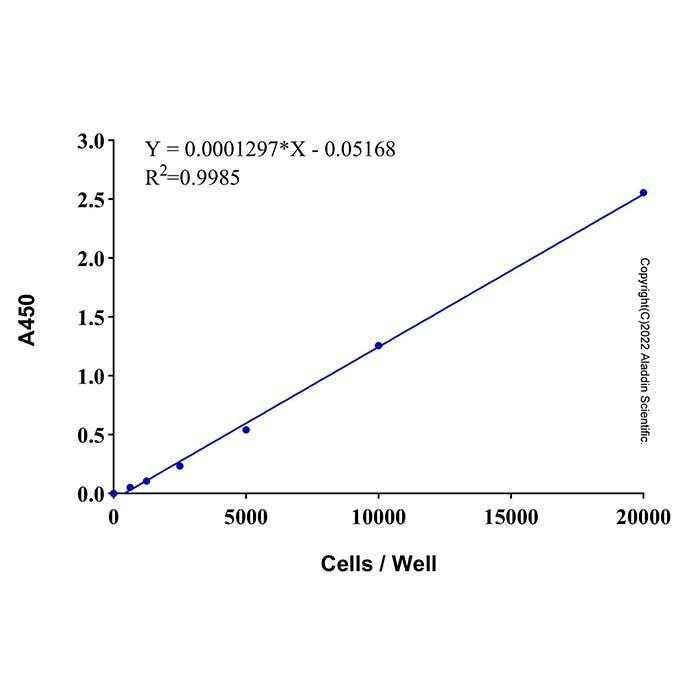
Water-soluble tetrazole (2-(2-methoxy-4nitrobenzene)-3-(4-nitrobenzene)-5-(2,4-disulfobenzene)-2H-tetrazole monosodium salt ), is a compound similar to MTT. In the presence of an electron coupling reagent, it is reduced by dehydrogenase in the mitochondria to an orange-yellow water-soluble formazan dye (formazan, below). This formazan dye Dissolve directly in the medium. The water-soluble tetrazole is bioreduced by intracellular dehydrogenase to produce formazan. The more cells proliferate, the darker the color of the medium; the more cytotoxic, the lighter the color. For the same cell, the number of formazan compounds produced is proportional to the number of living cells, and the color intensity is linearly related to the number of cells. It is the CCK-8 kit developed using this feature to directly analyze cell proliferation and toxicity. The CCK-8 method is widely used and can be used for the activity detection of biologically active factors, the screening of anti-tumor drugs, the determination of cell proliferation, the detection of cytotoxicity, and drug sensitivity and other experiments related to cell viability and proliferation. This kit is easy to use. The kit contains a prepared tube of CCK-8 solution containing water-soluble tetrazole, ready to use, no other preparation steps are required. The detection process does not require additional steps to dissolve formazan. It can be directly detected on a microplate reader using a 96-well plate or a 384-well plate, which is suitable for large-scale high-throughput sample detection.

Comparison of CCK-8 method and MTT
The CCK-8 Kit provides a highly sensitive, easy-to-operate, safe, and reproducible method for the detection of cell proliferation and viability.Compared with the traditional MTT assay, it does not require organic solvents or radioactive isotopes, featuring fewer steps, no sample loss, and accurate results.This kit is extremely convenient to use.It contains only one pre-prepared CCK-8 solution containing WST-8, and no further preparation is needed.No radioisotopes are required, and all detection steps can be performed in a single 96-well plate.There is no need to wash cells, collect cells, or perform additional steps to dissolve formazan.The kit is suitable for the detection of large batches of samples.
1. The formazan produced by the MTT experiment is not water-soluble and needs to be dissolved in organic solvents such as DMSO; while the formazan produced by this method is water-soluble, which not only eliminates the dissolution step, but also reduces the operating steps. Error.
2. Compared with the MTT method, this method has a wider linear range and higher sensitivity. This method is non-toxic to cells, so after adding WST-8 for color development, it can be repeatedly measured with a microplate reader at different times to find the best measurement time.
3. The reagent used in this method is more stable than MTT in the culture medium, and the experimental effect is reproducible.
4. MTT is toxic, and the formazan produced by it needs to be dissolved by organic solvents, which will cause harm to the operators. This reagent is non-toxic, no organic solvent is needed in use, and the operation is safer.
5.This kit can be stored for a long time at 4℃ and protected from light. It does not need to be prepared for use, and it is ready to use.
6. Phenol red and serum will not interfere with CCK detection (just deduct blank holes)
Comparison of the advantages of CCK-8 method and other cell proliferation/toxicity detection methods

Instructions
1. For cell proliferation assays, seed 2000 cells in 100 μL per well.For cytotoxicity assays, seed 5000 cells in 100 μL per well.The exact cell number per well should be determined according to factors such as cell size and proliferation rate.Culture the cells and treat with 0–10 μL of the specified drug as required.
2. Add 10 μL of CCK-8 solution to each well.If the initial culture volume is 200 μL, add 20 μL of CCK-8 solution, and scale proportionally for other volumes.Wells containing the corresponding volume of cell culture medium and CCK-8 solution but no cells can be used as blank controls.If the drug may interfere with the assay, set blank control wells containing medium, drug, and CCK-8 solution but no cells.
3. Incubate for 0.5–4 hours in a cell culture incubator;1 hour is sufficient for most cell types.
The incubation time depends on cell type and density.For the first use, measure absorbance at 0.5, 1, 2, and 4 hours using a microplate reader,then select the time point with an appropriate absorbance range for subsequent experiments.Measure absorbance at 450 nm.
4. If a 450 nm filter is unavailable, a filter within 420–480 nm can be used.A wavelength above 600 nm (650 nm) can be used as the reference wavelength for dual-wavelength measurement.
Precautions
1. If opened, store the reagent at 4°C and use up as soon as possible with frequent use.Repeated freezing and thawing will increase background values and interfere with experimental determination.
2. As the assay is performed using a 96‑well plate, evaporation must be considered during long‑term cell culture.On one hand, the outer wells of the plate are most prone to evaporation; these can be left unused and filled with an equal volume of PBS, water, or medium.On the other hand, placing the plate near the water source inside the incubator can help reduce evaporation.
3. The detection in this kit relies on dehydrogenase‑catalyzed reactions.Therefore, reducing agents (such as certain antioxidants) may interfere with the assay.If a high level of reducing agents is present in the test system, they should be removed beforehand.
4. Ensure there are no air bubbles in any well before measurement with a microplate reader, as bubbles will interfere with the absorbance reading.
5. This product is for research use only by qualified personnel.It is not intended for clinical diagnosis or treatment, or for use in food or drug products.Do not store in ordinary residential premises.
6. For your safety and health, please wear a lab coat and disposable gloves during operation.

 L2526149