
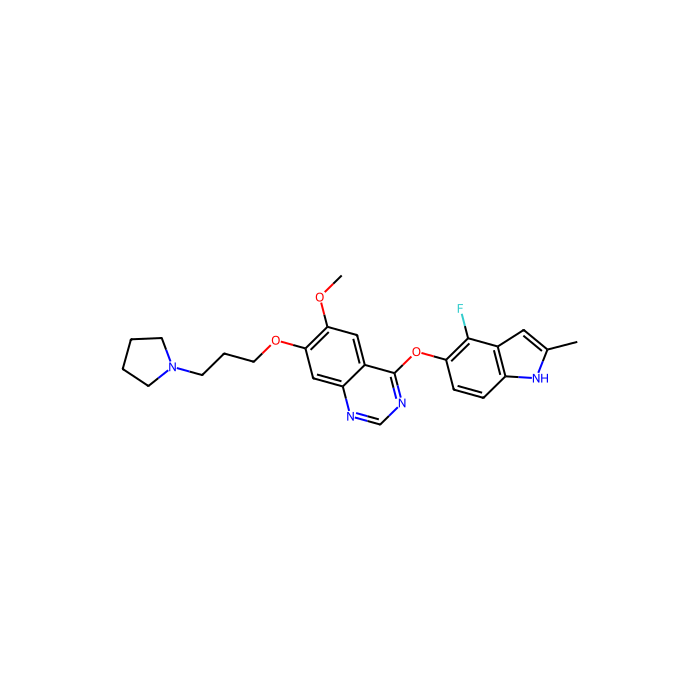
Determine the necessary mass, volume, or concentration for preparing a solution.
| Activity Type | Activity Value -log(M) | Mechanism of Action | Activity Reference | Publications (PubMed IDs) |
|---|
Moligand™, 10mM in DMSO Moligand™ for sensitive chromatographic and analytical workflows requiring minimal baseline interference.
Store at -80°C Ships Dry ice packs + Cold packs Check lot-specific COA for exact specifications.
SDS, COA, datasheet, and spec sheet available for download. Lot-specific COA accessible via lot number lookup.
Cited in 1 peer-reviewed publications across chromatography, organic synthesis, and cross-coupling reactions.
Information
Cediranib (AZD2171, NSC-732208) is a highly potentVEGFR(KDR)inhibitor withIC50of <1 nM, also inhibits Flt1/4 withIC50of 5 nM/≤3 nM, similar activity against c-Kit and PDGFRβ, 36-, 110-fold and >1000-fold selective more for VEGFR than PDGFR-α, CSF-1R and F
In vitro
Cediranib inhibits VEGF-stimulated proliferation with IC50 of 0.4 nM. Cediranib suppresses PDGF-AA with IC50 of 0.04 μM in MG63 cell lines. Cediranib has been shown to block Flt1-associated kinase with IC50 of 5 nM and VEGF-C and VEGF-D receptor Flt-4 with IC50 less than 3 nM. In addition, the IC50 values for inhibition of c-Kit and PDGFRβ tyrosine kinase are 2 nM and 5 nM respectively. Furthermore, no inhibition of enzyme activity is observed when 10 μM Cediranib is assayed with 100 μM ATP against AMPK, Chk1 Akt/PKB and others. Micromolar concentrations of Cediranib are needed to prevent tumor cell proliferation in vitro.
In vivo
Cediranib even suppresses tubule sprouting at subnanomolar concentrations and inhibits VEGF-induced angiogenesis. Cediranib causes hypertrophy in bone growth plate and prevents luteal development in ovary. These are physiological processes that are dependent upon angiogenesis. Cediranib shows broad spectrum activity in human tumor models at doses that are well tolerated. Besides, Cediranib causes regression of vascular tissues in human lung tumor xenografts.
Cell Data
cell lines:NHL, DLBCL, MCL, AML and ALL cell lines
Concentrations:10 μM
Incubation Time:72 hours
Powder Purity:≥97%
| ALogP | 4.9 |
|---|
| Isomeric SMILES | CC1=CC2=C(N1)C=CC(=C2F)OC3=NC=NC4=CC(=C(C=C43)OC)OCCCN5CCCC5 |
|---|---|
| Molecular Weight | 450.52 |
| Reaxy-Rn | 11404252 |
| Reaxys-RN_link_address | https://www.reaxys.com/reaxys/secured/hopinto.do?context=S&query=IDE.XRN=11404252&ln= |
Comprehensive hazard, handling, storage, and regulatory compliance document.
Download SDS →Lot-specific quality data. Enter your lot number to retrieve the exact COA.
Look up COA →Full quality attributes and acceptance criteria for this grade.
View spec sheet →| Activity Type | Activity Value -log(M) | Mechanism of Action | Activity Reference | Publications (PubMed IDs) |
|---|
| Activity Type | Activity Value -log(M) | Mechanism of Action | Activity Reference | Publications (PubMed IDs) |
|---|
| Activity Type | Activity Value -log(M) | Mechanism of Action | Activity Reference | Publications (PubMed IDs) |
|---|
| Activity Type | Activity Value -log(M) | Mechanism of Action | Activity Reference | Publications (PubMed IDs) |
|---|
| Activity Type | Activity Value -log(M) | Mechanism of Action | Activity Reference | Publications (PubMed IDs) |
|---|
| Activity Type | Activity Value -log(M) | Mechanism of Action | Activity Reference | Publications (PubMed IDs) |
|---|
| Activity Type | Activity Value -log(M) | Mechanism of Action | Activity Reference | Publications (PubMed IDs) |
|---|
| Activity Type | Activity Value -log(M) | Mechanism of Action | Activity Reference | Publications (PubMed IDs) |
|---|
| Activity Type | Activity Value -log(M) | Mechanism of Action | Activity Reference | Publications (PubMed IDs) |
|---|
| Activity Type | Activity Value -log(M) | Mechanism of Action | Activity Reference | Publications (PubMed IDs) |
|---|
| Activity Type | Activity Value -log(M) | Mechanism of Action | Activity Reference | Publications (PubMed IDs) |
|---|
| Activity Type | Activity Value -log(M) | Mechanism of Action | Activity Reference | Publications (PubMed IDs) |
|---|
| Activity Type | Activity Value -log(M) | Mechanism of Action | Activity Reference | Publications (PubMed IDs) |
|---|
| Activity Type | Activity Value -log(M) | Mechanism of Action | Activity Reference | Publications (PubMed IDs) |
|---|
| Activity Type | Activity Value -log(M) | Mechanism of Action | Activity Reference | Publications (PubMed IDs) |
|---|
| Activity Type | Activity Value -log(M) | Mechanism of Action | Activity Reference | Publications (PubMed IDs) |
|---|
| Activity Type | Activity Value -log(M) | Mechanism of Action | Activity Reference | Publications (PubMed IDs) |
|---|
Find and download the COA for your product by matching the lot number on the packaging.
| Lot Number | Certificate Type | Date | Item |
|---|---|---|---|
 F2414238 F2414238 | Certificate of Analysis | Apr 29, 2026 | C408684 |
| Solubility | Solubility (25°C) In vitro DMSO: 50 mg/mL (199.01 mM); Water: 25 mg/mL (99.5 mM); Ethanol: 1 mg/mL (3.98 mM); |
|---|
| 1. Sufang Xu, Xin Zhang, Jingru Sun, Man Qin, Huarong Du, Bing Luo. (2026) Macrophage-Derived Transcriptional Signatures Predict Prognosis and Drug Sensitivity in Thyroid Cancer: Integrative Analysis and Experimental Validation of SMYD3. ImmunoTargets and Therapy, [PMID:] [10.2147/ITT.S565624] |
Our grade selection guide covers purity, stabilizer status, and application suitability for all variants in our catalog.
View Moligand™ grade guide →