
Determine the necessary mass, volume, or concentration for preparing a solution.
| Activity Type | Relation | Activity value | Units | Action Type | Journal | PubMed Id | doi | Assay Aladdin ID |
|---|
Application
A versatile fluoride ion source used in a study of ion-specific swelling and de-swelling of ampholytic polymer gels, in the room temperature oxidation of noble metals in HF, and in the measurement of electronic polarizabilities of ions in polymers of alkali halides.
Taxonomy Tree
| Kingdom | Inorganic compounds |
|---|---|
| Superclass | Mixed metal/non-metal compounds |
| Class | Alkali metal salts |
| Subclass | Alkali metal fluorides |
| Intermediate Tree Nodes | Not available |
| Direct Parent | Alkali metal fluorides |
| Alternative Parents | Inorganic salts |
| Molecular Framework | Not available |
| Substituents | Alkali metal fluoride - Inorganic salt |
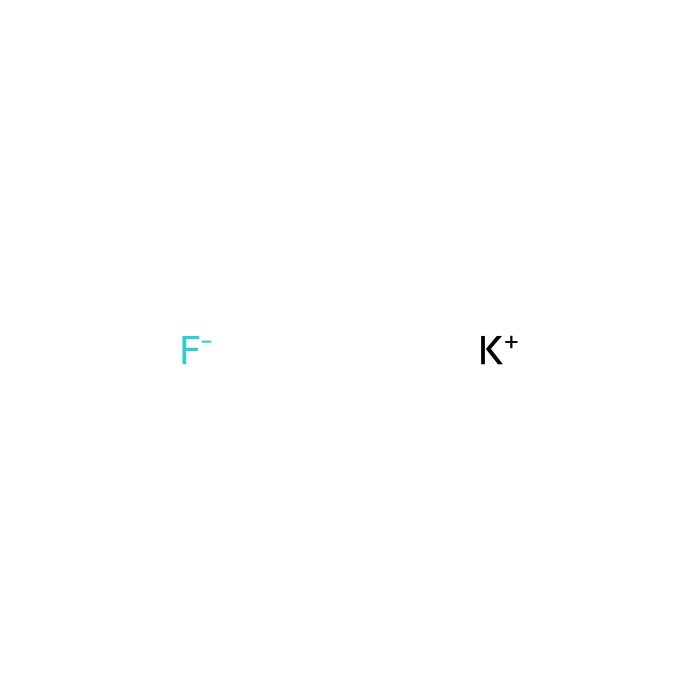
| Description | This compound belongs to the class of inorganic compounds known as alkali metal fluorides. These are inorganic compounds in which the largest halogen atom is fluorine, and the heaviest metal atom is an alkali metal. |
| External Descriptors | fluoride salt - potassium salt |
| Activity Type | Relation | Activity value | Units | Action Type | Journal | PubMed Id | doi | Assay Aladdin ID |
|---|
| Activity Type | Relation | Activity value | Units | Action Type | Journal | PubMed Id | doi | Assay Aladdin ID |
|---|
| Activity Type | Relation | Activity value | Units | Action Type | Journal | PubMed Id | doi | Assay Aladdin ID |
|---|
| Activity Type | Relation | Activity value | Units | Action Type | Journal | PubMed Id | doi | Assay Aladdin ID |
|---|
| Activity Type | Relation | Activity value | Units | Action Type | Journal | PubMed Id | doi | Assay Aladdin ID |
|---|
Find and download the COA for your product by matching the lot number on the packaging.
| Lot Number | Certificate Type | Date | Item |
|---|---|---|---|
 J2626534 | Certificate of Analysis | Sep 28, 2026 | P434123 |
| J2626535 | Certificate of Analysis | Sep 28, 2026 | P434123 |
| J2626537 | Certificate of Analysis | Sep 28, 2026 | P434123 |
| J2626538 | Certificate of Analysis | Sep 28, 2026 | P434123 |
| C2613058 | Certificate of Analysis | Mar 20, 2026 | P434123 |
| C2613061 | Certificate of Analysis | Mar 18, 2026 | P434123 |
| C2613060 | Certificate of Analysis | Mar 14, 2026 | P434123 |
| A2426248 | Certificate of Analysis | Dec 25, 2023 | P434123 |
| A2426249 | Certificate of Analysis | Dec 25, 2023 | P434123 |
| B2418471 | Certificate of Analysis | Dec 25, 2023 | P434123 |
| B2418472 | Certificate of Analysis | Dec 25, 2023 | P434123 |
| B2418473 | Certificate of Analysis | Dec 25, 2023 | P434123 |
| B2418474 | Certificate of Analysis | Dec 25, 2023 | P434123 |
| B2418567 | Certificate of Analysis | Dec 25, 2023 | P434123 |
| B2625211 | Certificate of Analysis | Dec 25, 2023 | P434123 |
| I2524090 | Certificate of Analysis | Dec 25, 2023 | P434123 |
| Sensitivity | Hygroscopic |
|---|---|
| Boil Point | 1505°C |
| Melt Point | 858°C |
| Molecular Weight | 58.1 |
| XLogP3 | |
| Hydrogen Bond Donor Count | 0 |
| Hydrogen Bond Acceptor Count | 1 |
| Rotatable Bond Count | 0 |
| Exact Mass | 57.9621 Da |
| Monoisotopic Mass | 57.9621 Da |
| Topological Polar Surface Area | 0.000 Ų |
| Heavy Atom Count | 2 |
| Formal Charge | 0 |
| Complexity | 2.000 |
| Isotope Atom Count | 0 |
| Defined Atom Stereocenter Count | 0 |
| Undefined Atom Stereocenter Count | 0 |
| Defined Bond Stereocenter Count | 0 |
| Undefined Bond Stereocenter Count | 0 |
| The total count of all stereochemical bonds | 0 |
| Covalently-Bonded Unit Count | 2 |
H318:Causes serious eye damage
H401:Toxic to aquatic life
H301+H311+H331:Toxic if swallowed, in contact with skin or if inhaled
P261:Avoid breathing dust/fume/gas/mist/vapors/spray.
P264:Wash hands [and …] thoroughly after handling.
P270:Do not eat, drink or smoke when using this product.
P271:Use only outdoors or in a well-ventilated area.
P273:Avoid release to the environment.
P280:Wear protective gloves/protective clothing/eye protection/face protection.
P405:Store locked up.
P403+P233:Store in a well-ventilated place. Keep container tightly closed.
P501:Dispose of contents/container to an approved waste disposal plant.
P302+P352+P312:IF ON SKIN: Wash with plenty of water.Call a POISON CENTER/ doctor if you feel unwell.
P301+P310+P330:IF SWALLOWED: Rinse mouth.Immediately call a POISON CENTER/doctor/.
P304+P340+P311:IF INHALED: Remove person to fresh air and keep comfortable for breathing. Call a POISON CENTER/ doctor.
P305+P351+P338+P310:IF IN EYES: Rinse cautiously with water for several minutes. If contact lenses are worn and can be easily removed, remove Contact lenses. Continue rinsing. Immediately call an emergency center/doctor.
Our grade selection guide covers purity, stabilizer status, and application suitability for all variants in our catalog.
View ACS grade guide →