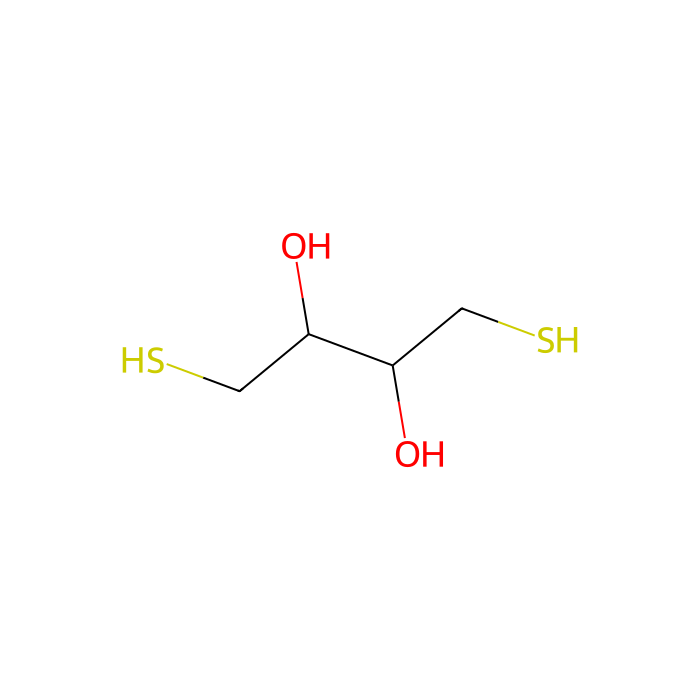
1,4-Dithiothreitol (DTT) - ≥97% , CAS No.3483-12-3

CAS: 3483-12-3 Cat. No.: D265376 Fórmula: C4H10O2S2 Peso molecular: 154.25 Beilstein Registry Number: 1719760 Número EC: 222-468-7
Disponible para pedir
CALIDAD & PUREZA ≥97%
Synonyms
Threitol, 1,4-dithio-, L-|(+/-)-1,4-Dimercapto-2,3-butanediol|2-propylpenten-2-oic Acid|dithio threitol|2,3-Butanediol, 1,4-dimercapto-, (2R,3R)-rel- (9CI)|(+/-)-Dithiothreitol|2,3-BUTANEDIOL, 1,4-DIMERCAPTO-, L-threo-|DTT, 1,4-Dithiothreitol|3,7-Dimethyl-6,7-epoxy-1-(4-ethylphenoxy)-2-octene|WR 34678|(2S,3S)-1,4-DIMERCAPTOBUTANE-2,3-DIOL|1,4-Dithiothreithol|(R-(R*,R*))-1,4-Dimercaptobutane-2,3-diol|DL-1,4-Dithiothreitol|dl-Dithiothreitol|DL-Dithiothreitol; Cleland inverted exclamation mark s reagent|ETHYL4-NITRO-L-PHENYLALANINE|1,4-Dithio-dl-threitol|cis-2,3-Dihydroxy-1,4-butanedithiol|threo-1,4-Dimercapto-2,3-butanediol|DL-Dithiothreitol, powder|Reagents, Cleland's|DTT|DTT, Dithiothreitol (Cleland's Reagenz)|Sputolysin|(2S,3S)-1,4-bis(sulfanyl)butane-2,3-diol|1H-2-Benzoxacyclotetradecin-1-one, 3,4,5,6,7,8,9,10-octahydro-7,14,16-trihydroxy-3-methyl-, (3S,7S)-|D,L-Dithiothreitol (DTT)|(E)-2-(3,7-Dimethylocta-2,6-dien-1-yl)cyclopentan-1-one|Dithiothreitol|Threitol, 1,4-dithio- (7CI,8CI)|Dithiothreitol, biochemical grade|(2S,3S)-1,4-disulfanylbutane-2,3-diol|LUMEFANTRINE [MI]|1,4-Dimercapto-butane-2,3-diol|2,3-Butanediol, 1,4-dimercapto-, (R*,R*)-|1,4-Dithiothreitol|2,3-Butanediol, 1,4-dimercapto-, (R-(R*,R*))-|D-threo-1,4-Dimercapto-2,3-butanediol|DTV|D-Dtt|D-1,4-Dithiothreitol|DTT (threitol derivative)|threo-2,3-Dihydroxy-1,4-butanedithiol|Cleland's reagent
Storage
Store at 2-8°C,Protected from light,Argon charged
Shipped In
Wet ice
★
Talla
USA
Alemania (EU)*
Precio
Cantidad
1g
D265376-1g
Disponible ≥10
—

12,90US$

19,90US$
Guardar 7,00 US$ (35.18%)
5g
D265376-5g
8 Disponible
—

15,90US$

23,90US$
Guardar 8,00 US$ (33.47%)
25g
D265376-25g
Disponible ≥10
—

39,90US$

59,90US$
Guardar 20,00 US$ (33.39%)
100g
D265376-100g
2 Disponible
—

153,90US$

230,90US$
Guardar 77,00 US$ (33.35%)
Enter a quantity for the sizes you want to add.

Descripción general

Overview

Reducing agent

Application

Use 1,4-Dithiothreitol primarily to protect free SH-groups from oxidation. Use it routinely in all work with enzymes and proteins during enzyme measurement and the characterization of proteins.

• As one of the reduction and alkylation reactants of the main allergen αs1-casein in milk.

• As a component of sperm membrane removal and reactivation medium.

•Because mercaptans can effectively protect the active sites of biocatalysts and maintain the stability of enzymes.

• As a reducing agent to test the substitution of N-alkaline maleic substitution and the reaction of excess radicals.

Before SDS-PAGE, DTT can effectively reduce protein disulfide bonds in the sample buffer. Both the irritation and toxicity of DTT are reduced by 2-mercaptoethanol. Usually, the required concentration of DTT (100mM) is used. It uses one-seventh of the concentration of 2-cholesterol-based ethanol (5% v/v, 700 mM).

Benefits

1.Rely on the higher stability of DTT in comparison to 2-mercaptoethanol

in aqueous solution

2.Experience more convenience and a less disagreeable odor

3.Benefit from the reduced tendency to oxidize in air.

Specification

Appearance: White to yellowish crystallizate

DTT (with Ellman's reagent): ≥97%

Thin layer chromatography: Chromatographically homogeneous, corresponds to reference

Stability: At +2 to +8°C within specification range for 24 months. Store dry. Protect from light.

Especificaciones

Sinónimos
Threitol, 1,4-dithio-, L- | (+/-)-1,4-Dimercapto-2,3-butanediol | 2-propylpenten-2-oic Acid | dithio threitol | 2,3-Butanediol, 1,4-dimercapto-, (2R,3R)-rel- (9CI) | (+/-)-Dithiothreitol | 2,3-BUTANEDIOL, 1,4-DIMERCAPTO-, L-threo- | DTT, 1,4-Dithiothreitol | 3,7-Dimethyl-6,7-epoxy-1-(4-ethylphenoxy)-2-octene | WR 34678 | (2S,3S)-1,4-DIMER Show more
Especificaciones y pureza
≥97%
Condiciones de almacenamiento de almacenamiento
Store at 2-8°C,Protected from light,Argon charged
Enviado en
Wet ice
Este producto requiere envío en cadena de frío. Los servicios terrestres y otros servicios económicos no están disponibles.
Pureza
≥97%
Nombres e identificadores
Pubchem Sid
Sonrisas canónicas
O[C@H](CS)[C@H](O)CS
IUPAC Name
(2S,3S)-1,4-bis(sulfanyl)butane-2,3-diol
InChIKey
VHJLVAABSRFDPM-QWWZWVQMSA-N
INCHI
1S/C4H10O2S2/c5-3(1-7)4(6)2-8/h3-8H,1-2H2/t3-,4-/m1/s1
Isómeros SMILES
C([C@H]([C@@H](CS)O)O)S
WGK Alemania
3
RTECS
EK1610000
CAS alternativo
27565-41-9
Peso molecular
154.25
Beilstein
1719760
Reaxy-Rn
9483598
Reaxys-RN_link_address
https://www.reaxys.com/reaxys/secured/hopinto.do?context=S&query=IDE.XRN=9483598&ln=

Datos avanzados

Taxonomic Classification

Taxonomy Tree

KingdomOrganic compounds
SuperclassOrganic oxygen compounds
ClaseOrganooxygen compounds
SubclassAlcohols and polyols
Intermediate Tree Nodes Polyols
Direct Parent1,2-diols
Alternative Parents Secondary alcohols  Alkylthiols  Hydrocarbon derivatives  
Molecular FrameworkAliphatic acyclic compounds
Substituents Secondary alcohol - 1,2-diol - Alkylthiol - Hydrocarbon derivative - Organosulfur compound - Aliphatic acyclic compound
DescripciónThis compound belongs to the class of organic compounds known as 1,2-diols. These are polyols containing an alcohol group at two adjacent positions.
External Descriptors 1,4-dithiothreitol
Estructura 3D
Modelo de Estructura Química Interactiva


Objetivos asociados (no humanos)
Trypanosoma brucei brucei (13300 Activities)
Activity TypeRelationActivity valueUnitsAction TypeJournalPubMed IddoiAssay Aladdin ID
pgaB Poly-beta-1,6-N-acetyl-D-glucosamine N-deacetylase (23 Activities)
Activity TypeRelationActivity valueUnitsAction TypeJournalPubMed IddoiAssay Aladdin ID
Mecanismos de acción
Certificados (CoA, COO, BSE/TSE y tabla de análisis)
C of A & Other Certificates(BSE/TSE, COO):
Analytical Chart:

Find and download the COA for your product by matching the lot number on the packaging.

40 results found

Lot NumberCertificate TypeFechaArticulo
I2618958I2618958Certificate of AnalysisNov 10, 2026 D265376
I2617967I2617967Certificate of AnalysisSep 20, 2026 D265376
A2630512A2630512Certificate of AnalysisFeb 10, 2026 D265376
L2518632L2518632Certificate of AnalysisDec 22, 2025 D265376
L2518631L2518631Certificate of AnalysisDec 22, 2025 D265376
L2518630L2518630Certificate of AnalysisDec 22, 2025 D265376
K2519445K2519445Certificate of AnalysisNov 24, 2025 D265376
F2630036F2630036Certificate of AnalysisNov 24, 2025 D265376
K2519444K2519444Certificate of AnalysisNov 24, 2025 D265376
K2519446K2519446Certificate of AnalysisNov 24, 2025 D265376
K2519447K2519447Certificate of AnalysisNov 24, 2025 D265376
L2523096L2523096Certificate of AnalysisNov 24, 2025 D265376
G2511231G2511231Certificate of AnalysisJul 29, 2025 D265376
G2511236G2511236Certificate of AnalysisJul 29, 2025 D265376
G2511233G2511233Certificate of AnalysisJul 29, 2025 D265376
G2511232G2511232Certificate of AnalysisJul 29, 2025 D265376
L2523101L2523101Certificate of AnalysisJul 29, 2025 D265376
E2528667E2528667Certificate of AnalysisJun 10, 2025 D265376
E2528668E2528668Certificate of AnalysisJun 10, 2025 D265376
E2528677E2528677Certificate of AnalysisJun 10, 2025 D265376
E2528676E2528676Certificate of AnalysisJun 10, 2025 D265376
D2501270D2501270Certificate of AnalysisApr 09, 2025 D265376
D2501271D2501271Certificate of AnalysisApr 09, 2025 D265376
D2501272D2501272Certificate of AnalysisApr 09, 2025 D265376
D2501273D2501273Certificate of AnalysisApr 09, 2025 D265376
F23161082F23161082Certificate of AnalysisApr 02, 2025 D265376
F23161088F23161088Certificate of AnalysisMar 04, 2025 D265376
F23161085F23161085Certificate of AnalysisMar 04, 2025 D265376
K2214043K2214043Certificate of AnalysisAug 21, 2024 D265376
F2210452F2210452Certificate of AnalysisMar 20, 2024 D265376
D2214017D2214017Certificate of AnalysisJan 08, 2024 D265376
L2123446L2123446Certificate of AnalysisOct 09, 2023 D265376
J2422035J2422035Certificate of AnalysisJun 26, 2023 D265376
I2426428I2426428Certificate of AnalysisJun 26, 2023 D265376
F23161084F23161084Certificate of AnalysisJun 26, 2023 D265376
C2307208C2307208Certificate of AnalysisMar 11, 2023 D265376
C2307203C2307203Certificate of AnalysisMar 11, 2023 D265376
K2214042K2214042Certificate of AnalysisNov 19, 2022 D265376
F2210421F2210421Certificate of AnalysisApr 19, 2022 D265376
F2210455F2210455Certificate of AnalysisApr 19, 2022 D265376
Propiedades químicas y físicas
SolubilidadSoluble in water, ethanol, chloroform, diethyl ether, acetone, ether and ethyl acetate
SensibilidadAir & Heat and Moisture Sensitive
Punto de inflamación (°F)235.4 °F
Punto de inflamación (°C)113 °C
Punto de ebullición (°C)125~130°C
Punto de fusión (°C)42-43°C
Peso molecular154.300 g/mol
XLogP3-0.400
Hydrogen Bond Donor Count4
Hydrogen Bond Acceptor Count4
Rotatable Bond Count3
Exact Mass154.012 Da
Monoisotopic Mass154.012 Da
Topological Polar Surface Area42.500 Ų
Heavy Atom Count8
Formal Charge0
Complexity52.000
Isotope Atom Count0
Defined Atom Stereocenter Count2
Undefined Atom Stereocenter Count0
Defined Bond Stereocenter Count0
Undefined Bond Stereocenter Count0
The total count of all stereochemical bonds0
Covalently-Bonded Unit Count1
Preguntas frecuentes y artículos
Surfactant-Free Nuclear Protein Extraction Protocol
2,3-dihydroxy-1,4-dithiolbutane (DTT)
Comparing Guanidine Hydrochloride and Urea for Inclusion-Body Solubilization
Enzyme Protectants and Common Methods to Prolong Enzymatic Activity
Buffer exchange of a sample using a dialysis bag
Difference Between Enzyme Activity and Specific Activity
Common Questions and Answers for SDS-PAGE Experiments
Common Issues for Western Blot (WB)
Common Reducing Agents Used in Protein Experiments
Standard Operating Procedure (SOP) for Bis-Tris Polyacrylamide Gel Electrophoresis (SDS-PAGE)
Common Reagents for Reducing Protein Disulfide Bonds
Buffer Additives to Prevent Protein Precipitation
Common Protectants and Formulations for Protein Storage
Why Did Nickel Agarose Beads Lose Their Color?
Why Did My Ni-Agarose Beads Turn Black or Brown?
Standard Operating Procedure (SOP) for the Protein Tris–Glycine Electrophoresis System
Protein Tris-Tricine Electrophoresis System Standard Operating Procedure
Why Are Nickel Agarose Beads Blue?
How to Optimize Buffer Components for Ni-Agarose Beads
Obtaining soluble and biologically active recombinant proteins from inclusion bodies
Differences Between Transformation and Transfection
Eight Common Lysis Buffers
How to Choose the Best Protein Purification Technique
FAQ on Molecular Interaction Assays
His-Tagged Protein Purification
GST-Tagged Protein Purification
What is Ion Exchange Chromatography Used For? 4 Important Applications for Protein Purification
Principles and Application Strategies of Common PCR Enhancers
His-Tag Protein Purification: Common Troubleshooting Questions and Practical Solutions
Photo-Crosslinking and Patterning of PEG-Based Hydrogels (2D/3D): Principles, Method Comparisons, and Product Selection Guidelines
How to Purify Proteins by Ion-Exchange Chromatography Under Denaturing Condition
Electrophoretic Mobility Shift Assay (EMSA) Standard Operating Procedure (SOP)
Technical Analysis and Application Guide for RNase Inhibitors
A Practical Guide to Small-Molecule Chemical Probes: Concept Clarification, Causal Validation, and Experimental Selection (with Product Navigation and Tables A–D)
Laccase: Technical Characteristics, Optimization Strategies, and Industrial Application Progress
Endoproteinase Lys-C: Mechanism, Applications, and Method-Control Considerations for Lysine-Specific Digestion
A Review of Ten Commonly Used Techniques for Detection, Quantification, and Interaction Analysis in Nucleic Acid Research
Self-Assembled Monolayers (SAMs): Selection & Methodology Process Window and Verification/Troubleshooting Along the Alkanethiol/Au Route (with Selection Guide and Product Tables 1–3)
Plant Omics Panorama: Workflow Frameworks and Multi-Omics Integration from Genomics to Transcriptomics, Proteomics, and Metabolomics
Glutathione (GSH) Quantification: Method Systems, Experimental Workflows, and Key Quality-Control Considerations
Haptoglobin (Hp): A Key Carrier in the Free Hemoglobin Clearance–Detoxification Axis, with Assays and Applications
RNA Extraction Technologies: Method Systems, Operational Workflows, and Key Quality-Control Considerations
Glutathione Reductase: A Flavin-Dependent Reductive System Maintaining GSH/GSSG Homeostasis, with Assays and Applications
EMSA PAGE Precast Gels: Principle Alignment, Performance Advantages, and Application Scenarios
Chymosin: A Review of Molecular Features, Coagulation Kinetics, and Activity Evaluation
Bromelain: Enzymological Properties and Key Points for Food, Pharmaceutical, and Industrial Applications
Whey Protein: Composition Profile, Manufacturing Routes, and Key Product-Type Essentials
Review of Chymotrypsin: Enzymological Properties, Catalytic Mechanism, and Research Applications
Review of Glucose-6-phosphate Dehydrogenase (G6PD): Structural Features, Metabolic Functions, and Research Applications
Glutaraldehyde-mediated Microbial Inactivation: Chemical Mechanisms, Determinants, and Key Validation Considerations
Clostridial Proteases: Classification, Molecular Mechanisms, and Research Applications
Invertebrate Oxygen Carrier Proteins in Immunology and Vaccine Research
Methodological Studies on Glycoprotein Structural Characterization and Quality Attribute Analysis
Research Framework for Multi-Enzyme Digestion Strategies and Optimization of Proteomic Coverage
Decision Logic for Peptide Synthesis Routes: Applicability and Criteria for Choosing among SPPS, LPPS, and Recombinant Expression
Thiol and Disulfide Status in Biological Samples: Detection Methods and Applications
Experimental Judgment in mRNA In Vitro Transcription: Template Design, 5′ Capping, and dsRNA Control
Protein Structure Analysis: An Experimental Path from Defining the Question to Functional Validation
From Functional Groups to Experimental Decision-Making: Protein Crosslinker Selection and Experimental Essentials
How Degradable Poly(ethylene glycol) Hydrogels Build Tunable Cellular Microenvironments: Adhesion, Degradation, Release, and Experimental Interpretation in 2D/3D Culture
Designing Hydrogel Scaffolds as Programmable Cell Microenvironments: From Click-Chemistry Functionalization to 3D Cell Culture Experimental Design
What Is Synthetic Biology? The Industrialization Pathway from Upstream Reagent Toolchains to Biomanufacturing Applications
Common Reducing Agents in Antibody–Drug Conjugates (ADCs)
What Is “Plant Collagen”? Distinguishing Ingredient Types, Structural Differences, Production Methods, and Skincare Effects
ERAD, ER-phagy, and Cell-Fate Regulation of Misfolded Proteins Under Endoplasmic Reticulum Stress
Route Selection for Thiol Synthesis: C–S Bond Construction, Sulfur Source Forms, and Thiol Release
Differences Between Animal-Derived Collagen and Recombinant Collagen in Skincare: Sequence and Structure, Safety, Skin Effects, and Evidence Evaluation
Why Proximity to Cysteine Does Not Necessarily Lead to Covalent Bond Formation: Warhead Reactivity, Reaction Geometry, and Target-Site Microenvironment
Citations of This Product
Calculadoras de soluciones
Reseñas

Reseñas de cliente

¿Quieres que te enviemos un mensaje cuando tengamos descuentos disponibles?

Recordármelo más tarde

¡Gracias! Por favor, revisa tu bandeja de entrada de correo electrónico para confirmar.

¡Vaya! Las notificaciones están desactivadas.