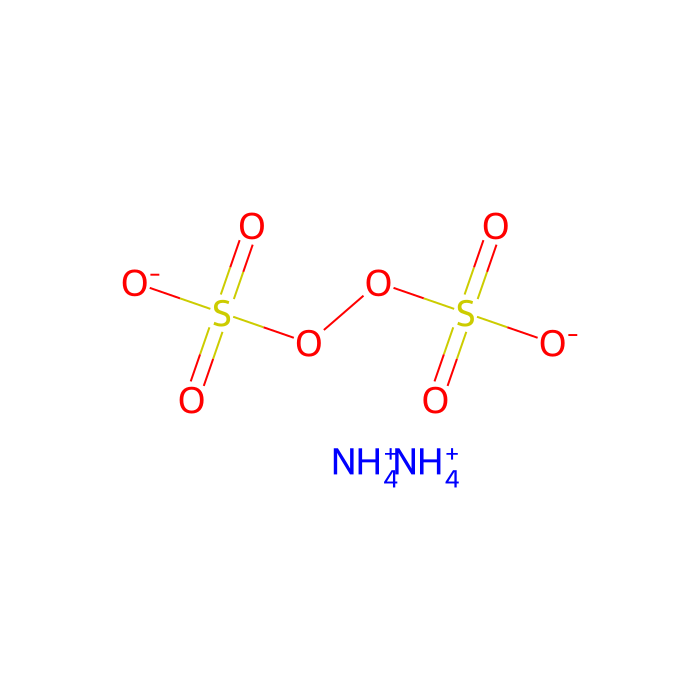
Ammonium persulfate(APS) - Suitable for molecular biology, ≥98% , CAS No.7727-54-0

CAS: 7727-54-0 Cat. No.: A112451 Formula: H8N2O8S2 Molecular Weight: 228.20 EC Number: 231-786-5
AVAILABLE TO ORDER
GRADE & PURITY Suitable for molecular biology ? Molecular-biology grade — free of nucleases and contaminants that degrade DNA/RNA. Use in cloning, PCR, and nucleic-acid work needing clean reagents. ≥98%
Synonyms
AMMONIUM PEROXYDISULFATE [MI] | CCRIS 1430 | ammonium persuiphate | diammonium [(sulfonatoperoxy)sulfonyl]oxidanide | UNII-22QF6L357F | ammonium persulphate-d8 | DTXSID9029691 | Ammonium persulfate [UN1444] [Oxidizer] | Diammonium peroxydisulfate | Bis(A
Storage
Protected from light,Room temperature
Shipped In
FedEx DG Service
★
Size
USA
Germany (EU)*
Price
Qty
25g
A112451-25g
5 In stock
—

$33.90

$38.90
Save $5.00 (12.85%)
100g
A112451-100g
5 In stock
—
$83.90
Enter a quantity for the sizes you want to add.
🧪
Why this grade

Suitable for molecular biology, ≥98% Suitable for molecular biology for sensitive chromatographic and analytical workflows requiring minimal baseline interference.

🌡

Storage & shipping

Protected from light,Room temperature Ships FedEx DG Service Check lot-specific COA for exact specifications.

📋

Quality documents

SDS, COA, datasheet, and spec sheet available for download. Lot-specific COA accessible via lot number lookup.

📚

Literature proof

Cited in 3122 peer-reviewed publications across chromatography, organic synthesis, and cross-coupling reactions.

Overview

Odorless. Completely decomposes at 120°C. When completely dry, it can be stored for a long time without decomposing. It is not easily hygroscopic, but after absorbing moisture, it gradually decomposes, releasing oxygen and ozone. Heating causes it to decompose into oxygen, forming (NH4)2S2O7. A strong oxidizing agent. Easily soluble in water, its aqueous solution is acidic. It gradually decomposes at room temperature, and rapidly decomposes at higher temperatures, releasing oxygen and forming ammonium bisulfate. Used as an oxidizing agent in the detection and determination of manganese and in the analysis of iron and steel.

Specifications

Synonyms
AMMONIUM PEROXYDISULFATE [MI] | CCRIS 1430 | ammonium persuiphate | diammonium [(sulfonatoperoxy)sulfonyl]oxidanide | UNII-22QF6L357F | ammonium persulphate-d8 | DTXSID9029691 | Ammonium persulfate [UN1444] [Oxidizer] | Diammonium peroxydisulfate | Bis(A
Specifications & Purity
Suitable for molecular biology, ≥98%
Storage
Protected from light,Room temperature
Shipped In
FedEx DG Service
Grade
Suitable for molecular biology
Purity
≥98%
Names and Identifiers
Pubchem Sid
Pubchem Sid Url
https://pubchem.ncbi.nlm.nih.gov/substance/504753860
Canonical Smiles
[NH4+].[NH4+].[O-]S(=O)(=O)OOS(=O)(=O)[O-]
IUPAC Name
diazanium;sulfonatooxy sulfate
InChIKey
ROOXNKNUYICQNP-UHFFFAOYSA-N
INCHI
1S/2H3N.H2O8S2/c;;1-9(2,3)7-8-10(4,5)6/h2*1H3;(H,1,2,3)(H,4,5,6)
Isomeric SMILES
[NH4+].[NH4+].[O-]S(=O)(=O)OOS(=O)(=O)[O-]
WGK Germany
1
RTECS
SE0350000
UN Number
1444
Packing Group
III
Molecular Weight
228.20
Reaxy-Rn
11343687
Reaxys-RN_link_address
https://www.reaxys.com/reaxys/secured/hopinto.do?context=S&query=IDE.XRN=11343687&ln=

Documentation

📋 Safety Data Sheet (SDS)

Comprehensive hazard, handling, storage, and regulatory compliance document.

Download SDS →

✅ Certificate of Analysis (COA)

Lot-specific quality data. Enter your lot number to retrieve the exact COA.

Look up COA →

📊 Datasheet

Quick-reference summary of product specifications and applications.

View datasheet →

🔬 Specification Sheet

Full quality attributes and acceptance criteria for this grade.

View spec sheet →

Advanced Data

Taxonomic Classification

Taxonomy Tree

KingdomInorganic compounds
SuperclassHomogeneous non-metal compounds
ClassNon-metal oxoanionic compounds
SubclassNon-metal peroxodisulfates
Intermediate Tree Nodes Not available
Direct ParentNon-metal peroxodisulfates
Alternative Parents Inorganic salts  Inorganic oxides  
Molecular FrameworkNot available
Substituents Non-metal peroxodisulfate - Inorganic oxide - Inorganic salt
DescriptionThis compound belongs to the class of inorganic compounds known as non-metal peroxodisulfates. These are inorganic non-metallic compounds containing a peroxodisulfate as its largest oxoanion.
External Descriptors Not available
3D Structure
Interactive Chemical Structure Model


Certificates(CoA,COO,BSE/TSE and Analysis Chart)
C of A & Other Certificates(BSE/TSE, COO):
Analytical Chart:

Find and download the COA for your product by matching the lot number on the packaging.

18 results found

Lot NumberCertificate TypeDateItem
G2621440Certificate of AnalysisJul 16, 2026 A112451
G2607281Certificate of AnalysisMay 14, 2026 A112451
G2607280Certificate of AnalysisMay 14, 2026 A112451
F2601248Certificate of AnalysisMay 14, 2026 A112451
L2509435Certificate of AnalysisDec 03, 2025 A112451
L2509434Certificate of AnalysisDec 03, 2025 A112451
D2623780Certificate of AnalysisDec 03, 2025 A112451
A2408152Certificate of AnalysisOct 11, 2025 A112451
I2510192Certificate of AnalysisJul 26, 2025 A112451
I2510195Certificate of AnalysisJul 26, 2025 A112451
G2502135Certificate of AnalysisMay 29, 2025 A112451
I2116166Certificate of AnalysisMar 05, 2025 A112451
B2525158Certificate of AnalysisFeb 12, 2025 A112451
B2525142Certificate of AnalysisFeb 12, 2025 A112451
J2429325Certificate of AnalysisOct 22, 2024 A112451
J2429348Certificate of AnalysisOct 22, 2024 A112451
A2506548Certificate of AnalysisOct 22, 2024 A112451
I2116165Certificate of AnalysisJun 14, 2023 A112451
Chemical and Physical Properties
SolubilityWater solubility::580 g/L soluble (20 °C)
SensitivityLight sensitive.
Refractive Index1.5
Melt Point(°C)120°C
Molecular Weight228.210 g/mol
XLogP3
Hydrogen Bond Donor Count2
Hydrogen Bond Acceptor Count8
Rotatable Bond Count1
Exact Mass227.972 Da
Monoisotopic Mass227.972 Da
Topological Polar Surface Area152.000 Ų
Heavy Atom Count12
Formal Charge0
Complexity206.000
Isotope Atom Count0
Defined Atom Stereocenter Count0
Undefined Atom Stereocenter Count0
Defined Bond Stereocenter Count0
Undefined Bond Stereocenter Count0
The total count of all stereochemical bonds0
Covalently-Bonded Unit Count3
Documents & Articles
Nucleic Acid Electrophoresis Workflow—5 Main Steps
Ammonium peroxydisulfate
Method and Precautions of SDS-PAGE Gel Preparation
Molecular Biology Grade
Radical Initiator Selection Guide
Standard Operating Procedure (SOP) for Bis-Tris Polyacrylamide Gel Electrophoresis (SDS-PAGE)
Protein Tris-Acetate Electrophoresis System Standard Operating Procedure
Standard Operating Procedure (SOP) for the Protein Tris–Glycine Electrophoresis System
Protein Tris-Tricine Electrophoresis System Standard Operating Procedure
Fundamentals and Applications of Etching Solutions: Using Metallic Copper / PCB Etching as an Example
Electrophoretic Mobility Shift Assay (EMSA) Standard Operating Procedure (SOP)
Materials Can “Switch”: How Smart Polymers Respond to Temperature, pH, and Light (with Experimental Selection Tips & Product Navigation)
A Review of Ten Commonly Used Techniques for Detection, Quantification, and Interaction Analysis in Nucleic Acid Research
EMSA PAGE Precast Gels: Principle Alignment, Performance Advantages, and Application Scenarios
Chymosin: A Review of Molecular Features, Coagulation Kinetics, and Activity Evaluation
Experimental Judgment and Condition Selection for Visible-Light Catalysis in Organic Synthesis
Structural and Performance Design of Acrylic Resins for Coatings: Monomer Composition, Key Parameters, and Film Formation/Curing Mechanisms
From Natural Cellulose to Nanocrystals: Structural Characteristics, Application Directions, and Industrialization Challenges of CNC
Vinyl Acetate-Acrylic Emulsion (Vinyl Acrylic Emulsion): A Cost-Performance Balance Solution for Architectural Coatings
PVAc, VAE, and Vinyl Acetate-Based Emulsions: Film-Forming Logic and Performance Boundaries in Architectural Coatings
How to Select Vinyl-Related Resins: Building Formulation Judgment Based on Substrate, Performance Targets, and Failure Risks
Waterborne Resin Technology Explained: Waterborne Forms, Performance Balance, and a Technology Map
What Is an Etchant? Etching Mechanisms for Revealing Metallographic Microstructures, Selection Methods, and Applications of Related Wet-Etching Reagents
Citations of This Product
Solution Calculators
Reviews

Customer Reviews

Need help choosing the grade?

Our grade selection guide covers purity, stabilizer status, and application suitability for all variants in our catalog.

View Suitable for molecular biology grade guide →

Shall we send you a message when we have discounts available?

Remind me later

Thank you! Please check your email inbox to confirm.

Oops! Notifications are disabled.