Integrin beta 3/CD61 Mouse mAb (APC) - Primary antibody, specific to Integrin beta 3

Cat. No.: Ab186829
AVAILABLE TO ORDER
GRADE & PURITY ExactAb™ ? ExactAb™ — Aladdin's antibody line emphasizing precision and validated quality. Use for reliable, specificity-validated antibody applications. Validated ? Validated grade — performance confirmed in defined applications before release. Use when you want documented assurance the reagent works as stated. 5 μL/test
Application
Flow Cytometry
Host species
Mouse
Reactive species
Human
Isotype
Mouse IgG1
Clone Number
HIP11
Conjugation
APC
★
Size
USA
Germany (EU)*
Price
Qty
10T
Ab186829-10T
US Made to order · 2–4 wks ·
—
$91.90
25T
Ab186829-25T
US Made to order · 2–4 wks ·
—
$183.90
100T
Ab186829-100T
US Made to order · 2–4 wks ·
—
$453.90
Enter a quantity for the sizes you want to add.

Overview

Mouse anti Human Integrin beta 3/CD61 Antibody, Monoclonal (HIP11), could be used for Flow Cytometry.

Specifications

Product Name
Integrin beta 3/CD61 Mouse mAb (APC) - Primary antibody, specific to Integrin beta 3
Synonyms
BDPLT2|GPIIIa|GT|GT2|CD61 antigen|CD61|GP3A|GP3Aplatelet glycoprotein IIIa|GPIIIaintegrin beta-3|INGRB3|Integrin beta 3|integrin, beta 3 (platelet glycoprotein IIIa, antigen CD61)|ITG B3|ITGB3|Platelet membrane glycoprotein IIIa|BDPLT16 antibody|BDPLT2 antibody|CD 61 antibody|CD61 antibody|CD61 antigen antibody|GP3A antibody|GPIIIa antibody|GT antibody|HPA 1 antibody|HPA 4 antibody|Integrin beta 3 (platelet glycoprotein IIIa antigen CD61) antibody|Integrin beta chain beta 3 antibody|Integrin beta-3 antibody|ITG B3 antibody|ITGB 3 antibody|ITGB3 antibody|NAIT antibody|platelet fibrinogen receptor antibody|Platelet fibrinogen receptor beta subunit antibody|Platelet fibrinogen receptor, beta subunit antibody|Platelet glycoprotein IIIa antibody|Platelet glycoprotein IIIa precursor antibody|Platelet membrane glycoprotein IIIa antibody|PTP antibody
Specifications & Purity
ExactAb™, Validated, 5 μL/test
Biochemical and Physiological Mechanisms
Integrin alpha-V/beta-3 is a receptor for cytotactin, fibronectin, laminin, matrix metalloproteinase-2, osteopontin, osteomodulin, prothrombin, thrombospondin, vitronectin and von Willebrand factor. Integrin alpha-IIb/beta-3 is a receptor for fibronectin, fibrinogen, plasminogen, prothrombin, thrombospondin and vitronectin. Integrins alpha-IIb/beta-3 and alpha-V/beta-3 recognize the sequence R-G-D in a wide array of ligands. Integrin alpha-IIb/beta-3 recognizes the sequence H-H-L-G-G-G-A-K-Q-A-G-D-V in fibrinogen gamma chain. Following activation integrin alpha-IIb/beta-3 brings about platelet/platelet interaction through binding of soluble fibrinogen. This step leads to rapid platelet aggregation which physically plugs ruptured endothelial surface. In case of HIV-1 infection, the interaction with extracellular viral Tat protein seems to enhance angiogenesis in Kaposi's sarcoma lesions.
Host species
Mouse
Specificity
Integrin beta 3
Immunogen
Normal peripheral blood platelets and platelets from IPT patients
Positive Control
Flow Cytometry: human peripheral blood platelets
Conjugation
APC
Excitation (nm)
Red Laser(633nm)
Emission(nm)
660nm
Ex/Em(nm)
Ex:650nm;Em:660nm
Grade
ExactAb™, Validated
Light Chain Type
kappa
Purification Method
Protein A purified
Concentration
5 μL/test
Product Line
Biological Products
Storage and Shipping
Storage
Store at 2-8°C,Protected from light,Do not freeze
Shipped In
Wet ice,Do not freeze
Stability And Storage
The antibody solution should be stored undiluted between 2°C and 8°C, and protected from prolonged exposure to light. Do not freeze.
Images

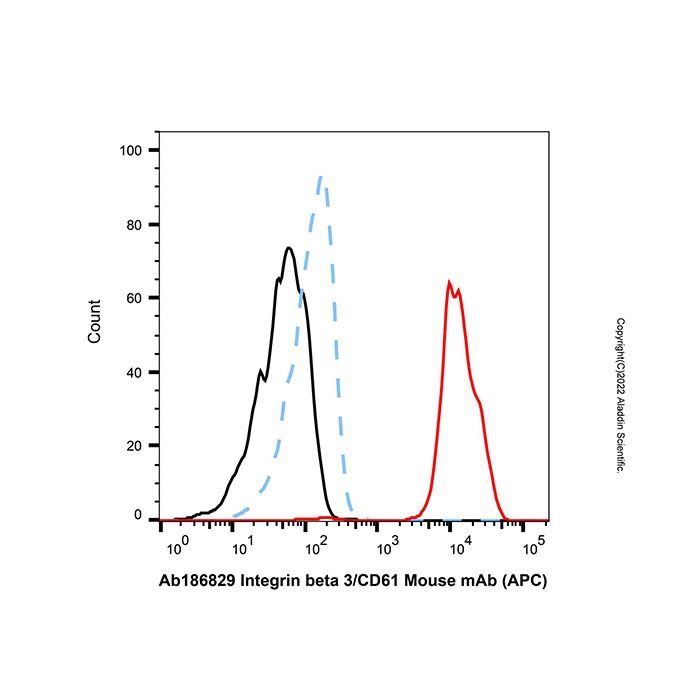
Integrin beta 3/CD61 Mouse mAb (APC) (Ab186829) - Flow Cytometry
Flow cytometry analysis of Integrin beta 3/CD61 expression by human peripheral blood platelets (red) compared to an isotype control (blue). Cells were stained with  Integrin beta 3/CD61 Mouse mAb (APC) (Ab186829) at 0.1μg/test for 1 hour at 4°C. Blue - Mouse IgG (APC) (Ab180309). Black - Unlabelled control, cells without incubation with primary antibody.

Application
Application
Dilution info
Flow Cytometry

5μl/test

For flow cytometric staining, the suggested use of this reagent is 5 µL per million cells in 100 µL staining volume or 5 µL per 100 µL of whole blood. 

Advanced Data

Associated Targets(Human)
ITGB3 Tclin Integrin beta-3 (0 Activities)
Activity TypeActivity Value -log(M)Mechanism of ActionActivity ReferencePublications (PubMed IDs)
Certificates (CoA,COO,BSE/TSE and Analysis Chart)
C of A & Other Certificates(BSE/TSE, COO):
Analytical Chart:

Find and download the COA for your product by matching the lot number on the packaging.

3 results found

Lot NumberCertificate TypeDateItem
ZJ25F0421019ZJ25F0421019Certificate of AnalysisFeb 24, 2026 Ab186829
ZJ25F0421020ZJ25F0421020Certificate of AnalysisFeb 24, 2026 Ab186829
ZJ25F0421021ZJ25F0421021Certificate of AnalysisFeb 24, 2026 Ab186829
Solution Calculators
Reviews

Customer Reviews

Application Protocols

Tested applications, recommended working dilutions, and specific protocols are Not specified for this item; refer to CoA/Spec Sheet.

General reminders when working with APC-conjugated antibodies (non item-specific):

  • Perform all steps protected from light to preserve APC fluorescence.
  • Use appropriate controls (unstained, single‑stained, FMO) for panel compensation and gating.
  • Validate fixation/permeabilization to ensure APC signal retention.
  • Calibrate instruments for far‑red detection (e.g., 633–640 nm laser, 660/20 nm bandpass, as applicable).

Follow your laboratory’s validated SOPs and consult the CoA/Spec Sheet for any item-specific recommendations.

Biological Roles

Target overview (literature; not product specifications):

  • Integrin beta 3 (ITGB3, CD61) pairs with α subunits (notably αIIb to form αIIbβ3 on platelets and αV to form αVβ3 on various cell types). These heterodimeric receptors mediate cell adhesion to extracellular matrix proteins (e.g., fibrinogen, vitronectin) and regulate outside‑in/inside‑out signaling.
  • Physiological roles: Platelet aggregation, clot retraction, osteoclast function, angiogenesis, and cell migration. ITGB3 participates in cytoskeletal reorganization via talin/kindlin engagement and downstream kinases.
  • Expression: High on platelets and megakaryocytes (αIIbβ3), broader distribution for αVβ3 on endothelial cells, osteoclasts, and some tumor-derived lines.
  • Ligand recognition: RGD motif–containing ligands are prototypical binders for β3-containing integrins.

Research implications (general; no clinical claims):

  • Flow cytometric phenotyping of platelet activation (e.g., conformational state changes using specific antibodies),
  • Adhesion/migration assays to study integrin signaling pathways,
  • Receptor occupancy and panel design for immunophenotyping in hematology and vascular biology.

Item-specific data such as clone epitope, affinity (KD), and species cross-reactivity are Not specified for this item; refer to CoA/Spec Sheet.

Buffer Applications

Not typically applicable as a buffering agent. This product is an antibody–APC conjugate intended for immunoassays rather than pH control.

Practical notes (general):

  • Use standard isotonic buffers (e.g., PBS, TBS) with suitable protein carriers (e.g., 0.5–2% BSA) to minimize nonspecific binding during staining, provided such excipients are compatible with your assay.
  • Avoid buffers containing high concentrations of detergents or organic solvents that can diminish APC fluorescence.

Any item-specific buffer formulation or recommended diluents are Not specified for this item; refer to CoA/Spec Sheet.

Green Alternatives

As an aqueous biological reagent, this antibody–APC conjugate already avoids common volatile organic solvents used in chemical synthesis.

Greener practices (general recommendations):

  • Aqueous systems: Prepare dilutions in phosphate- or tris-buffered saline rather than solvent-based media.
  • Minimize waste: Optimize staining volumes and panel design to reduce reagent consumption and plastic disposables.
  • Energy efficiency: Store at 2–8°C as specified; avoid unnecessary ultra-cold storage or repeated chilling cycles.
  • Safer fixatives: When fixation is necessary, consider neutral buffered formalin alternatives validated for APC preservation or use lower-toxicity crosslinkers where feasible.
  • Detergents: Use mild, biodegradable surfactants (e.g., saponin) instead of harsher solvents during permeabilization, provided they are validated with APC.

Comparison (general; not product-specific):

  • APC vs synthetic dyes: APC offers high brightness but is more light-/denaturation-sensitive. Synthetic far‑red dyes may be more solvent/chemical robust but can involve less sustainable manufacturing. Choice should balance panel performance, stability, and environmental footprint.
Pharmaceutical Uses

Not for clinical, diagnostic, or therapeutic use.

Research/formulation context (general):

  • Intended use: For research use only, e.g., analytical flow cytometry, immunostaining, or assay development in non-clinical settings.
  • Excipient considerations: Antibody formulations may include stabilizers (e.g., proteins, sugars, salts, preservatives) to maintain stability during refrigerated storage; specifics are Not specified for this item; refer to CoA/Spec Sheet.
  • Regulatory status: No pharmacopeial monograph is implied for this research reagent.

Any application in GMP/clinical workflows would require separate qualification and is outside the scope of this product’s intended use.

Physical Properties

Item-specific physicochemical specifications are not provided for this antibody conjugate.

Item-specific:

  • Form, concentration, buffer, pH, excipients: Not specified for this item; refer to CoA/Spec Sheet.
  • Molecular weight: Not specified for this item; refer to CoA/Spec Sheet.

Literature/general values (for context; not product specifications):

  • IgG mass (literature): Unconjugated IgG ≈ 150 kDa; APC conjugation increases apparent mass depending on labeling density.
  • APC properties (literature): Peak excitation/emission ~650/660–675 nm; large Stokes shift; strong absorbance in the red region. APC is sensitive to photobleaching and denaturation by organic solvents or extremes of pH.
  • Appearance (typical): Clear to slightly opalescent protein solution; APC imparts a deep red color (not specified for this item).
  • Solubility (general): Readily soluble in aqueous buffers; incompatible with high percentages of organic solvents.

Key practical implications:

  • Protect from light to preserve APC fluorescence.
  • Avoid surfactant or low-pH conditions that can denature APC or the antibody unless validated.

Where exact numeric values are required for your method validation (e.g., degree of labeling, protein concentration, buffer composition), please consult the product’s CoA/Spec Sheet.

Quality & Grades
  • Grade/Purity (item-specific): ExactAb™, Validated.
  • What this implies (general guidance):
    • ExactAb™ (general): Denotes a rigorously characterized monoclonal antibody with consistent lot-to-lot performance, typically including identity verification, purity assessment, and performance validation in relevant immunoassays. Specific test panels and acceptance criteria are Not specified for this item; refer to CoA/Spec Sheet.
    • Validated (general): Indicates that functional performance has been confirmed in one or more application(s) under defined conditions. Exact validated applications, species reactivity, and recommended dilutions are Not specified for this item; refer to CoA/Spec Sheet.
  • Conjugate quality considerations (general):
    • Fluor-to-protein (F/P) ratio: Optimal F/P maintains brightness without quenching or impairing antigen binding. Exact value Not specified for this item.
    • Purity: Typically assessed by SEC/HPLC or SDS‑PAGE to confirm monomeric content and low aggregates; specific thresholds Not specified for this item.
    • Binding specificity: Determined against ITGB3/CD61; clone, epitope, and cross-reactivity data Not specified for this item.

For method qualification, request the batch-specific CoA/Spec Sheet for details on concentration, buffer composition, preservatives, F/P ratio, and validated applications.

Reaction & Applications

Not a small-molecule reagent; classical synthetic reactions (e.g., Grignard, cross-coupling) are not applicable.

Research application context (general guidance for CD61 APC-conjugated mAbs; not item-specific performance claims):

  • Flow cytometry: APC provides bright far‑red fluorescence compatible with common 633–640 nm lasers; useful for profiling ITGB3/CD61 expression on platelets, megakaryocytes, and certain leukocyte subsets.
  • Immunofluorescence (IF): Suitable for detecting surface ITGB3 in fixed or live cells when fixation/permeabilization is fluor-compatible.
  • Imaging cytometry and high-content screening: Far‑red emission reduces spectral overlap with FITC/PE channels.

Item-specific validated applications, recommended dilutions, and positive control suggestions are Not specified for this item; refer to CoA/Spec Sheet.

Reaction Conditions

Not applicable to chemical reaction conditions. This antibody–APC conjugate is used under biological assay conditions.

Assay conditions (general guidance; not item-specific):

  • Flow cytometry: Typical staining at 4°C or room temperature for 15–30 min in the dark, followed by washing in PBS/BSA. Exact dilutions and incubation conditions for this item are Not specified; refer to CoA/Spec Sheet.
  • IF/Imaging: Validate fixation/permeabilization protocols for APC retention (avoid methanol when possible). Incubate in the dark to prevent photobleaching.

Always optimize conditions empirically for cell type, antigen density, and instrument configuration.

Safety & Handling
  • GHS classification, signal word, H‑statements, pictograms (item-specific): Not specified for this item; refer to SDS.
  • Primary hazards (general for antibody–APC conjugates): Low acute toxicity expected for protein reagents. APC fluorochrome is light‑sensitive; prolonged illumination can reduce performance. Preservatives (if present; not specified) may have associated hazards.
  • PPE: Laboratory coat, gloves (nitrile), and safety glasses are recommended. Use aseptic technique to avoid microbial contamination of protein solutions.
  • Engineering controls: Handle under low-light conditions; use amber tubes or foil wrap to minimize photobleaching. Work in a clean area to prevent contamination.
  • Incompatibilities: Avoid strong oxidizers, proteases, extreme pH (<5 or >9 unless validated), high salt/chaotropic agents, and organic solvents that can denature proteins and APC.
  • First aid (general guidance): In case of skin/eye contact, rinse with water. If inhaled (aerosol), move to fresh air. If ingested, rinse mouth with water. Seek medical attention as appropriate. Always follow your institution’s EHS procedures.
  • Spill response: Absorb with inert material, clean with detergent and water. Dispose of according to local regulations.

Always defer to the product’s SDS and your institutional risk assessment for authoritative safety information.

Solvent Selection

This product is an aqueous antibody–APC conjugate; organic solvent selection is not typically applicable.

  • Matrix (item-specific): Not specified; antibodies are generally supplied in buffered aqueous solutions. Refer to CoA/Spec Sheet.
  • General compatibility (literature):
    • Prefer neutral pH aqueous buffers (e.g., PBS, TBS) for dilution and staining.
    • Avoid or minimize organic cosolvents (e.g., DMSO, methanol, acetone), which can denature proteins and quench APC fluorescence.
    • If fixation/permeabilization is required, validate with antibody- and fluor-compatible reagents (e.g., formaldehyde fixation followed by saponin-based permeabilization), as alcohols can diminish APC signal.
  • Light protection: Use amber vials and protect from strong light throughout sample preparation.

If your workflow mandates special media (e.g., serum-free buffers, protein blockers), verify compatibility empirically. For exact buffer composition and recommended diluents for this item, consult the CoA/Spec Sheet.

Storage & Reconstitution

Item-specific storage and shipping:

  • Storage conditions (item-specific): Store at 2–8°C. Protect from light. Do not freeze.
  • Shipped in (item-specific): Wet ice. Do not freeze during shipment.

Additional handling guidance (general):

  • Keep vial tightly capped; minimize time at ambient temperature. Avoid repeated temperature cycling.
  • Do not expose to strong light; use amber vials or wrap in foil when not in use.
  • If provided as a liquid (form not specified), mix gently by inversion; avoid vortexing to limit aggregation.
  • If lyophilized (not specified), follow the CoA/Spec Sheet for reconstitution solvent, volume, and stabilization additives.
  • Maintain sterility to prevent microbial growth in aqueous protein solutions.

Not specified for this item; refer to CoA/Spec Sheet:

  • Formulation buffer and pH
  • Protein concentration and preservative (if any)
  • Appearance
  • Reconstitution instructions (if applicable)

Always record first‑use date and track on‑bench time to preserve performance over the product’s lifetime.

Structure & Identity

This product is a fluorophore-conjugated monoclonal antibody reagent for research use.

  • Product name (item-specific): Integrin beta 3/CD61 Mouse mAb (APC)
  • SKU (item-specific): Ab186829
  • Antibody class (item-specific): Mouse monoclonal antibody (mAb)
  • Conjugate (item-specific): APC (Allophycocyanin)
  • Target antigen (item-specific): Integrin beta 3 (CD61; ITGB3)
  • Grade/Purity (item-specific): ExactAb™, Validated
  • Molecular formula, MW, SMILES, InChIKey (item-specific): Not applicable to antibody conjugates; Not specified for this item; refer to CoA/Spec Sheet.

Structural description (general knowledge):

  • Antibody architecture (literature): Typical IgG molecules are Y‑shaped glycoproteins composed of two heavy and two light chains with antigen-binding variable domains at the Fab arms and an Fc domain mediating effector functions.
  • Fluorophore (literature): APC is a phycobiliprotein complex with multiple bilin chromophores, exhibiting strong far‑red fluorescence and high quantum yield; it is covalently coupled to antibody lysines via activated linkers.
  • 2D description in words (general): A globular IgG protein scaffold bearing multiple APC chromophores attached on solvent-accessible lysine side chains; antigen-binding paratopes at the tips of the Fab regions recognize epitopes on human/mammalian ITGB3/CD61.

Notes:

  • Any clone designation, isotype, species reactivity panel, and exact degree of labeling (F/P ratio) are Not specified for this item; refer to CoA/Spec Sheet.
Synthetic Utility

Not applicable. This is a biological affinity reagent (monoclonal antibody conjugated to APC), not a synthetic building block or catalyst.

For researchers planning conjugation or panel assembly (general guidance):

  • Ensure compatibility of co‑stained fluorophores to minimize spectral overlap with APC (far‑red channel).
  • If secondary modifications (e.g., biotinylation) are desired, verify that additional conjugation steps do not impair APC fluorescence or antigen binding. Such modifications are not part of this item.
Target Specificity

Item-specific information available from the product name:

  • Antigen/Target: Integrin beta 3 (CD61; ITGB3)
  • Antibody type: Mouse monoclonal antibody (mAb)
  • Conjugate: APC (Allophycocyanin)

Not specified for this item; refer to CoA/Spec Sheet:

  • Clone designation and epitope mapping
  • Isotype/subclass
  • Species reactivity and cross-reactivity profile
  • Affinity (KD) and blocking/neutralizing capabilities
  • Validated applications and positive control tissues/cell lines

Use this tab to match your biological system (species/cell type) once the CoA/Spec Sheet details are reviewed.

Frequently Asked Questions

What does ExactAb? mean?
ExactAb? indicates the product has been validated for use in rigorous antibody validation workflows. Validation may include positive/negative control samples, signal-to-noise testing, and protocol-specific QC. Lot-specific test data is published on the Certificate of Analysis where available.
What does Validated mean?
Validated indicates the product has been validated for use in rigorous antibody validation workflows. Validation may include positive/negative control samples, signal-to-noise testing, and protocol-specific QC. Lot-specific test data is published on the Certificate of Analysis where available.
How should this product be stored?
Store at 2–8 °C, protected from light. Do not freeze. Freezing may cause irreversible damage to this material.
How is this product shipped?
This product ships chilled on wet ice. Unpack on arrival and transfer it to the storage condition stated above.
What documentation is provided?
Available product documentation, including Certificates of Analysis (COA), Safety Data Sheets (SDS), and specification sheets, is shown in the product document area. Document availability and access follow the current site policy.
Which species reactivity has this antibody been validated against?
Validated reactivity is listed on the PDP and on each lot's datasheet. We validate against the most commonly tested species for the target (Integrin beta 3/CD61 Mouse mAb (APC)); cross-reactivity in untested species may exist but is not guaranteed. Contact technical support for specific species inquiries.

Need help choosing the grade?

Our grade selection guide covers purity, stabilizer status, and application suitability for all variants in our catalog.

View Validated grade guide → View ExactAb™ grade guide →

Related Products

Goat Anti-Mouse IgG H&L Antibody - Secondary antibody, for ELISA,LF,GICA various applications, from Mouse, generated in Goat
Goat Anti-Mouse IgG H&L (HRP) - Secondary antibody, for WB,ELISA,IHC-P various applications, from Mouse, generated in Goat, IgG
Mouse IgG - Isotype Control Antibody, generated in Rat, >95%, IgG
Rabbit Anti-Mouse IgG H&L (HRP) - Secondary antibody, IgG
BALB/c Mouse IgG - Isotype Control Antibody, IgG
Rabbit Anti-Mouse IgG antibody - Secondary antibody
Goat Anti-Mouse IgG H&L (FITC) - Secondary antibody
Goat Anti-Mouse IgG H&L (TRITC) - Secondary antibody
Goat Anti-Mouse IgG H&L Antibody - Secondary antibody, Goat IgG
Goat Anti-Mouse IgG H&L (Cy5) - Secondary antibody
Goat Anti-Mouse IgG H&L (HRP) - Secondary antibody
Goat Anti-Mouse IgG H&L (Biotin) - Secondary antibody
Rabbit Anti-Mouse IgG (HRP) - Secondary antibody
Rabbit Anti-Mouse IgG (Biotin) - Secondary antibody
Goat Anti-Mouse IgG H&L (HRP) - Secondary antibody, Goat IgG
Goat Anti-Mouse IgG H&L (TRITC) - Secondary antibody, Goat IgG
Goat Anti-Mouse IgG H&L (Biotin) - Secondary antibody, Goat IgG
Goat Anti-Mouse IgG H&L (FITC) - Secondary antibody, Goat IgG
Goat Anti-Mouse IgG H&L (Cy5) - Secondary antibody, Goat IgG
Goat Anti-Mouse IgG H&L (PE) - Secondary antibody, Goat IgG
Goat Anti-Mouse IgG H&L (APC) - Secondary antibody, Goat IgG
Mouse IgG (Biotin) - Isotype Control Antibody, Mouse IgG
Integrin beta 3/CD61 Mouse mAb - Primary antibody, specific to Integrin beta 3, Mouse IgG1
Mouse IgG (PE) - Isotype Control Antibody, Mouse IgG
Mouse IgG (APC) - Isotype Control Antibody, Mouse IgG
Mouse IgG (FITC) - Isotype Control Antibody, Mouse IgG
Mouse IgG2a-Fc - Isotype Control Antibody, Mouse IgG2a
Goat Anti-Mouse IgG H&L (Alkaline Phosphatase) - Secondary antibody, Goat IgG
Goat Anti-Mouse IgG H&L (AF405) - Secondary antibody, Goat IgG
Goat Anti-Mouse IgG H&L (AF647) - Secondary antibody, Goat IgG
Mouse IgG2b-kappa, anti-Spike RBD - Isotype Control Antibody, specific to Spike RBD, Mouse IgG2b
Mouse IgG2a-kappa, anti-Spike RBD - Isotype Control Antibody, specific to Spike RBD, Mouse IgG2a
Mouse IgG3-kappa, anti-HEL - Isotype Control Antibody, specific to HEL, Mouse IgG3
Mouse IgG2c-kappa, anti-HEL - Isotype Control Antibody, specific to HEL, Mouse IgG2c
Mouse lgG2A(D265A)-kappa, anti-HEL - Isotype Control Antibody, specific to HEL, Mouse IgG2a(D265A)
Mouse IgG1(D265A)-kappa, anti-HEL - Isotype Control Antibody, specific to HEL, Mouse IgG1(D265A)
Mouse IgG (AF488) - Isotype Control Antibody, IgG
Mouse IgG (PerCP) - Isotype Control Antibody, IgG
Mouse IgG (AF405) - Isotype Control Antibody, IgG
Mouse IgG (AF647) - Isotype Control Antibody, IgG
Goat Anti-Mouse IgG H&L (AF555) - Secondary antibody, specific to Mouse IgG, Goat IgG
Mouse IgG (AF700) - Isotype Control Antibody, IgG
Goat Anti-Mouse IgG H&L (AF700) - Secondary antibody, specific to Mouse IgG, Goat IgG
Mouse IgG (PE-Cy5) - Isotype Control Antibody
Mouse IgG (PE-Cy7) - Isotype Control Antibody
Mouse IgG2b-kappa, anti-E8L - Isotype Control Antibody, specific to E8L
Mouse IgG2a-kappa, anti-A29L - Isotype Control Antibody, specific to A29L
Mouse IgG2c-kappa (AF647), anti-HEL - Isotype Control Antibody, specific to HEL
Mouse IgG2c-kappa (AF700), anti-HEL - Isotype Control Antibody, specific to HEL
Mouse IgG2c-kappa (AF405), anti-HEL - Isotype Control Antibody, specific to HEL
Mouse IgG2c-kappa (Biotin), anti-HEL - Isotype Control Antibody, specific to HEL
Mouse IgG2a-kappa (APC), anti-Spike RBD - Isotype Control Antibody, specific to Spike RBD
Mouse IgG2a-kappa (FITC), anti-Spike RBD - Isotype Control Antibody, specific to Spike RBD
Mouse IgG2a-kappa (AF700), anti-Spike RBD - Isotype Control Antibody, specific to Spike RBD
Mouse IgG2a-kappa (AF647), anti-Spike RBD - Isotype Control Antibody, specific to Spike RBD
Mouse IgG2a-kappa (AF555), anti-Spike RBD - Isotype Control Antibody, specific to Spike RBD
Mouse IgG2a-kappa (AF405), anti-Spike RBD - Isotype Control Antibody, specific to Spike RBD
Mouse IgG2c-kappa (FITC), anti-HEL - Isotype Control Antibody, specific to HEL
Mouse IgG2c-kappa (AF555), anti-HEL - Isotype Control Antibody, specific to HEL
Mouse IgG2c-kappa (APC), anti-HEL - Isotype Control Antibody, specific to HEL
Mouse IgG2c-kappa (PE), anti-HEL - Isotype Control Antibody, specific to HEL
Mouse IgG2a-kappa (Biotin), anti-Spike RBD - Isotype Control Antibody, specific to Spike RBD
Mouse IgG2a-Fc (Biotin) - Isotype Control Antibody
Mouse IgG2a-Fc (FITC) - Isotype Control Antibody
Mouse IgG (AF555) - Isotype Control Antibody
Mouse IgG2b-kappa (Biotin), anti-Spike RBD - Isotype Control Antibody, specific to Spike RBD
Mouse IgG2b-kappa (FITC), anti-Spike RBD - Isotype Control Antibody, specific to Spike RBD
Mouse IgG2b-kappa (APC), anti-Spike RBD - Isotype Control Antibody, specific to Spike RBD
Mouse IgG2b-kappa (APC-Cy7), anti-Spike RBD - Isotype Control Antibody, specific to Spike RBD
Integrin beta 3/CD61 Mouse mAb (Biotin) - Primary antibody, specific to Integrin beta 3
Integrin beta 3/CD61 Mouse mAb (FITC) - Primary antibody, specific to Integrin beta 3
Goat Anti-Mouse IgG H&L (PE-Cy5) - Secondary antibody, specific to Mouse IgG
Centrose patent anti-dysadherin (anti-Dysadherin) - Primary antibody, specific to FXYD5
Mouse IgG2a-kappa (AF405), anti-A29L - Isotype Control Antibody, specific to A29L
Mouse IgG2a-kappa (AF488), anti-A29L - Isotype Control Antibody, specific to A29L
Mouse IgG2a-kappa (AF647), anti-A29L - Isotype Control Antibody, specific to A29L
Mouse IgG2a-kappa (AF700), anti-A29L - Isotype Control Antibody, specific to A29L
Mouse IgG2a-kappa (Biotin), anti-A29L - Isotype Control Antibody, specific to A29L
Mouse IgG2a-kappa (FITC), anti-A29L - Isotype Control Antibody, specific to A29L
Mouse IgG3-kappa (Biotin), anti-HEL - Isotype Control Antibody, specific to HEL
Mouse IgG3-kappa (FITC), anti-HEL - Isotype Control Antibody, specific to HEL
Mouse IgG3-kappa (PE), anti-HEL - Isotype Control Antibody, specific to HEL
Mouse IgG3-kappa (AF488), anti-HEL - Isotype Control Antibody, specific to HEL
Mouse IgG3-kappa (APC), anti-HEL - Isotype Control Antibody, specific to HEL
Mouse IgG3-kappa (AF647), anti-HEL - Isotype Control Antibody, specific to HEL
Mouse IgG2b-kappa (AF555), anti-Spike RBD - Isotype Control Antibody, specific to Spike RBD
Goat Anti-Mouse IgG H&L (AF488) - Secondary antibody
Goat Anti-Mouse IgG H&L (PE-Cy7) - Secondary antibody
Mouse IgG (PE-Cy5.5) - Isotype Control Antibody
Goat Anti-Mouse IgG H&L (AF750) - Secondary antibody
Mouse IgG2a-kappa (AF555), anti-A29L - Isotype Control Antibody, specific to A29L
Mouse IgG2a-kappa (PE-Cy5.5), anti-A29L - Isotype Control Antibody, specific to A29L
Goat Anti-Mouse IgG H&L (AF546) - Secondary antibody
Goat Anti-Mouse IgG H&L (Oregon Green 488) - Secondary antibody
Goat Anti-Mouse IgG H&L (Cy3) - Secondary antibody
Mouse IgG2a-kappa (APC), anti-A29L - Isotype Control Antibody, specific to A29L
Mouse IgG3-kappa (AF555), anti-HEL - Isotype Control Antibody, specific to HEL
Mouse IgG (PE-AF647) - Isotype Control Antibody

Shall we send you a message when we have discounts available?

Remind me later

Thank you! Please check your email inbox to confirm.

Oops! Notifications are disabled.