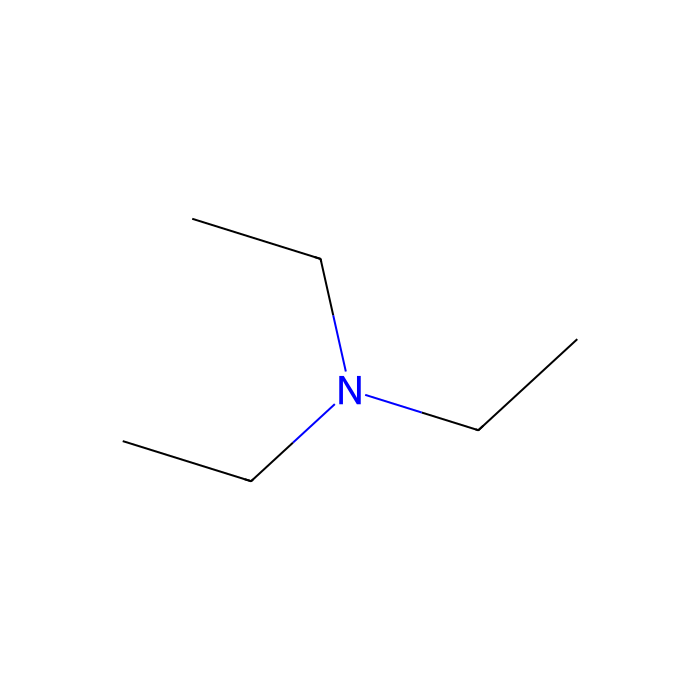
Triethylamine - Ultra pure, ≥99.5%(GC) , CAS No.121-44-8

CAS: 121-44-8 Cat. No.: T103290 Formula: C6H15N Molecular Weight: 101.19 Beilstein Registry Number: 605283 EC Number: 204-469-4
AVAILABLE TO ORDER
GRADE & PURITY Ultra pure ? Ultra-pure grade with very low impurity content across the board. Use for trace analysis, electronics, or processes intolerant of contamination. ≥99.5%(GC)
Synonyms
triethyl amin | Triethylamine, for protein sequence analysis, ampule, >=99.5% (GC) | Triethylamine, United States Pharmacopeia (USP) Reference Standard | EINECS 204-469-4 | N,N-Diethylethanamine | N,N-diethyl-ethanamine | triehyl amine | TRIETHYLAMINE [MI
Storage
Protected from light,Room temperature,Argon charged
Shipped In
FedEx DG Service
★
Size
USA
Germany (EU)*
Price
Qty
100ml
T103290-100ml
3 In stock
—
$44.90
250ml
T103290-250ml
2 In stock
—
$89.90
Enter a quantity for the sizes you want to add.
🧪
Why this grade

Ultra pure, ≥99.5%(GC) Ultra pure for sensitive chromatographic and analytical workflows requiring minimal baseline interference.

🌡

Storage & shipping

Protected from light,Room temperature,Argon charged Ships FedEx DG Service Check lot-specific COA for exact specifications.

📋

Quality documents

SDS, COA, datasheet, and spec sheet available for download. Lot-specific COA accessible via lot number lookup.

📚

Literature proof

Cited in 2626 peer-reviewed publications across chromatography, organic synthesis, and cross-coupling reactions.

Overview

Triethylamine is a tertiary amine. It has been reported as a promising precipitating reagent for phosphomolybdic acid.Et3N/formic acid system has been used for the asymmetric transfer hydrogenation (ATH) of methoxy-substituted derivatives.
Triethylamine is a strong base and precipitating agent widely used in Heck reaction and to prepare esters and amides from acyl chlorides.

Application

Triethylamine may be used in the following studies:
As a base for the Heck reactions.
Synthesis of spirocycles via Heck cyclization.
Preparation of triethylammonium picrate and 0.1M triethylamine hydrochloride.

Specifications

Synonyms
triethyl amin | Triethylamine, for protein sequence analysis, ampule, >=99.5% (GC) | Triethylamine, United States Pharmacopeia (USP) Reference Standard | EINECS 204-469-4 | N,N-Diethylethanamine | N,N-diethyl-ethanamine | triehyl amine | TRIETHYLAMINE [MI
Specifications & Purity
Ultra pure, ≥99.5%(GC)
Storage
Protected from light,Room temperature,Argon charged
Shipped In
FedEx DG Service
Grade
Ultra pure
Purity
≥99.5%(GC)
Names and Identifiers
Pubchem Sid508811448
Pubchem Sid Urlhttps://pubchem.ncbi.nlm.nih.gov/substance/508811448
Canonical SmilesCCN(CC)CC
IUPAC NameN,N-diethylethanamine
InChIKeyZMANZCXQSJIPKH-UHFFFAOYSA-N
INCHI1S/C6H15N/c1-4-7(5-2)6-3/h4-6H2,1-3H3
Isomeric SMILES CCN(CC)CC
WGK Germany 1
RTECS YE0175000
UN Number 1296
Packing Group II
Molecular Weight 101.19
Beilstein 605283

Documentation

📋 Safety Data Sheet (SDS)

Comprehensive hazard, handling, storage, and regulatory compliance document.

Download SDS →

✅ Certificate of Analysis (COA)

Lot-specific quality data. Enter your lot number to retrieve the exact COA.

Look up COA →

📊 Datasheet

Quick-reference summary of product specifications and applications.

View datasheet →

🔬 Specification Sheet

Full quality attributes and acceptance criteria for this grade.

View spec sheet →

Advanced Data

Taxonomic Classification

Taxonomy Tree

KingdomOrganic compounds
SuperclassOrganic nitrogen compounds
ClassOrganonitrogen compounds
SubclassAmines
Intermediate Tree Nodes Tertiary amines
Direct ParentTrialkylamines
Alternative Parents Organopnictogen compounds  Hydrocarbon derivatives  
Molecular FrameworkAliphatic acyclic compounds
Substituents Tertiary aliphatic amine - Organopnictogen compound - Hydrocarbon derivative - Aliphatic acyclic compound
DescriptionThis compound belongs to the class of organic compounds known as trialkylamines. These are organic compounds containing a trialkylamine group, characterized by exactly three alkyl groups bonded to the amino nitrogen.
External Descriptors tertiary amine
3D Structure
Interactive Chemical Structure Model


Mechanisms of Action
Certificates(CoA,COO,BSE/TSE and Analysis Chart)
C of A & Other Certificates(BSE/TSE, COO):
Analytical Chart:

Find and download the COA for your product by matching the lot number on the packaging.

33 results found

Lot NumberCertificate TypeDateItem
K2513590Certificate of AnalysisAug 04, 2026 T103290
G2631616Certificate of AnalysisJul 25, 2026 T103290
G2631615Certificate of AnalysisJul 25, 2026 T103290
G2631614Certificate of AnalysisJul 25, 2026 T103290
G2311344Certificate of AnalysisJul 03, 2026 T103290
G2311303Certificate of AnalysisJul 03, 2026 T103290
F2623456Certificate of AnalysisMay 20, 2026 T103290
F2623455Certificate of AnalysisMay 20, 2026 T103290
F2623444Certificate of AnalysisMay 20, 2026 T103290
E2619458Certificate of AnalysisMay 12, 2026 T103290
E2619459Certificate of AnalysisMay 12, 2026 T103290
E2619460Certificate of AnalysisMay 12, 2026 T103290
A2627627Certificate of AnalysisJan 23, 2026 T103290
A2627626Certificate of AnalysisJan 23, 2026 T103290
A2627628Certificate of AnalysisJan 23, 2026 T103290
K2513589Certificate of AnalysisNov 07, 2025 T103290
K2513584Certificate of AnalysisNov 07, 2025 T103290
E2512448Certificate of AnalysisMar 26, 2025 T103290
E2512447Certificate of AnalysisMar 26, 2025 T103290
G2313571Certificate of AnalysisJan 15, 2025 T103290
J2408757Certificate of AnalysisSep 24, 2024 T103290
J2408690Certificate of AnalysisSep 24, 2024 T103290
J2408695Certificate of AnalysisSep 24, 2024 T103290
H2422096Certificate of AnalysisAug 24, 2024 T103290
F2425196Certificate of AnalysisJul 19, 2024 T103290
F2429033Certificate of AnalysisJul 19, 2024 T103290
F2429156Certificate of AnalysisJul 19, 2024 T103290
B2223505Certificate of AnalysisDec 12, 2022 T103290
L2128094Certificate of AnalysisOct 20, 2022 T103290
K2210102Certificate of AnalysisSep 22, 2022 T103290
K2210103Certificate of AnalysisSep 22, 2022 T103290
K2210104Certificate of AnalysisSep 22, 2022 T103290
B2223491Certificate of AnalysisMar 02, 2022 T103290
Chemical and Physical Properties
SensitivityLight sensitive;Air sensitive
Refractive Index1.4003
Flash Point(°F)12.2 °F
Flash Point(°C)-11 °C
Boil Point(°C)89~90°C
Melt Point(°C)-115°C
Molecular Weight101.190 g/mol
XLogP31.400
Hydrogen Bond Donor Count0
Hydrogen Bond Acceptor Count1
Rotatable Bond Count3
Exact Mass101.12 Da
Monoisotopic Mass101.12 Da
Topological Polar Surface Area3.200 Ų
Heavy Atom Count7
Formal Charge0
Complexity25.700
Isotope Atom Count0
Defined Atom Stereocenter Count0
Undefined Atom Stereocenter Count0
Defined Bond Stereocenter Count0
Undefined Bond Stereocenter Count0
The total count of all stereochemical bonds0
Covalently-Bonded Unit Count1
Documents & Articles
Biological buffer: the unusual amongst the usual
A Complete Guide to Ion-Pair Reversed-Phase Chromatography (IPC / IP-RP): Mechanisms, Four Tuning Knobs, Troubleshooting, and Ion-Pair Reagent Families (Tables 1–4)
Installing a Redox Switch on Biomolecules: Principles, Conjugation Essentials, and an Application Guide for ATTO MB2 NHS ester
OSF/ASF Dual-Channel Toolbox: Divergent Reactions of Four-Membered Ring Sulfonyl Fluorides, Condition “Knobs,” and Selection Navigation
Secondary Effects Behind Chromatographic Peak Tailing and Unstable Peak Shapes: How Residual Silanols (Si–OH) Affect Basic Compounds, and the Shortest Troubleshooting/Remediation Path (with Product Navigation and Tables 1–3)
Make “Aryl Chlorides + Low Pd Loading + Scale-Up Reproducibility” Reliable: The Initiation and Durability Logic of Pd–NHC (Palladium–N-Heterocyclic Carbene) Cross-Coupling (with Selection Navigation and Product Tables)
Understanding ATD-DMAP: From Reagent Design to Esterification, Amidation, and Stereochemical Integrity
Understanding Cbz (Benzyloxycarbonyl): Selection Logic and Practical Value of a Classical Amino Protecting Group
Reconsidering N-Acyl Amino Protecting Groups: Deprotection Differences, Strategic Roles, and Experimental Selection of Ac, Bz, and Tfa
Selective Deprotection and Sulfonyl Group Migration of N-Aryl Sulfonamides Mediated by TfOH (Trifluoromethanesulfonic Acid): Reaction Patterns and Synthetic Implications
The Positioning of TBTU in Practice: Racemization Risk, Extended Uses, and Selection Criteria
The Methodological Value of Boc-Oxyma: Low-Racemization Coupling, Route Continuity, and Extended Applications
The Methodological Value of DSC: Building NHS-Type Activated Intermediates and Deciding When to Use Them
The Methodological Value of TPS-Cl: The Logic of Selective Activation and Representative Transformations in Nucleoside and Nucleotide Chemistry
The Methodological Value of TCFH: Advantages in Challenging Amidation and the Switching Logic of Carboxylic Acid Activation Pathways
Low-Racemization Control in Peptide Synthesis: An Inverse N→C Peptide Synthesis Strategy via Activated α-Aminoesters
Decision Logic for Selecting Coupling Reagents in Amide Bond Formation: Activation Pathways, Side Reactions, Epimerization, Workup, and Safety
Experimental Selection Logic for Carboxylic Acid Preactivation Pathways: Differences and Suitable Use Cases for Classical Mixed Anhydrides, CDI, Sulfonyl Chloride Systems, and the Yamaguchi System
Triphenylphosphine Dibromide (PPh₃Br₂) Is More Than Just a Brominating Reagent: Experimental Selection Logic from Alcohol-to-Alkyl Bromide Conversion to Carboxylic Acid Activation and One-Pot Esterification, Vinyl Bromide Formation, and Nitrile Constructi
Reaction Roles of DBU in Different Systems: Experimental Judgment from a Strong Organic Base to Nucleophilic Catalysis and Participation in the Reaction Pathway
Selection Logic for the Teoc Amino Protecting Group: From Fluoride-Triggered Deprotection to Orthogonal Protecting-Group Design
Boc₂O Selection Cannot Be Judged by Protection Installation Alone: Experimental Decision-Making from Substrate Nucleophilicity and Medium Effects to Deprotection Pathways
DMAP Is More Than Just an Organic Base: Experimental Judgment from Nucleophilic Acyl Transfer to Esterification and Macrolactonization
Experimental Decision-Making for Introducing Aminoalkyl Side Chains Using N-Haloalkyl Phthalimides: Chain Length, Leaving Group, and Deprotection Choice
Experimental Evaluation of Triphosgene in Organic Synthesis: Understanding Its Selection Logic Through Reaction Tasks
4-[(tert-Butyldimethylsilyl)oxy]butan-1-ol: Experimental Selection Logic as a Monoprotected 1,4-Butanediol Building Block and a Protected C4 Linker
Triphenylphosphine-Involved Carboxylic Acid Activation and Amide Bond Formation: Activation Pathways, Anhydride Competition, and Applicability Scenarios
Experimental Considerations for the Use of ADMP in the Conversion of Primary Amines to Organic Azides: Substrate Nucleophilicity, Base Matching, and Medium Selection
Experimental Judgment for CMPI in Carboxylic Acid Activation: Applicable Tasks, Base Matching, and Workup Burden
Experimental Judgment for TFPN in Carboxylic Acid Activation: Suitable Scenarios, Intermediate Distribution, and Nucleophile Compatibility
Experimental Judgment and Condition Selection for Visible-Light Catalysis in Organic Synthesis
Adding a Temperature-Triggered Switch to NCO: How Blocked Isocyanates Affect the Storage, Curing, and Film Performance of 1K Baking Coatings
1K, 2K, Waterborne, Moisture-Curing, and Blocked Systems: Classification Logic and Identification Methods for Polyurethane Coating Curing Systems
Failure Mechanisms, Application Limitations, and Systematic Improvement Directions for Polyester Coatings
How to Troubleshoot Abnormal Impurities in Peptide Synthesis? Locating Process Issues Through Amino-Related Side Reactions
Polyurethane Coating Resins: Not a Single Resin, but a Designable High-Performance System
Application of Shellac, a Natural Film-Forming Resin, in Coatings: Alcohol-Soluble Fast-Drying Film Formation, Sealing and Repair, and Performance Boundaries
Cashew Nut Shell Liquid (CNSL): From Cashew Processing By-Product to Reactive Bio-Based Raw Material for Coating Resins
Waterborne Resin Technology Explained: Waterborne Forms, Performance Balance, and a Technology Map
Resin Polarity in Coating Formulations: From Molecular Structure to Dissolution, Compatibility, Interfacial Interactions, and Formulation Design
AITF-Mediated Carboxylic Acid Activation for the Synthesis of Amides, Peptides, and Esters: Activation Mechanism and Applicable Scenarios
Stabilization Design of Bridgehead α-Fluoroamines and Their Value as Medicinal Chemistry Building Blocks
CTSOBt Benzotriazole–Sulfonate Coupling Reagent: Carboxylic Acid Activation and Synthetic Application Value
Strain Release of Azatricycloalkanes: Modular Bridge-Position Functionalization and Stereochemical Control of Three-Dimensional Bridged Aza Scaffolds
Sulfonyl Hydrazide-Mediated Introduction of Small C(sp³) Fragments: Nickel-Catalyzed Cross-Coupling, Medicinal Chemistry Applications, and Reagent Selection
Medicinal Chemistry Design of the Indazole Scaffold: Tautomerism, Molecular Recognition, Substitution-Site Design, and Synthetic Strategies
Build the Three-Membered Ring First, or Form the Carbon–Nitrogen Bond First?—Retrosynthetic Strategies, Route Selection, and Stereochemical Control in Cyclopropylamine Synthesis
3,3-Spiro-α-Proline Building Blocks: Structural Features, Complementary Synthetic Routes, and Multigram-Scale Preparation
Activation of Carboxylic Acids by TFSP and Related Triflylpyridinium Reagents: Conversion to Aldehydes, Amides, Esters, and Oxazoles via Acylpyridinium Intermediates
Citations of This Product
Solution Calculators
Reviews

Customer Reviews

Need help choosing the grade?

Our grade selection guide covers purity, stabilizer status, and application suitability for all variants in our catalog.

View Ultra pure grade guide →

Shall we send you a message when we have discounts available?

Remind me later

Thank you! Please check your email inbox to confirm.

Oops! Notifications are disabled.