
Piperazine Selection Guide: Using a “Six-Membered Diaza Ring” to Make Salt Forms and Linking Strategies More Controllable (Appendix Tables 1–4 Product Navigator)
Piperazine Selection Guide: Using a “Six-Membered Diaza Ring” to Make Salt Forms and Linking Strategies More Controllable (Appendix Tables 1–4 Product Navigator)
1.Why do you keep seeing “piperazine” in R&D?
Many R&D programs run into similar bottlenecks at comparable stages:
1. Uncontrollable solubility and salt forms: The compound has decent activity, but aqueous solubility and/or salt form stability is poor, making formulation, dosage forms, or in vivo exposure difficult to reproduce consistently.
2. You want to introduce a “protonatable center” without rebuilding the core scaffold: You want higher hydrophilicity or a different distribution profile, but changing the core scaffold is costly and risky.
3. You need a reliable linking platform: You want to connect two structural pieces in a tidy, modular way (linker/coupling/side-chain installation), while keeping the synthetic route reproducible and scalable.
Piperazine is often prioritized because a single small ring simultaneously delivers two capabilities:
1. Protonatable → easy to form salts → a more designable solubility window;
2. Two nitrogens in a 1,4-relationship → a natural “two-exit” connectivity motif, making it convenient to connect two fragments in a well-organized manner.
2.What is piperazine (also called “Hujiaoqin” in Chinese)? What does “piperazines” refer to?
2.1 Piperazine is a well-defined parent scaffold
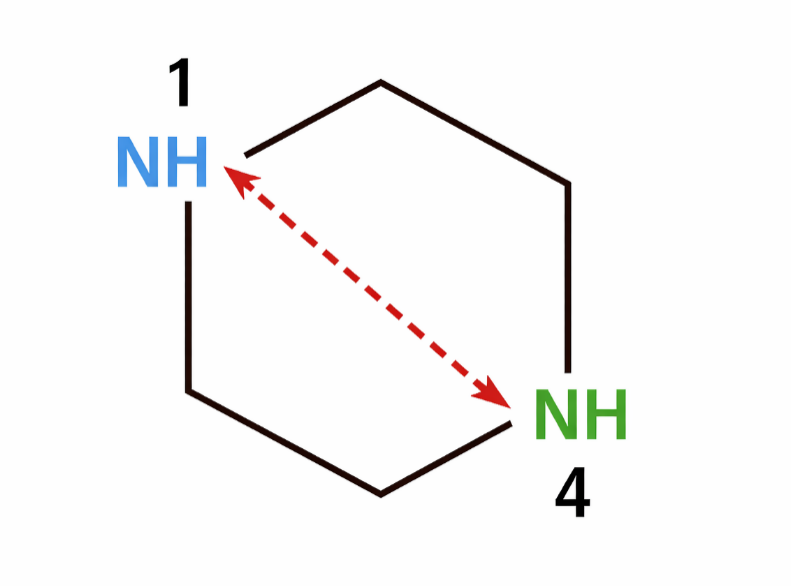
Piperazine is a saturated six-membered nitrogen heterocycle with two nitrogen atoms at the 1,4-positions (opposite each other on the ring). It can therefore also be called 1,4-diazacyclohexane. Unsubstituted piperazine is essentially a cyclic diamine (both nitrogens are secondary amines), which underlies why, in chemical and drug-like molecules, it often behaves as two basic centers that can be substituted and/or protonated.
2.2 “Piperazines” are not a single substance
“Piperazines” typically refers to a broad class of derivatives that contain a piperazine ring. Differences in N-substitution level (mono- vs di-substitution, quaternization, etc.), connectivity (which nitrogen is used for attachment, whether carbon-substitution is introduced), and salt/protonation state can all substantially change basicity, solubility, logD/permeation, and formulation behavior. Therefore, high-quality reviews often use terms such as “piperazine scaffold” or “piperazine motif” to emphasize that it is a common structural unit, not a single compound.
3.Structural features: Three tunable variables of piperazine (governing charge state, connectivity, and H-bonding patterns)
3.1 Stepwise diprotonation: switchable charge states enable more designable salt forms and solubility windows
Piperazine is a dibasic system and typically undergoes two stepwise protonation events in water. For the unsubstituted piperazine core, commonly cited reference values are:
1. pKaH (BH⁺ ⇌ B + H⁺) ≈ 9.7
2. pKaH2 (BH₂²⁺ ⇌ BH⁺ + H⁺) ≈ 5.3–5.7
3. Implications: Converting neutral B to the monocation BH⁺ is “easier” (higher pKa), whereas losing one proton from the dication BH₂²⁺ to BH⁺ corresponds to a lower pKa. As a result, around physiologically relevant pH, piperazine derivatives are often predominantly monoprotonated (BH⁺); the fractions of neutral (B) and diprotonated (BH₂²⁺) species are usually smaller, but can change markedly with substitution pattern, ionic strength, solvent, and local microenvironment. Shifts in charge distribution directly impact accessible salt forms, the pH–solubility profile, distribution, permeability/efflux, and other key behaviors.
3.2 A 1,4-opposed “two-exit” platform: well-suited as a linker scaffold for orderly series expansion
Because the two nitrogens in piperazine sit in a 1,4-opposed arrangement, it is naturally suited as a bis-terminal linking platform: one end can attach to the core scaffold, and the other end can attach to a side chain/tag/linker arm—making it convenient to expand a series rapidly using the same synthetic playbook. A key point is that once mono-substitution occurs, the molecule becomes desymmetrized, and subsequent modifications may involve site-selectivity and strategy differences.
3.3 Be explicit about substitution: protonation state plus N-substitution jointly determine HBA/HBD patterns and pKa distribution
In the unprotonated state, amine nitrogens typically serve as hydrogen-bond acceptors (HBA). Whether they are hydrogen-bond donors (HBD) depends on whether an N–H bond remains (unsubstituted piperazine has N–H at both nitrogens). Upon protonation, that nitrogen generally no longer acts as an HBA. Whether it can still act as an HBD depends on whether an N–H is present: R₂NH₂⁺/R₃NH⁺ species can still be HBDs, whereas quaternary ammonium R₄N⁺ lacks N–H and therefore is not an HBD.
Substitution patterns systematically rewrite this interaction map: mono- vs di-substitution changes whether N–H is retained; and N-acylation or N-sulfonylation typically strongly reduces basicity at that site, sending charge distribution and interaction modes down different branches.
4.Practical Classification of Piperazines
The problem you’re solving | Common piperazine forms | Key points to watch |
Make a salt / increase aqueous solubility / improve formulation | Piperazine salts (mono-salt/di-salt); compounds bearing a protonatable piperazine side chain | The two pKa values and charge distribution at the target pH; pH–solubility curve; counter-ion screening; hygroscopicity/polymorphism and solid-state stability; chemical stability in solution and solid state |
“Two-ended linking” / coupling platform (linker/spacer) | 1,4-opposed di-N substituted linkers (symmetric/asymmetric); mono-protected, mono-substituted piperazine (the other end reserved for secondary functionalization) | How linker length and steric bulk affect conformation/3D presentation; site selectivity and protection strategy; synthetic accessibility and scale-up control; the “back-effect” after installation on overall charge/solvation |
As a potency fragment in binding (part of the core interactions) | Aryl/heteroaryl piperazines; piperazine derivatives with substituents that tune basicity | Whether selectivity and key interactions depend on the protonation state; permeability/efflux linkage (PAMPA/Caco-2, efflux ratio); common metabolic soft spots (N-dealkylation, N-oxidation) and clearance; consistency checks between salt form and exposure |
Primarily to “tune basicity/charge strength” (reduce the cost of positive charge or fine-tune pKa) | N-mono-/di-substituted piperazines; N-acylation/sulfonylation branches (markedly lower basicity); arylation, etc. | Charge-state fractions at the target pH; how HBA/HBD changes with protonation and substitution; trade-offs between solubility vs permeability; state the substitution type clearly (mono-/di-substitution, acylation or sulfonylation) to ensure comparability |
Library synthesis: quickly “install piperazine” (reaction handles/building blocks) | Mono-protected piperazines (e.g., Boc/Cbz); mono-substituted piperazine intermediates amenable to further functionalization; piperazine side-chain blocks bearing leaving groups (for SN2/coupling) | Site selection (N1/N4) and protection/deprotection order; side reactions (over-alkylation/quaternization, etc.); intermediate salt forms and purification; compatibility with downstream couplings |
Accelerating reactions in engineered absorption systems (CO₂ capture promoter) | PZ as a promoter/activator (e.g., MDEA + PZ); high-concentration PZ systems | Balance kinetic enhancement vs capacity/regeneration energy; corrosion; oxidative/thermal degradation and byproducts; nitrosamine risk and control; salt precipitation/crystallization and the operating window |
(If materials/polymerization is involved) diamine chain extension/crosslinking | Piperazine as a diamine curing/chain-extending component (epoxy, polyurea/polyurethane systems, etc.) | Reaction rate and gel window; stoichiometry and crosslink density; volatility/odor and safety; mechanical performance and water/heat resistance of the final material |
5.Typical Applications
5.1 A high-frequency side chain in molecular design: using piperazine to make “salt form/aqueous solubility/linker arms” more controllable
When to use: When a molecule needs better handling in aqueous contexts (more manageable salt forms/formulation), while keeping side-chain connectivity orderly and enabling rapid, consistent series expansion.
Common implementation:
1. Attach piperazine as a side-chain scaffold to an aryl/heteroaryl ring or an alkyl chain, then use the other nitrogen for further derivatization (extension, terminal-group installation, or bifunctional linking).
2. Convert piperazine to a salt form (e.g., hydrochloride) to obtain a more controllable solid form for storage and accurate weighing; screen counter-ions based on solubility, hygroscopicity, and solid-state stability.
5.2 Linker arms and coupling platform: one end to the core, the other to a tag/carrier/material
When to use: Rapidly generate a set of comparable derivatives under a unified synthetic strategy—systematically scanning linker length, terminal functionality, and coupling partners (e.g., probes/labels, carriers, surface modification, crosslinking precursors, etc.).
Common implementation:
1. Use mono-protected piperazine (one end protected, the other reactive) for “directional editing”: install the first linker segment on the reactive end, then deprotect and modify the second end.
2. Build 1,4-disubstituted piperazines to obtain more “ordered” linkers (symmetric or asymmetric, chosen according to the intended directionality).
5.3 Industrial CO₂ capture: PZ as an absorption promoter to increase amine-solution uptake rates
When to use: When amine-based CO₂ capture/absorption systems require improved absorption kinetics and overall process efficiency.
Common implementation:
1. Piperazine (PZ) is commonly blended into amine solvents (e.g., MDEA) as a promoter/activator to increase the CO₂ absorption rate; the process is then optimized holistically via operating parameters such as blend ratio, temperature, and regeneration conditions.
2. What to evaluate: Don’t focus only on “faster absorption.” Also evaluate corrosion, solvent degradation and long-term stability; under conditions with potential NOx/nitrite sources, prioritize assessment and control of nitrosamine risk; and monitor salt precipitation/crystallization and viscosity changes that define the operating window (whether stable operation and heat/mass transfer are affected).
6.Validation Checklist: How to avoid “better solubility, worse overall performance”
When piperazine is used as a property-tuning fragment, the most common misjudgment is to focus only on increased polarity/saltability and solubility, while overlooking the countervailing effects from membrane permeability, efflux, and clearance. A more robust approach is to verify with a minimal, sequential dataset:
Desired outcome | What to do first (priority) | Why it comes first |
More controllable solubility/salt form | pKa (or prediction) + pH–solubility curve + counter-ion/salt form screening | Confirm the dominant charge state at the target pH and whether a real, usable “formulation window” has opened |
Avoid worse exposure | Permeability (PAMPA or Caco-2) + efflux ratio | Identify the common risk path: “higher charge → lower permeability / higher efflux” |
Avoid faster clearance | Metabolic stability (liver microsomes/hepatocytes, etc.) + plasma protein binding / unbound fraction (and, when feasible, reassess transporter-related risks) | Lower exposure from “more hydrophilicity” can come from metabolic clearance, but also from non-metabolic clearance and transporter processes; this minimal set helps separate the drivers |
7.Common Pitfalls
1. Pitfall 1: Piperazine automatically makes a molecule “more usable.”
Piperazine expands the “design space,” but does not guarantee a one-directional improvement; judge net effect using the linked data workflow in Section 6.
2. Pitfall 2: Not specifying “mono-substitution/di-substitution/and whether acylated (sulfonylated).”
Substitution type and protonation state systematically rewrite HBA/HBD patterns and the pKa distribution; they are prerequisite information for structural comparability.
3. Pitfall 3: Treating “piperazine” only as an anthelmintic drug and missing its role as a structural fragment in R&D.
Piperazine and its salts do have an anthelmintic (anti-parasitic) medicinal history; however, in many R&D discussions, “piperazine” often refers to the piperazine fragment within a molecule, used to tune charge/solubility and connectivity (and in some systems it may also participate in key binding and SAR). Be explicit about whether you are discussing therapeutic piperazine (and its salts) or a piperazine motif, to avoid conflation.
8.Product Navigator|Locate Tables 1–4 by “Research Task / Experimental Scenario” (Piperazine-Related)
Research task / experimental need | Which table to check first | Why this table first | Common follow-up links |
Prepare buffers for cell culture/biochemical reactions and keep pH stable (HEPES/HEPPS/PIPES, etc.) | Table 1 Biological Buffers | Table 1 consolidates the Good’s buffer system (HEPES, HEPES-Na, HEPPS, PIPES and their salts), directly matching the need to “prepare buffers / control pH.” | If you need to improve formulation handling/solubility → Table 4 (salt-form controls); if you need to introduce piperazine as a structural reference → Table 2 |
Cell/immune-related experiments that are sensitive to endotoxin or animal-origin contaminants and require a more “cell-friendly” buffer grade | Table 1 Biological Buffers | Table 1 includes entries explicitly positioned for cell culture and ultra-low endotoxin grades, helping reduce biological background noise. | If you need salt form / preparation consistency → Table 4 (salt forms); if you need further linker installation/functionalization → Table 2 |
Synthesis centered on the “piperazine ring”: you need the most basic core as an amine source / building-block starting point (free piperazine, substituted piperazines) | Table 2 Core Scaffolds & Substituted/Linker Variants | Table 2 summarizes piperazine itself, methyl/ethyl/positional substitutions (2-, 2,5-, 2,6-), supporting scaffold construction and property/conformational controls. | If you need a more stable/easier-to-weigh salt-form amine source → Table 4 (salt forms); if you need aryl/heteroaryl coupling modules → Table 3 |
You need an asymmetric substitution strategy with “one end still reactive”: cap one end first and keep the other end for coupling (e.g., mono-N substitution) | Table 2 Core Scaffolds & Substituted/Linker Variants | Table 2 includes 1-methylpiperazine, N-ethylpiperazine, N-(2-hydroxyethyl)piperazine, etc.—entries that are “mono-substituted yet still retain a reactive site.” | If you need a clearer selective strategy via protecting groups → Table 4 (Boc/Fmoc/Cbz); if you need to introduce aryl/heteroaryl modules → Table 3 |
You need to markedly increase hydrophilicity/solubility or build hydrophilic linkers (hydroxyethyl substitution, bis(hydroxyethyl)piperazine, etc.) | Table 2 Core Scaffolds & Substituted/Linker Variants | Table 2 groups “hydroxyethyl/bis(hydroxyethyl)” hydrophilic side chains together, suitable as solubility knobs and for linker construction. | If your goal is buffering/pH control rather than hydrophilic side chains → Table 1; if you want to improve water solubility/handling via salt forms → Table 4 |
You need polyamine / multi-point coupling linkers to increase coupling sites and cationic density (AEP, bis(ethylamine) side chains, etc.) | Table 2 Core Scaffolds & Substituted/Linker Variants | Table 2 includes AEP and 2,2'-(piperazine-1,4-diyl)diethanamine—“polyamine linkers” suited for grafting modification, crosslinking, or multi-point coupling. | If you need selective stepwise coupling (protect first, then couple) → Table 4 (protected/intermediate forms); if you need aryl/heteroaryl modules → Table 3 |
Medicinal chemistry/ligand design: you need “aryl piperazines/heteroaryl piperazines” as high-frequency coupling fragments (common in receptor ligands) | Table 3 Aryl/Heteroaryl Piperazine Fragments | Table 3 focuses on phenyl, para-F/Cl/Me/OMe, ortho-Cl, para-CF₃, and 2-/4-pyridyl, 2-pyrimidyl modules—best suited for parallel SAR scanning. | If you need selective functionalization (protect/deprotect then couple) → Table 4; if you need core/hydrophilic linker controls → Table 2 |
Systematic controls: compare how para substitution (F/Cl/Me/OMe/CF₃) affects activity and properties | Table 3 Aryl/Heteroaryl Piperazine Fragments | Table 3 is naturally organized as an “aryl substitution series,” enabling parallel comparisons within a consistent family and easier trend extraction. | If you need to tune solubility/salt form to ensure measurability → Table 4; if you need a more hydrophilic or more flexible linker arm → Table 2 |
You have already selected an aryl piperazine, but experiments need better solubility or more stable weighing (hydrochloride/monohydrochloride) | Table 3 (locate the parent first) + Table 4 (salt-form controls) | First locate the corresponding aryl piperazine parent in Table 3, then use the salt/counter-ion control logic in Table 4 to address preparation and stability (this set includes aryl piperazine hydrochloride/monohydrochloride entries). | If you still need to increase water solubility via side chains → Table 2 (hydroxyethyl/bis(hydroxyethyl)/polyamine linkers) |
Synthetic route development: you need protected forms/intermediates to achieve selectivity (Boc, Boc₂, Fmoc, Cbz) | Table 4 Salt Forms / Protecting Groups / Intermediates | Table 4 consolidates the protecting-group toolbox (mono-Boc, Boc₂, Fmoc salt, Cbz) and transformable carbamate intermediates, suitable for stepwise construction of asymmetrically substituted piperazine derivatives. | If you need target fragments (aryl/heteroaryl) → Table 3; if you need core and hydrophilic/polyamine linkers → Table 2 |
Replace “free amine” with an easier-to-handle form: lower volatility/hygroscopicity, improve water solubility, and run salt screening (HCl/HBr/phosphate/organic-acid salts) | Table 4 Salt Forms / Counter-ion Controls | Table 4 summarizes inorganic and organic acid salts of piperazine (and the salt-form strategy), supporting better handling and consistency in process/formulation work. | If the core task is buffering/pH control → Table 1; if you need specific cores/linkers → Table 2; if you need aryl/heteroaryl ligand modules → Table 3 |
You need a DKP (2,5-diketopiperazine) scaffold as a conformationally constrained control / standard reference for cyclic-dipeptide-related research (glycine anhydride) | Table 4 Salt Forms / Protecting Groups / Intermediates (includes DKP) | The DKP reference core (glycine anhydride) is placed in Table 4, making it easy to distinguish from “piperazine rings” while serving peptidomimetic/conformationally constrained studies. | If your work returns to piperazine linkers and fragment coupling → Table 2 / Table 3 |
Table 1|Biological Buffers (Good’s buffer systems: HEPES/HEPPS/PIPES, etc.)
Category | CAS No. | Aladdin Cat. No. | Name | Spec or Purity | Product Highlights & Applications |
Biological buffer|Good’s buffer system (hydroxyethylpiperazine sulfonic acid) | 7365-45-9 | HEPES | Animal-origin-free; for cell culture; ≥99.5%; ultra-low endotoxin | Premium cell-culture-grade HEPES: emphasizes animal-origin-free sourcing and ultra-low endotoxin, suitable for experiments sensitive to inflammatory cytokines/immune-cell status; used to stabilize pH and improve reproducibility during cell culture and imaging/handling workflows. | |
Biological buffer|Good’s buffer system (piperazine sulfonic acid / hydroxyethylpiperazine) | 75277-39-3 | HEPES sodium salt (HEPES-Na) | For cell culture, ≥99.5% (T) | Sodium-salt form of HEPES: more convenient for direct solution preparation/weighing and faster dissolution; used for cell culture, buffer preparation, and maintaining pH in biological systems (especially when CO₂ buffering is insufficient or in open systems). | |
Biological buffer|Good’s buffer system (piperazine sulfonic acid / hydroxyethylpiperazine) | 16052-06-5 | HEPPS | For cell culture, ≥99.5% (T) | A classic cell-culture buffer: the piperazine scaffold plus a sulfonate side chain provides stable buffering capacity and high water solubility; commonly used to maintain culture pH stability and reduce pH drift that affects cell state and experimental reproducibility. | |
Biological buffer|Good’s buffer system (piperazine sulfonates) | 5625-37-6 | 1,4-Piperazinediethanesulfonic acid (PIPES) | For cell culture, ≥99% | One of the commonly used Good’s buffers: applicable to a wide range of biochemical/cell-experiment buffering systems; the piperazine disulfonic-acid structure confers strong hydrophilicity and tends to minimize membrane-permeation interference, often used in protein/nucleic-acid systems and cell-related buffers. | |
Biological buffer|Good’s buffer system (PIPES salt form) | 76836-02-7 | 1,4-Piperazinediethanesulfonic acid disodium salt | ≥98% | Disodium salt of PIPES: enables more convenient buffer preparation and improves dissolution/assay-loading consistency; commonly used to maintain pH stability in biochemical/cell experiments and reduce batch-to-batch differences caused by system drift. | |
Biological buffer|Good’s buffer system (piperazine bis-sulfonate; POPSO-type) | 68189-43-5 | Piperazine-1,4-bis(2-hydroxypropanesulfonic acid) dihydrate | ≥99% | A piperazine bis-sulfonate member of the Good’s buffer family (often used/searched as a POPSO-type buffer): highly hydrophilic with stable buffering capacity, suitable for biochemical/cell systems sensitive to pH drift. |
Table 2|Core Scaffolds and Substituted/Hydrophilic/Polyamine Linkers (for fragment coupling and fine property tuning)
Category | CAS No. | Aladdin Cat. No. | Name | Spec or Purity | Product Highlights & Applications |
Core scaffold|Piperazine (amine source / fragment scaffold) | 110-85-0 | Piperazine | UltraBio™, anhydrous grade, ≥99% (T) | The most fundamental “piperazine core”: a common diamine scaffold/building block for installing piperazine rings into drug-like molecules, salt-form screening, and as a nucleophilic amine in alkylation, acylation, sulfonylation, etc.; anhydrous grade helps in moisture-sensitive steps and stoichiometric control. | |
Core scaffold|Piperazine (hydrate / handling form) | 142-63-2 | Piperazine hexahydrate | ≥98% | Hydrated form of piperazine: weighing and dissolution behavior differs from the anhydrous material, suitable for aqueous/solution preparation; in moisture-sensitive synthesis or where stoichiometric precision is critical, account for water content. | |
Core scaffold|N-substituted piperazine (one end remains functionalizable) | 109-01-3 | 1-Methylpiperazine | ≥99% | Mono-N-substituted piperazine: retains the other N as a subsequent attachment point (“one end capped, one end still reactive”), commonly used to rapidly build side chains/linkers and to tune salt form, solubility, and basicity. | |
Core scaffold|Alkyl-substituted piperazine (fine property tuning) | 109-07-9 | 2-Methylpiperazine | ≥99.5% | Substituted piperazine core: used to build substituted piperazine comparison series (steric/electronic/hydrophobic fine-tuning), frequently seen in medicinal-chemistry fragment swaps and structure optimization. | |
Core scaffold|N-substituted piperazine (mono-ethyl) | 5308-25-8 | 1-Ethylpiperazine | ≥98% | Mono-ethyl-substituted piperazine: for constructing asymmetrically substituted piperazines and tuning properties; ethyl is more hydrophobic and bulkier than methyl, useful for chain-length/volume comparisons. | |
Functionalized piperazine|Hydrophilic side chain (mono-hydroxyethyl) | 103-76-4 | N-(2-Hydroxyethyl)piperazine | ≥98% | Mono-hydroxyethyl substitution: increases hydrophilicity while retaining one reactive N site; commonly used to introduce hydrophilic linker arms, improve formulation solubility, and create “hydrophilicity-upshift” comparison series. | |
Functionalized piperazine|Hydrophilic side chain (hydroxyethyl; solubility knob) | 122-96-3 | 1,4-Bis(2-hydroxyethyl)piperazine | ≥98% | Di(hydroxyethyl) substitution provides strong hydrophilicity and multiple H-bonding sites: often used to increase water solubility, build hydrophilic linkers/side chains, or serve as a “hydrophilicity-enhanced control” to assess impacts on permeability/efflux/formulation. | |
Core scaffold|N,N’-substituted piperazine (symmetrically capped) | 106-58-1 | 1,4-Dimethylpiperazine | ≥98% (GC) | Both nitrogens capped with methyl groups: a more “tertiary-amine-type piperazine” control, used to compare basicity/solubility/metabolic-site changes; also used as a ligand/base/structural control substrate in reaction screening. | |
Core scaffold|N,N’-substituted piperazine (symmetrically capped) | 6483-50-7 | 1,4-Diethylpiperazine | ≥98% | Both nitrogens ethyl-capped: more hydrophobic and bulkier than the dimethyl analogue; often used to benchmark how increased alkyl volume/hydrophobicity affects basicity, permeability, solubility, and metabolic liabilities. | |
Stereo/configuration control|Substituted piperazine (2,5-positions; trans) | 2815-34-1 | trans-2,5-Dimethylpiperazine | ≥98% (GC) | 2,5-substitution with defined trans configuration: used for systematic comparisons of conformational/stereochemical effects on activity and properties; common in “same scaffold, different configuration” optimization. | |
Core scaffold|Positional substitution (2,6-positions; conformational control) | 108-49-6 | 2,6-Dimethylpiperazine | ≥98% | 2,6-substitution changes ring conformation and steric distribution: used for steric/conformational comparisons and fine property tuning (basicity, solubility, exposure of metabolic sites); suitable for “same core, different substitution position” controls. | |
Functionalized amine|Diamine linker (introducing a second amine site) | 140-31-8 | 1-(2-Aminoethyl)piperazine | ≥99% | A classic “diamine/polyamine linker”: adds a primary amine outside the piperazine ring, markedly increasing nucleophilicity and the number of attachment sites; commonly used for grafting modification, coupling linkers, ionic side-chain construction, and designs requiring stronger water solubility/higher cationic density. | |
Functionalized amine|Diamine linker (bis-ethylamine side chains) | 6531-38-0 | 2,2'-(Piperazine-1,4-diyl)diethanamine | ≥95% | A “dual-side-chain diamine” linker: installs –CH₂CH₂NH₂ on both nitrogens, substantially increasing coupling sites and cationic density; commonly used in polymer/surface grafting, crosslinking modification, and designs needing multi-point coupling or stronger hydrophilicity. |
Table 3|Aryl/Heteroaryl Piperazine Fragments (free bases and salts; high-frequency controls and coupling modules)
Category | CAS No. | Aladdin Cat. No. | Name | Spec or Purity | Product Highlights & Applications |
Aryl piperazine|Common medicinal-chemistry fragment (phenyl) | 92-54-6 | 1-Phenylpiperazine | ≥97% | One of the most basic aryl piperazines: a high-frequency receptor/ligand coupling module; serves as a parent reference for para-/ortho-substituted aryl piperazines, enabling evaluation of substitution-driven activity and property changes. | |
Aryl piperazine salt|Salt form/control (hydrochloride) | 2210-93-7 | 1-Phenylpiperazine hydrochloride | ≥98% | Hydrochloride salt of an aryl piperazine: improves aqueous solubility and weighing stability; commonly used for salt-form controls, pharmacology/in vitro solution preparation, and aqueous handling; also convenient for “salt form vs free base” property comparisons. | |
Aryl piperazine|Common medicinal-chemistry fragment (aryl-substituted) | 30459-17-7 | 1-(4-Trifluoromethylphenyl)piperazine | ≥98% (GC) (T) | A representative aryl piperazine fragment: widely used as a modular building block in CNS/receptor-ligand programs; para-CF₃ provides hydrophobic/electronic tuning, useful for SAR scans and property adjustment (logD, receptor affinity). | |
Aryl piperazine|Common medicinal-chemistry fragment (aryl-substituted) | 39512-50-0 | 1-(2-Chlorophenyl)piperazine | ≥98% (GC) | Ortho-chloro aryl piperazine: often used to build aryl-piperazine control series (sterics + hydrophobicity + electronics shift together); a high-frequency linker/pharmacophore module in medicinal chemistry. | |
Aryl piperazine salt|Salt form/control (monohydrochloride) | 41202-32-8 | 1-(2-Chlorophenyl)piperazine monohydrochloride | ≥95% | Monohydrochloride of an ortho-chloro aryl piperazine: generally more convenient for aqueous preparation and weighing stability than the free base; commonly used for salt-form controls and in vitro sample preparation, and for comparing solubility/stability vs the corresponding free base. | |
Aryl piperazine|Common medicinal-chemistry fragment (para-halogen) | 2252-63-3 | 1-(4-Fluorophenyl)piperazine | ≥98% | Para-fluoro aryl piperazine: used to build aryl-piperazine series controls (halogen tuning of electronics/metabolic stability/hydrophobicity), suitable for rapid assembly and activity/property benchmarking. | |
Aryl piperazine|Common medicinal-chemistry fragment (para-halogen) | 38212-33-8 | 1-(4-Chlorophenyl)piperazine | ≥98% | Para-chloro aryl piperazine: a classic aryl-piperazine module for receptor ligands/CNS-related control series; Cl substitution often changes hydrophobicity and metabolic-site profile, enabling systematic optimization. | |
Aryl piperazine|Common medicinal-chemistry fragment (para-alkyl) | 39593-08-3 | 1-(4-Methylphenyl)piperazine | ≥98% | Para-methyl aryl piperazine: a control used for a “moderate upshift” in electronics/hydrophobicity; commonly run in parallel with para-F/Cl/OMe analogues in SAR. | |
Aryl piperazine|Common medicinal-chemistry fragment (para electron-donating) | 38212-30-5 | 1-(4-Methoxyphenyl)piperazine | ≥97% | Para-methoxy aryl piperazine: OMe provides electron donation and some polarity contribution; often built alongside para-F/Cl/Me series to map para-substitution SAR and optimize the property window. | |
Heteroaryl piperazine|Common medicinal-chemistry fragment (pyridyl; 2-position) | 34803-66-2 | 1-(2-Pyridyl)piperazine | ≥97% | 2-Pyridyl piperazine: the heteroaryl ring adds an additional acceptor site and electronic effects, often used to tune binding mode and polarity; 2-position linkage introduces steric/orientation differences, suitable for 2- vs 4-pyridyl parallel controls. | |
Heteroaryl piperazine|Common medicinal-chemistry fragment (pyridyl; 4-position) | 1008-91-9 | 1-(4-Pyridyl)piperazine | ≥97% | 4-Pyridyl piperazine: less ortho steric hindrance than the 2-position analogue, often giving a more “linear” connection trajectory; used in receptor ligands, fragment coupling, and coordinated optimization of pKa/logD/solubility. | |
Heteroaryl piperazine|Common medicinal-chemistry fragment (pyrimidyl) | 20980-22-7 | 1-(2-Pyrimidyl)piperazine | ≥98% | A heteroaryl–piperazine coupling fragment: the pyrimidine ring offers stronger electronic effects and potential receptor interactions; commonly used as a “heteroaryl–piperazine” module for tuning polarity/electronic distribution and SAR scanning. |
Table 4|Salt Forms / Counter-ion Controls + Protecting Groups / Intermediates + DKP Parent-Core Controls
Category | CAS No. | Aladdin Cat. No. | Name | Spec or Purity | Product Highlights & Applications |
Salt form / pairing acid|Inorganic acid salt (hydrochloride) | 142-64-3 | Piperazine dihydrochloride monohydrate | ≥98% (T) | Piperazine hydrochloride salt: often used to increase aqueous solubility and reduce handling variability from free-amine volatility/hygroscopicity; suitable as an amine source for aqueous reactions, buffer systems, or scenarios needing a “stoichiometrically controllable amine salt.” | |
Salt form / pairing acid|Inorganic acid salt (hydrobromide) | 59813-05-7 | Piperazine dihydrobromide | ≥98% (N) | Hydrobromide salt form: similar to the hydrochloride for improved solubility and handling stability; also useful as a counter-ion comparison (Cl⁻ vs Br⁻) to assess reaction/crystallization behavior and purification difficulty. | |
Salt form / pairing acid|Inorganic/polyprotic acid salt (phosphate) | 18534-18-4 | Piperazine phosphate monohydrate | ≥97% | Phosphate salt form: for salt screening and crystallization/stability controls; often improves aqueous handling and reduces irritation/volatility differences associated with free amines. | |
Salt form / pairing acid|Organic acid salt (malate) | 14852-14-3 | Piperazine DL-malate | ≥98% (T) | Organic-acid salt of piperazine: used to improve crystallinity/solubility and weighing stability; common in process/formulation-driven salt-form controls and solubility tuning, and can serve as a milder, easier-to-handle amine source in reactions. | |
Salt form / pairing acid|Dicarboxylate salt (adipate) | 142-88-1 | Piperazine adipate | ≥98% (T) | Dicarboxylate salt form: used for salt screening and polymorph/solubility/stability comparisons; in formulation or process development, commonly used to verify how different counter-ions shift the property window. | |
Salt form / pairing acid|Polycarboxylate salt (citrate) | 144-29-6 | Piperazine citrate hydrate | ≥98% (T) | Citrate salt: polycarboxylate counter-ions often bring higher hydrophilicity and distinct crystallization/hygroscopic behavior, useful for solubility enhancement, salt-form controls, and compatibility evaluation in aqueous systems. | |
Protecting group / synthetic intermediate|N-protected piperazine (Boc₂) | 76535-75-6 | 1,4-Di-tert-butyl piperazine-1,4-dicarboxylate | ≥98% | A typical Boc₂-protected piperazine: enables selective functionalization (deprotect as needed for mono- or bis-end connection); a high-frequency starting material for building piperazine linkers and bifunctional intermediates. | |
Protecting group / synthetic intermediate|N-protected piperazine (mono-Boc) | 57260-71-6 | 1-Boc-piperazine | ≥98% | Mono-Boc protection: supports selective functionalization with “one end protected, the other reactive”; a common intermediate for building asymmetrically substituted piperazines, linkers, and deprotect-then-couple workflows. | |
Protecting group / synthetic intermediate|N-protected piperazine (Fmoc; salt form) | 352351-60-1 | 1-Fmoc-piperazine hydrobromide | ≥97% | Fmoc-protected piperazine (provided as an HBr salt): commonly used in solid-phase synthesis, stepwise protect/deprotect strategies, and routes requiring base-labile deprotection; the salt form improves handling stability and dosing accuracy. | |
Protecting group / synthetic intermediate|N-protected piperazine (Cbz/Z; benzyloxycarbonyl) | 31166-44-6 | 1-Carbobenzoxypiperazine | ≥95% (GC) | Cbz (Z)-protected piperazine: suited to hydrogenolysis deprotection routes; used for selective functionalization and stepwise construction of asymmetrically substituted piperazines; often paired with Boc/Fmoc as a “protecting-group toolbox” enabling orthogonal deprotection conditions. | |
Synthetic intermediate|N-acylated derivative (carbamate; further transformable) | 50606-31-0 | Methyl piperazine-1-carboxylate | ≥98% | An N-carbamate piperazine intermediate: introduces a carbonyl function that can be further transformed (hydrolysis/amide formation/ammonolysis, etc.), facilitating construction of “piperazine–carbonyl linkage” fragments. | |
Diketopiperazine|2,5-Diketopiperazine parent core (DKP/cyclic dipeptide scaffold) | 106-57-0 | Glycine anhydride | ≥98% (N) | A representative 2,5-diketopiperazine (diketopiperazine, DKP) scaffold: commonly used as a reference core for peptidomimetic/conformationally constrained scaffolds and for parent-core benchmarking in natural product/peptide-modification contexts; also a starting point for cyclic-dipeptide-related synthesis and materials/bioactivity studies. |
Note: The above are representative Aladdin products. For more specifications, please refer to the product list at the end of the article, or search the Aladdin website using the product name / CAS number / catalog number.
For more related articles, please see below: