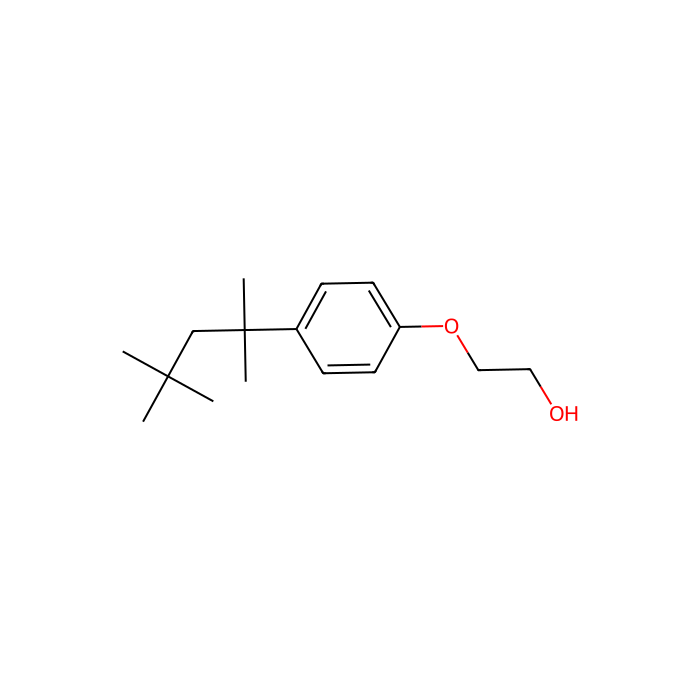
TRITON™ X-305 Surfactant - 70% in H2O , CAS No.9002-93-1

CAS: 9002-93-1 Cat. No.: T434385 Formula: C8H17C6H4(OCH2CH2)nOH(n≈10) Beilstein Registry Number: 2315025 EC Number: 618-344-0 PubChem CID: 5590
AVAILABLE TO ORDER
GRADE & PURITY 70% in H2O
Synonyms
Igepal CA-210 | CAS_118-96-7 | PDSP1_001087 | Ethanol,1,3,3-tetramethylbutyl)phenoxy]- | 2-(4-(2,4,4-Trimethylpentan-2-yl)phenoxy)ethan-1-ol | Octoxynol-1 | Triton X 305 | P-TERT-OCTYLPHENYL (2-HYDROXYETHYL)ETHER | AT25387 | Igepal CA 630 | FT-0673247 | T
Storage
Room temperature
★
Size
USA
Germany (EU)*
Price
Qty
100ml
T434385-100ml
3 In stock
—
$31.90
500ml
T434385-500ml
1 In stock
—
$93.90
Enter a quantity for the sizes you want to add.
🧪
Why this grade

70% in H2O for sensitive chromatographic and analytical workflows requiring minimal baseline interference.

🌡

Storage & shipping

Room temperature Ships Check lot-specific COA for exact specifications.

📋

Quality documents

SDS, COA, datasheet, and spec sheet available for download. Lot-specific COA accessible via lot number lookup.

📚

Literature proof

Cited in 821 peer-reviewed publications across chromatography, organic synthesis, and cross-coupling reactions.

Overview

Triton ™ X-305 is a non-ionic surfactant. This octylphenol ethoxylate has higher number of ethylene oxide units, increased cmc (Critical micelle concentration) and hydrophile/lipophile balance when compared to Triton ™ X-100. Triton X-305 is compatible with anionic, cationic, and other nonionic surfactants and chemically stable in most acidic and alkaline solutions.

Uses
Agrochemicals
Paints and coatings dispersions
Emulsion polymerization
Fiber lubricants
Benefits
Excellent emulsion stabilizer
Provides freeze/thaw & ionic stability
Effective at high temperatures
Good solubility in the presence of salts or electrolytes & caustic solutions

Application

Triton ™ X-305 has been used: In the treatment of cells for immunocytochemistry Along with peroxotungstic acid in the preparation of tungsten trioxide films by sol-gel method In the dispersion polymerization of styrene with activated poly(N-vinylpyrrolidone) (PVP) for the synthesis of lanthanide-encoded polystyrene particles


Specifications

Synonyms
Igepal CA-210 | CAS_118-96-7 | PDSP1_001087 | Ethanol,1,3,3-tetramethylbutyl)phenoxy]- | 2-(4-(2,4,4-Trimethylpentan-2-yl)phenoxy)ethan-1-ol | Octoxynol-1 | Triton X 305 | P-TERT-OCTYLPHENYL (2-HYDROXYETHYL)ETHER | AT25387 | Igepal CA 630 | FT-0673247 | T
Specifications & Purity
70% in H2O
Legal Information
Tri-Chek is a trademark of Micro Essential Laboratory, Inc. Triton is a trademark of The Dow Chemical Company or an affiliated company of Dow
Storage
Room temperature
Names and Identifiers
Pubchem Sid
Pubchem Sid Url
https://pubchem.ncbi.nlm.nih.gov/substance/504750915
Canonical Smiles
CC(C)(C)CC(C)(C)C1=CC=C(C=C1)OCCO
IUPAC Name
2-[4-(2,4,4-trimethylpentan-2-yl)phenoxy]ethanol
InChIKey
JYCQQPHGFMYQCF-UHFFFAOYSA-N
INCHI
1S/C16H26O2/c1-15(2,3)12-16(4,5)13-6-8-14(9-7-13)18-11-10-17/h6-9,17H,10-12H2,1-5H3
Isomeric SMILES
CC(C)(C)CC(C)(C)C1=CC=C(C=C1)OCCO
WGK Germany
1
RTECS
MD0907700
Alternate CAS
9036-19-5
PubChem CID
5590
UN Number
3082
Beilstein
2315025

Documentation

📋 Safety Data Sheet (SDS)

Comprehensive hazard, handling, storage, and regulatory compliance document.

<<<<<<< HEAD Download SDS → ======= Download SDS → >>>>>>> release248-p3

✅ Certificate of Analysis (COA)

Lot-specific quality data. Enter your lot number to retrieve the exact COA.

Look up COA →

📊 Datasheet

Quick-reference summary of product specifications and applications.

View datasheet →

🔬 Specification Sheet

Full quality attributes and acceptance criteria for this grade.

View spec sheet →

Advanced Data

Taxonomic Classification

Taxonomy Tree

KingdomOrganic compounds
SuperclassBenzenoids
ClassBenzene and substituted derivatives
SubclassPhenylpropanes
Intermediate Tree Nodes Not available
Direct ParentPhenylpropanes
Alternative Parents Phenoxy compounds  Phenol ethers  Alkyl aryl ethers  Primary alcohols  Hydrocarbon derivatives  
Molecular FrameworkAromatic homomonocyclic compounds
Substituents Phenylpropane - Phenoxy compound - Phenol ether - Alkyl aryl ether - Ether - Organic oxygen compound - Hydrocarbon derivative - Primary alcohol - Organooxygen compound - Alcohol - Aromatic homomonocyclic compound
DescriptionThis compound belongs to the class of organic compounds known as phenylpropanes. These are organic compounds containing a phenylpropane moiety.
External Descriptors a small molecule
3D Structure
Interactive Chemical Structure Model


Associated Targets(Human)
NR3C1 Tclin Glucocorticoid receptor (14987 Activities)
Activity TypeRelationActivity valueUnitsAction TypeJournalPubMed IddoiAssay Aladdin ID
KCNH2 Tclin HERG (29587 Activities)
Activity TypeRelationActivity valueUnitsAction TypeJournalPubMed IddoiAssay Aladdin ID
CYP3A4 Tclin Cytochrome P450 3A4 (53859 Activities)
Activity TypeRelationActivity valueUnitsAction TypeJournalPubMed IddoiAssay Aladdin ID
HaCaT (4069 Activities)
Activity TypeRelationActivity valueUnitsAction TypeJournalPubMed IddoiAssay Aladdin ID
Lymphoblastoid cell (5959 Activities)
Activity TypeRelationActivity valueUnitsAction TypeJournalPubMed IddoiAssay Aladdin ID
TDP1 Tchem Tyrosyl-DNA phosphodiesterase 1 (345557 Activities)
Activity TypeRelationActivity valueUnitsAction TypeJournalPubMed IddoiAssay Aladdin ID
SMN1 Tchem Survival motor neuron protein (34246 Activities)
Activity TypeRelationActivity valueUnitsAction TypeJournalPubMed IddoiAssay Aladdin ID
Associated Targets(non-human)
Cruzipain (33337 Activities)
Activity TypeRelationActivity valueUnitsAction TypeJournalPubMed IddoiAssay Aladdin ID
Plasmodium falciparum (966862 Activities)
Activity TypeRelationActivity valueUnitsAction TypeJournalPubMed IddoiAssay Aladdin ID
Rattus norvegicus (775804 Activities)
Activity TypeRelationActivity valueUnitsAction TypeJournalPubMed IddoiAssay Aladdin ID
Nfe2l2 Nuclear factor erythroid 2-related factor 2 (214 Activities)
Activity TypeRelationActivity valueUnitsAction TypeJournalPubMed IddoiAssay Aladdin ID
Rorc Nuclear receptor ROR-gamma (89407 Activities)
Activity TypeRelationActivity valueUnitsAction TypeJournalPubMed IddoiAssay Aladdin ID
Mechanisms of Action
Certificates (CoA,COO,BSE/TSE and Analysis Chart)
C of A & Other Certificates(BSE/TSE, COO):
Analytical Chart:

Find and download the COA for your product by matching the lot number on the packaging.

7 results found

Lot NumberCertificate TypeDateItem
L2321264L2321264Certificate of AnalysisSep 21, 2026 T434385
B2506259B2506259Certificate of AnalysisJan 21, 2025 T434385
B2506266B2506266Certificate of AnalysisJan 21, 2025 T434385
B2506268B2506268Certificate of AnalysisJan 21, 2025 T434385
B2506276B2506276Certificate of AnalysisJan 21, 2025 T434385
B2506282B2506282Certificate of AnalysisJan 21, 2025 T434385
L2321263L2321263Certificate of AnalysisNov 14, 2023 T434385
Chemical and Physical Properties
SolubilityInsoluble in alcohol and soluble in water; Compatible with most polar organic solvents; Insoluble in fatty hydrocarbons and aromatic hydrocarbons; Chemically stable in most acidic and alkaline solutions; Compatible with anions, cations, and other non-ioni
Refractive Index1.491
Flash Point(°C)251°C
Boil Point(°C)270°C
Melt Point(°C)6°C
Molecular Weight250.380 g/mol
XLogP34.600
Hydrogen Bond Donor Count1
Hydrogen Bond Acceptor Count2
Rotatable Bond Count6
Exact Mass250.193 Da
Monoisotopic Mass250.193 Da
Topological Polar Surface Area29.500 Ų
Heavy Atom Count18
Formal Charge0
Complexity232.000
Isotope Atom Count0
Defined Atom Stereocenter Count0
Undefined Atom Stereocenter Count0
Defined Bond Stereocenter Count0
Undefined Bond Stereocenter Count0
The total count of all stereochemical bonds0
Covalently-Bonded Unit Count1
Documents & Articles
Non-Ionic Surfactants in Focus: Alcohol Ethoxylates, Polyethylene Glycol Trimethylnonyl Ether, and Triton™ X-100
IPTG Induction and Extraction of Proteins Modified
Buffer exchange of a sample using a dialysis bag
Common Questions and Answers for SDS-PAGE Experiments
Buffer Additives to Prevent Protein Precipitation
Common Protectants and Formulations for Protein Storage
Eight Common Lysis Buffers
EdU Staining: Basic Principle and Experimental Workflow
FAQ on Molecular Interaction Assays
GST-Tagged Protein Purification
Biotin-Labeled Protein Purification
Protease & Phosphatase Inhibitor Cocktails: Research Applications and Principles
NPE (NP-n) Selection Guide: How EO Number Affects Solubility, HLB, Cloud Point, and CMC | With an Aladdin Product Reference Table
A Panoramic Guide to Surfactants: Definitions & Mechanisms, Key Metrics, Application Scenarios, and Selection Navigation (Tables 1–3)
A Review of Ten Commonly Used Techniques for Detection, Quantification, and Interaction Analysis in Nucleic Acid Research
Protein Tags Demystified: Classification, Properties, and Suitable Experimental Applications
Why Acridine Can Turn “Trace Molecules” into a Measurable Light Signal: A Mechanistic, Selection, and Troubleshooting Guide to Acridinium Ester Chemiluminescent Immunoassays (Including Product Tables 1–4)
Acid Phosphatase: Dephosphorylation Reactions in Acidic Microenvironments and Their Research, Assay, and Detection Applications
Diaphorase: NAD(P)H-Dependent Electron-Transfer Activity and Its Applications in Detection and Research
Urinary Follicle-Stimulating Hormone (uFSH): Source Attributes, Molecular Properties, and Research Application Frameworks
Lipase (Triacylglycerol Hydrolase): Interfacial Catalysis, Selectivity Classes, and Assay/Application Systems
Cholesterol Esterase: Mechanistic Insights and Application Frameworks Driven by Interfacial Hydrolysis
Hemicellulases: A Review of Substrate Specificity, Catalytic Systems, and Research and Industrial Applications
Interleukin-29 (IL-29/IFN-λ1): Molecular Features, Signaling Networks, and a Systematic Framework for Research Applications
dsDNase-Mediated Hydrolysis of Double-Stranded DNA: Enzymatic Characteristics, Methodological Strategies, and Bioanalytical Applications
Review of the Principles, Common Methods, and Key Application Considerations for the Determination of Glycerol and Triglyceride Contents
Review of the Principles, Methods, and Application Considerations for Superoxide Dismutase Activity Determination
Methodological Studies on Glycoprotein Structural Characterization and Quality Attribute Analysis
Tyramide Signal Amplification in In Situ Fluorescence Detection
Significance of CK, CK-MB, and CK-MM Testing in the Interpretation of Tissue Injury
Cell Apoptosis Detection by TUNEL Labeling: Signal Interpretation and Result Evaluation
Application Comparison of the Neutral Red Assay and the MTT/CCK-8 Assays in Cytotoxicity Testing
Preparation Methods and Precautions for Silane Coupling Agent Primer Solutions
Application Differences Among Glutaraldehyde, Paraformaldehyde, and Formalin in Tissue and Cell Sample Fixation
Resin Polarity in Coating Formulations: From Molecular Structure to Dissolution, Compatibility, Interfacial Interactions, and Formulation Design
Practical Guide to TSA Tyramide Signal Amplification: How to Select Reagents, Optimize the Workflow, and Reduce Background When Detection Signals Are Weak for Low-Abundance Targets
Signal Transduction Mechanism of Graphene Biosensors: From Molecular Recognition to Electrical/Optical Signal Readout and Materials Selection
Interfacial Mechanism and Formulation Applications of AEO-9 (Fatty Alcohol Polyoxyethylene Ether): An Analysis of Emulsification, Wetting, Oil Soil Removal, and Co-Formulation Compatibility
Wetting and Penetration Mechanisms of Penetrating Agents in Household and Personal Care Cleaning Systems: Representative Structural Analysis Using JFC, OEP-70, and DOSS as Examples
Structural Logic of Nonionic Surfactants: Mechanisms of Action, Classification Features, and Selection Principles
Comparison of Bilirubin Detection Methods: Application Selection of the Diazo Method, Vanadate Oxidation Method, Bilirubin Oxidase Method, and HPLC
Citations of This Product
Solution Calculators
Reviews

Customer Reviews

Frequently Asked Questions

How should this product be stored?
Store at room temperature.
What are the CAS number, molecular formula and molecular weight?
The CAS Number is 9002-93-1, the molecular formula is C8H17C6H4(OCH2CH2)nOH. InChIKey JYCQQPHGFMYQCF-UHFFFAOYSA-N.
What documentation is provided?
Available product documentation, including Certificates of Analysis (COA), Safety Data Sheets (SDS), and specification sheets, is shown in the product document area. Document availability and access follow the current site policy.

Shall we send you a message when we have discounts available?

Remind me later

Thank you! Please check your email inbox to confirm.

Oops! Notifications are disabled.