GRADE & PURITYCarrier Free?Carrier-free — supplied without added carrier protein/stabilizer. Use when carriers (e.g. BSA) would interfere with conjugation or sensitive assays.ExactAb™?ExactAb™ — Aladdin's antibody line emphasizing precision and validated quality. Use for reliable, specificity-validated antibody applications.Azide Free?Azide-free — without sodium azide preservative. Use in conjugations, cell work, or assays where azide is toxic or inhibitory.Validated?Validated grade — performance confirmed in defined applications before release. Use when you want documented assurance the reagent works as stated.See COA
Mouse anti Human FOXP1 Antibody, Monoclonal (D4), could be used for WB and so on. Application WB: 0.5-2 µg/mL Protein Function Transcriptional repressor. It plays an important role in the specification and differentiation of lung epithelium. Can act with CTBP1 to synergistically repress transcription but CTPBP1 is not essential. Essential transcriptional regulator of B cell development.
Specifications
Product Name
FOXP1 Mouse mAb - Primary antibody, specific to FOXP1, Mouse IgG2a
Synonyms
12CC4 antibody|FLJ23741 antibody|Fork head related protein like B antibody|Forkhead box P1 antibody|Forkhead box protein P1 antibody|FOX P1 antibody|FOXP 1 antibody|foxp1 antibody|Glutamine rich factor 1 antibody|hFKH1B antibody|HSPC215 antibody|MGC12942 antibody|MGC88572 antibody|MGC99551 antibody|QRF 1 antibody|QRF1 antibody|fork head-related protein like B|forkhead box P1|forkhead box protein P1|FoxP1|glutamine-rich factor 1|hFKH1B|QRF1|QRF112CC4|Mac-1-regulated forkhead|MFH
Specifications & Purity
Carrier Free, ExactAb™, Azide Free, Validated, See COA
Host species
Mouse
Specificity
FOXP1
Immunogen
Recombinant FOXP1 expressed in E.coli (AA 461-671)
Positive Control
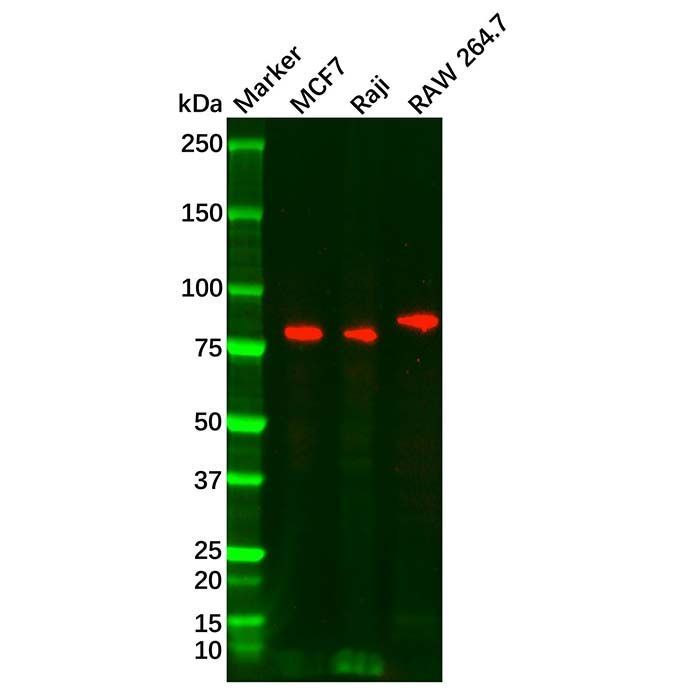
WB: RAW264.7, MCF7 and Raji cell lysates.
Conjugation
Unconjugated
Grade
Azide Free, Carrier Free, ExactAb™, Validated
Isotype
Mouse IgG2a
Light Chain Type
kappa
SDS-PAGE
150 kDa
Purification Method
Protein A and Protein G purified
Concentration
See COA
Product Line
Biological Products
Storage and Shipping
Shape
Liquid
Storage
Store at -20°C,Avoid repeated freezing and thawing
Shipped In
Ice chest + Ice pads
Stability And Storage
Store at 4℃ short term (1-2 weeks). Store at -20℃ long term (24 months). Upon receipt, it is recommended to aliquot. Avoid freeze/thaw cycle.
Images
FOXP1 Mouse mAb (Ab104034) - Western Blot All lanes: FOXP1 Mouse mAb (Ab104034) at 1/1000 dilution Samples: Lysates at 20 µg per lane Secondary: Goat Anti-Mouse IgG H&L (HRP) (Ab138040) at 1/50000 dilution
Predicted band size: 75 kDa Observed band size: 80 kDa Exposure time: 200.0 s
Determine the necessary mass, volume, or concentration for preparing a solution.
Dilution Calculator
Determine the dilution needed to prepare a stock solution.
Reconstitution Calculator
Reviews
Customer Reviews
Application Protocols
Item-specific tested applications, recommended dilutions, incubation times, and species reactivity are not provided for Ab104034. Refer to the CoA/Spec Sheet for any validated-use details.
Usage guidance:
Because the product is listed as Validated, the manufacturer has assessed performance; however, exact protocols are not included in the provided data.
Users should establish assay-specific conditions (e.g., WB, IHC, IF, ELISA, IP, ChIP) through small-scale titrations and appropriate controls (positive/negative samples, secondary-only controls).
Please consult the CoA/Spec Sheet and your lab’s standard operating procedures for protocol specifics. No item-specific application parameters are claimed here.
Biological Roles
FOXP1 (Forkhead box protein P1) biology (literature overview):
Family and domain structure: FOXP1 is a member of the FOXP subfamily of forkhead/winged-helix transcription factors. It contains a C-terminal forkhead DNA-binding domain, leucine zipper, and zinc-finger-like regions that support dimerization and DNA binding.
Cellular localization: Predominantly nuclear; regulates transcription by binding specific forkhead motifs.
Developmental roles: Implicated in B-cell maturation and identity, cardiac morphogenesis, lung development, and neural circuit formation. It modulates gene programs central to cell fate decisions.
Immune system context: In B cells, FOXP1 influences receptor signaling thresholds and differentiation states; it has roles in germinal center dynamics (literature).
Molecular partners: Forms homo- or heterodimers (e.g., with FOXP2/FOXP4 in some contexts); recruits co-repressors/co-activators to modulate chromatin state.
Expression control: Multiple isoforms exist due to alternative splicing; nuclear localization signals and post-translational modifications (e.g., phosphorylation, acetylation) regulate activity and stability.
Use of FOXP1 antibodies:
Investigate protein levels, isoform patterns, nuclear localization, and DNA occupancy.
Combine with genetic perturbations or RNA measurements to connect FOXP1 protein dynamics with transcriptional outputs.
Note: This section summarizes general biology and does not represent item-specific validation or performance claims.
Buffer Applications
While this product is not a buffering reagent, buffers are central to its successful use in immunoassays. Item-specific buffer composition is not provided.
General guidance (literature/practice):
Dilution/assay buffers: PBS or TBS at pH ~7.2–7.6 with 0.05–0.1% Tween-20 for WB/IHC/ELISA washing steps. Include blocking proteins (e.g., 1–5% BSA or milk) where compatible with detection.
Antigen retrieval (IHC): Heat-induced epitope retrieval in citrate (pH 6.0) or Tris-EDTA (pH 9.0); optimize empirically for FOXP1 epitopes.
Nuclear proteins: Use hypotonic buffer followed by detergent/salt extraction for nuclear enrichment; include protease and phosphatase inhibitors.
Storage buffers (user-supplied if needed): For long-term aliquots, PBS with 10–50% glycerol can mitigate freeze–thaw stress (ensure compatibility with downstream applications).
Important: Because this product is Carrier Free and Azide Free, no carriers or azide are present by design. If carriers/preservatives are desirable for your workflow, add them only to working aliquots, not to the master stock intended for conjugation.
Green Alternatives
For an antibody reagent, “green” considerations focus on format, stabilization, and logistics rather than solvent substitution.
Greener practice options (general guidance):
Concentrated, carrier-free, azide-free stocks (as provided) enable on-demand preparation of working aliquots, reducing waste from expired premixed buffers.
Stabilization strategy: Instead of routine single-use plastics, prepare small aliquots in low-bind, reusable cryoboxes. Consider glycerol supplementation to permit −20°C storage and avoid repeated freeze–thaw cycles (reduces waste from degradation).
Shipping and cold chain: Where feasible, coordinate consolidated shipments to reduce packaging. If a lyophilized format becomes available, it can reduce ice-pack use; however, this item is provided as Carrier Free/Azide Free with storage at −20°C as specified.
Assay design: Adopt miniaturized assay formats (e.g., 96- to 384-well scaling) to reduce reagent consumption.
Trade-offs:
Azide-free formulations reduce environmental and safety concerns related to azide but increase bioburden risk; aseptic handling is required.
Carrier-free format simplifies downstream conjugation and reduces animal-derived components (if carriers are bovine-sourced), but may require user-added stabilizers, introducing additional materials.
Summary: Use careful aliquoting, right-sizing experiments, and efficient shipping/stock management to minimize environmental impact without compromising data quality.
Pharmaceutical Uses
Not applicable. This is a research-use-only antibody reagent and is not intended for therapeutic, diagnostic, or clinical manufacturing applications.
General context (non-clinical):
Such antibodies may be used in preclinical research assays (e.g., target validation, biomarker research) but are not produced under cGMP for clinical use and lack pharmacopeial monographs relevant to drug substances or excipients.
Statement of use:
For research use only (as provided in Product Data).
Physical Properties
Item-specific physico-chemical specifications are not provided for this antibody preparation.
Form/Appearance: Not specified for this item; refer to CoA/Spec Sheet.
Concentration: Not specified for this item; refer to CoA/Spec Sheet.
Buffer composition: Not specified for this item; refer to CoA/Spec Sheet (product is Carrier Free and Azide Free per Quality & Grades).
pH/osmolality: Not specified for this item; refer to CoA/Spec Sheet.
Extinction coefficient (A280): Not specified for this item; refer to CoA/Spec Sheet.
General literature values and context (for typical IgG):
Approximate size: ~150 kDa for intact IgG; fragments (Fab/Fv) are smaller if present (no fragments are indicated for this item).
Isoelectric point (pI): typically ~6–9 depending on isotype and sequence (literature).
Solubility: IgG is water-soluble in physiological buffers (PBS/TBS) and stabilizers (e.g., 1–5% BSA, 10–50% glycerol) when compatible; this product is Carrier Free, so such additives are not included unless user adds them.
Stability: Antibodies are generally stable at ≤ −20°C for long-term storage; avoid multiple freeze–thaw cycles (specified under Storage).
Important: Do not treat literature values as item specifications. For exact concentration, buffer, and any excipients, consult the CoA/Spec Sheet.
What these designations typically imply (general definitions):
Carrier Free: No protein carriers (e.g., BSA) are added. Benefits include precise conjugation control, accurate protein quantitation, and reduced risk of carrier-related background or interference. Users may add their own stabilizers post-aliquoting if compatible with downstream assays.
Azide Free: No sodium azide preservative. This is essential for applications involving live cells or enzyme-based detection systems where azide can inhibit peroxidases and mitochondrial function. Without azide, maintain sterility and consider short-term storage at 2–8°C or aliquot-freezing at −20°C.
ExactAb™: Proprietary quality branding indicating consistent lot-to-lot performance and well-characterized manufacturing controls. Use this to support assay repeatability. (For the specific scope of ExactAb™ testing, consult the CoA/Spec Sheet.)
Validated: The antibody has been performance-checked by the manufacturer; however, specific tested applications, species reactivity, clone number, and isotype are not provided in the Product Data. Treat as a strong starting point but verify performance in your system.
Documentation:
For precise lot attributes (concentration, purity assessments, residual host proteins/DNA, endotoxin, and tested applications), consult the CoA/Spec Sheet.
Reaction & Applications
Chemical reaction chemistry is not applicable to this protein reagent. Instead, consider immunoassay applications.
General research applications for FOXP1 antibodies (literature and best practice; not item-specific claims):
Western blotting (WB) to detect FOXP1 isoforms in nuclear extracts. Employ nuclear extraction protocols for transcription factors and appropriate positive controls (e.g., FOXP1-expressing cell lines).
Immunohistochemistry (IHC) or immunofluorescence (IF) for nuclear localization studies in fixed tissues/cells; optimize antigen retrieval (citrate or EDTA buffer) based on tissue.
Chromatin immunoprecipitation (ChIP) or CUT&RUN/CUT&Tag to analyze FOXP1 DNA-binding occupancy; requires ChIP-grade performance (verify lot and validation before use).
ELISA or sandwich immunoassays where FOXP1 is captured/detected in lysates (less common for nuclear TFs but feasible with optimized lysis).
Tips (general):
FOXP1 is nuclear: enrich nuclear fraction and include DNase-free conditions to reduce viscosity during lysis.
Validate specificity via siRNA/CRISPR knockdown, overexpression controls, or competing peptide (if available).
Note: Specific tested applications, dilutions, and species reactivity for Ab104034 are not provided in the Product Data. Confirm suitability experimentally and consult the CoA/Spec Sheet.
Reaction Conditions
Classical reaction-condition guidance (solvent, temperature, catalysts) is not relevant to an antibody reagent. For bioconjugation or assay usage, consider the following general, literature-based conditions:
Amine-reactive conjugation (e.g., NHS-esters): pH 7.5–8.5 in amine-free buffers (e.g., PBS or bicarbonate without Tris). Avoid primary amine buffers (e.g., Tris, glycine) during activation/coupling. Typical room temperature reactions for 30–120 min.
Thiol-reactive conjugation (maleimides): Reduce hinge disulfides carefully (e.g., mild TCEP) to generate limited free thiols; perform coupling at pH ~6.5–7.0 to preserve maleimide specificity for thiols.
Copper-free click (SPAAC): Introduce azide or DBCO handles enzymatically or chemically; perform in neutral buffers without copper to preserve antibody activity.
Post-conjugation cleanup: Size-exclusion or spin desalting to remove excess reagent; verify recovery and degree of labeling spectrophotometrically.
Assay optimization (general):
Titrate antibody concentration, blocking conditions, and incubation times empirically for WB/IHC/IF/ELISA. Include positive/negative controls (knockout/knockdown or overexpressing lines) for FOXP1.
Note: No item-specific reaction or application conditions are provided in the Product Data; consult the CoA/Spec Sheet and optimize for your system.
Safety & Handling
GHS/Regulatory:
GHS classification, signal word, pictograms, and H-statements: Not specified for this item; refer to the SDS.
Research Use: For research use only (as stated in Product Data). Not for human or veterinary use.
General safety guidance for protein antibodies (literature/best practice):
PPE: Wear lab coat, gloves, and safety glasses when handling liquids to prevent skin/eye contact.
Handling: Work on ice or at 2–8°C during bench manipulations to maintain antibody stability. Avoid microbial contamination (use sterile tips/tubes; keep caps closed).
Incompatibilities: Avoid strong oxidizers, proteases, and extreme pH (<5 or >9) unless validated; avoid metal-catalyzed oxidation.
Special notes for this item: Azide Free (see Quality & Grades) — no sodium azide preservative is present, which reduces toxicity/corrosion risk but increases susceptibility to microbial growth; practice aseptic technique or add a compatible preservative if appropriate for your assay.
First aid (general): In case of skin/eye contact, rinse with water. If inhaled as aerosol, move to fresh air. If ingested, rinse mouth. Seek medical attention per institutional policy and SDS guidance.
Spills: Wipe with absorbent, then disinfect surfaces (e.g., 70% ethanol). Dispose per institutional biosafety procedures.
Always defer to the product’s SDS and local institutional biosafety rules for authoritative safety and waste disposal guidance.
Solvent Selection
Not a solvent. This product is a protein antibody intended for use in aqueous buffers.
Practical guidance (general for antibodies):
Compatible buffers: PBS or TBS at pH ~7.2–7.6 are common. For sensitive assays, use high-purity, low-endotoxin, nuclease-free reagents.
Additives (user-supplied if compatible):
Stabilizers: 1–5% BSA or 0.1–0.5% non-fat dry milk may be used as blocking/diluent components for immunoassays (avoid if Carrier Free composition must be preserved for conjugation).
Cryoprotectants: 10–50% glycerol can reduce freeze–thaw damage when storing at −20°C; confirm compatibility with your assay.
Avoid: Organic solvents (e.g., methanol, acetonitrile, DMSO) unless a specific protocol requires limited exposure; they can denature proteins. Minimize exposure to detergents or high salt unless validated.
Selection vs alternatives:
Carrier-free format is preferred for chemical conjugation (e.g., HRP, fluorophores, beads) because carriers and azide can interfere with coupling chemistries.
For live-cell applications or enzyme-based detection, azide-free formulations (as provided) are advantageous compared with azide-containing stocks.
Storage conditions: Store at −20°C. Avoid repeated freezing and thawing.
Shipped in: Ice chest + ice pads.
Item-specific formulation/reconstitution:
Appearance: Not specified for this item; refer to CoA/Spec Sheet.
Buffer composition and concentration: Not specified for this item; refer to CoA/Spec Sheet.
Reconstitution: Not specified for this item; refer to CoA/Spec Sheet. If received lyophilized, reconstitute with sterile, antibody-compatible buffer as directed on the vial label; if received as liquid, proceed to aliquoting.
Best practices (general for antibodies):
Upon receipt, briefly centrifuge the vial to collect contents, verify integrity, and record lot information.
Aliquot to single-use volumes in low-bind tubes to prevent freeze–thaw cycles. For −20°C storage, consider adding sterile glycerol (e.g., up to 50%) to working aliquots if compatible with your assays.
Store master stock in Carrier Free/Azide Free form if you plan downstream conjugations. Add stabilizers/preservatives only to separate working aliquots.
Thaw on ice; mix gently without vortexing to avoid aggregation. Avoid repeated warming/cooling.
Always consult the CoA/Spec Sheet for lot-specific instructions.
Structure & Identity
High-quality mouse monoclonal antibody directed against FOXP1 (Forkhead box protein P1).
Molecular formula: Not specified for this item; refer to CoA/Spec Sheet.
Molecular weight: Not specified for this item; refer to CoA/Spec Sheet.
CAS, CID, InChIKey, SMILES: Not applicable for protein biologics; not specified for this item.
Structural features (general antibody architecture; literature):
Typical IgG consists of two heavy and two light chains forming a Y-shaped heterotetramer stabilized by disulfide bonds.
Variable regions (VH/VL) provide antigen-binding specificity via complementarity-determining regions (CDRs); constant regions mediate Fc-dependent functions.
If unconjugated (no label specified), this mAb is presumed to be unlabeled; no azide (Azide Free) is indicated under Quality & Grades.
Target context (literature):
FOXP1 is a forkhead/winged-helix transcription factor; nuclear localization; contains a DNA-binding forkhead domain, leucine zipper, and polyglutamine tract.
Notes: Structural identifiers such as InChI or SMILES are not applicable to antibodies. For clone ID, isotype, or sequence, see Target Specificity and consult the CoA if available.
Synthetic Utility
Not a small-molecule building block; synthetic organic transformations are not applicable.
Relevant laboratory utility (general for antibodies):
As a capture or detection reagent in immunoassays (WB, IHC, IF, ELISA, IP), FOXP1 antibodies enable target-specific enrichment or visualization rather than participating in chemical synthesis.
Carrier-free, azide-free format is advantageous for chemical bioconjugation (e.g., coupling to fluorophores, HRP, biotin, magnetic beads) using amine-directed (NHS-ester), thiol-directed (maleimide), or click-chemistry handles. Conjugation conditions must be optimized by the user, as item-specific parameters are not provided.
Target Specificity
Item-specific details (from Product Data and product name):
Target antigen: FOXP1 (Forkhead box protein P1)
Antibody type: Monoclonal antibody (mAb)
Host: Mouse
Not specified for this item; refer to CoA/Spec Sheet:
Validated applications and predicted isoform recognition
General notes (non-item-specific):
FOXP1 is a nuclear transcription factor; specificity is commonly verified via knockout/knockdown or peptide competition and by observing nuclear staining patterns.
Multiple FOXP1 isoforms exist; epitope location determines isoform coverage. Confirm with the manufacturer’s datasheet or by testing against known isoform panels.
Frequently Asked Questions
What does ExactAb? mean?
ExactAb? indicates the product has been validated for use in rigorous antibody validation workflows. Validation may include positive/negative control samples, signal-to-noise testing, and protocol-specific QC. Lot-specific test data is published on the Certificate of Analysis where available.
What does Carrier Free mean?
Carrier Free indicates that the material has been processed and tested for specialty industrial processing. Specifications focus on the impurities that affect performance in that application — for example, metal content for electronics, particle size for batteries, refractive index for optics, or moisture content for moisture-sensitive processes.
How should this product be stored?
Store at ?20 °C. Avoid repeated freeze–thaw cycles. Aliquot into single-use volumes before freezing.
How is this product shipped?
This product ships in an insulated container with ice pads. Unpack on arrival and transfer it to the storage condition stated above.
What documentation is provided?
Available product documentation, including Certificates of Analysis (COA), Safety Data Sheets (SDS), and specification sheets, is shown in the product document area. Document availability and access follow the current site policy.
Which species reactivity has this antibody been validated against?
Validated reactivity is listed on the PDP and on each lot's datasheet. We validate against the most commonly tested species for the target (FOXP1 Mouse mAb); cross-reactivity in untested species may exist but is not guaranteed. Contact technical support for specific species inquiries.
Need help choosing the grade?
Our grade selection guide covers purity, stabilizer status, and application suitability for all variants in our catalog.
We use cookies to ensure the website functions properly and, where permitted, to improve your experience. You can manage your preferences at any time in Settings. Learn more in our Cookie Policy.
Shall we send you a message when we have discounts available?
Remind me later
Thank you! Please check your email inbox to confirm.
Products are supplied to verified businesses, institutions, and qualified professionals for research and development use only. Not for use in humans, animals, diagnosis, or therapy.

 ZJ24F1011845