
Determine the necessary mass, volume, or concentration for preparing a solution.
| Activity Type | Relation | Activity value | Units | Action Type | Journal | PubMed Id | doi | Assay Aladdin ID |
|---|
≥99% for sensitive chromatographic and analytical workflows requiring minimal baseline interference.
Store at 2-8°C,Argon charged Ships Wet ice,FedEx DG Service Check lot-specific COA for exact specifications.
SDS, COA, datasheet, and spec sheet available for download. Lot-specific COA accessible via lot number lookup.
Cited in 279 peer-reviewed publications across chromatography, organic synthesis, and cross-coupling reactions.
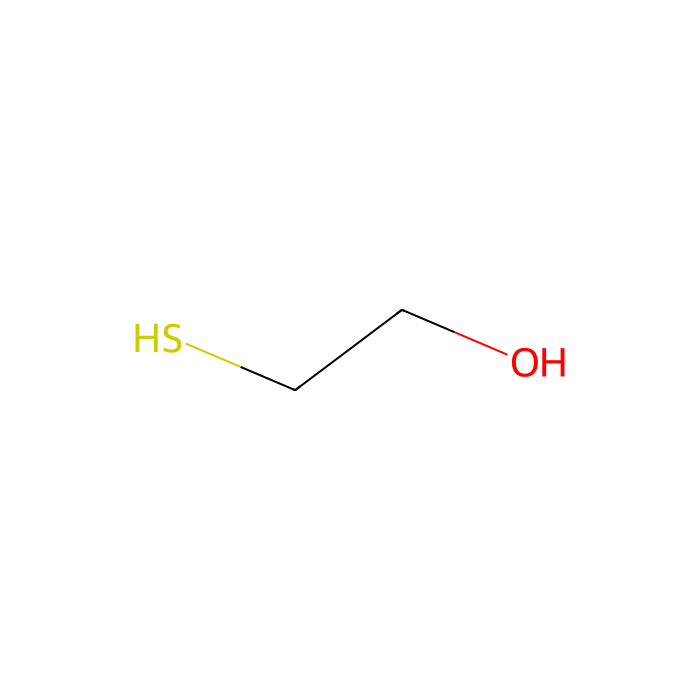
2-mercaptoethanol is a thiol compound, commonly used as a reducing agent in organic reactions.
Application:
2-mercaptoethanol is widely used for retarding oxidation of biological compounds in solution.
BME is suitable for reducing protein disulfide bonds prior to polyacrylamide gel electrophoresis and is usually included in a sample buffer for SDS-PAGE at a concentration of 5%. Cleaving intermolecular (between subunits) disulfide bonds allows the subunits of a protein to separate independently on SDS-PAGE. Cleaving intramolecular (within subunit) disulfide bonds allows the subunits to become completely denatured so that each peptide migrates according to its chain length with no influence due to secondary structure.
Comprehensive hazard, handling, storage, and regulatory compliance document.
Download SDS →Lot-specific quality data. Enter your lot number to retrieve the exact COA.
Look up COA →Full quality attributes and acceptance criteria for this grade.
View spec sheet →Taxonomy Tree
| Kingdom | Organic compounds |
|---|---|
| Superclass | Organosulfur compounds |
| Class | Thiols |
| Subclass | Alkylthiols |
| Intermediate Tree Nodes | Not available |
| Direct Parent | Alkylthiols |
| Alternative Parents | Primary alcohols Hydrocarbon derivatives |
| Molecular Framework | Aliphatic acyclic compounds |
| Substituents | Alkylthiol - Organic oxygen compound - Hydrocarbon derivative - Primary alcohol - Organooxygen compound - Alcohol - Aliphatic acyclic compound |
| Description | This compound belongs to the class of organic compounds known as alkylthiols. These are organic compounds containing the thiol functional group linked to an alkyl chain. |
| External Descriptors | a small molecule |
| Activity Type | Relation | Activity value | Units | Action Type | Journal | PubMed Id | doi | Assay Aladdin ID |
|---|
| Activity Type | Relation | Activity value | Units | Action Type | Journal | PubMed Id | doi | Assay Aladdin ID |
|---|
Find and download the COA for your product by matching the lot number on the packaging.
| Lot Number | Certificate Type | Date | Item |
|---|---|---|---|
 I2617309 | Certificate of Analysis | Sep 09, 2026 | M301573 |
| I2617308 | Certificate of Analysis | Sep 09, 2026 | M301573 |
| I2617307 | Certificate of Analysis | Sep 09, 2026 | M301573 |
| I2617306 | Certificate of Analysis | Sep 09, 2026 | M301573 |
| I2617305 | Certificate of Analysis | Sep 09, 2026 | M301573 |
| G2608156 | Certificate of Analysis | Jun 29, 2026 | M301573 |
| G2608157 | Certificate of Analysis | Jun 29, 2026 | M301573 |
| G2608159 | Certificate of Analysis | Jun 29, 2026 | M301573 |
| G2608160 | Certificate of Analysis | Jun 29, 2026 | M301573 |
| D2620172 | Certificate of Analysis | Apr 03, 2026 | M301573 |
| D2620167 | Certificate of Analysis | Apr 03, 2026 | M301573 |
| D2620168 | Certificate of Analysis | Apr 03, 2026 | M301573 |
| D2620169 | Certificate of Analysis | Apr 03, 2026 | M301573 |
| D2620170 | Certificate of Analysis | Apr 03, 2026 | M301573 |
| D2620171 | Certificate of Analysis | Apr 03, 2026 | M301573 |
| G2528154 | Certificate of Analysis | Jul 16, 2025 | M301573 |
| L2510124 | Certificate of Analysis | Jul 16, 2025 | M301573 |
| G2528155 | Certificate of Analysis | Jul 16, 2025 | M301573 |
| G2528156 | Certificate of Analysis | Jul 16, 2025 | M301573 |
| G2528158 | Certificate of Analysis | Jul 16, 2025 | M301573 |
| G2528549 | Certificate of Analysis | Jul 16, 2025 | M301573 |
| A2612048 | Certificate of Analysis | Jul 16, 2025 | M301573 |
| D2521073 | Certificate of Analysis | Apr 14, 2025 | M301573 |
| D2521069 | Certificate of Analysis | Apr 14, 2025 | M301573 |
| D2521070 | Certificate of Analysis | Apr 14, 2025 | M301573 |
| D2521071 | Certificate of Analysis | Apr 14, 2025 | M301573 |
| D2521072 | Certificate of Analysis | Apr 14, 2025 | M301573 |
| D2521095 | Certificate of Analysis | Apr 14, 2025 | M301573 |
| G2515087 | Certificate of Analysis | Apr 14, 2025 | M301573 |
| J2510086 | Certificate of Analysis | Apr 14, 2025 | M301573 |
| C2522001 | Certificate of Analysis | Dec 12, 2024 | M301573 |
| L2420341 | Certificate of Analysis | Dec 12, 2024 | M301573 |
| L2420330 | Certificate of Analysis | Dec 12, 2024 | M301573 |
| L2420329 | Certificate of Analysis | Dec 12, 2024 | M301573 |
| L2420328 | Certificate of Analysis | Dec 12, 2024 | M301573 |
| L2420325 | Certificate of Analysis | Dec 12, 2024 | M301573 |
| L2420323 | Certificate of Analysis | Dec 12, 2024 | M301573 |
| H2420118 | Certificate of Analysis | Aug 07, 2024 | M301573 |
| H2420117 | Certificate of Analysis | Aug 07, 2024 | M301573 |
| J2416210 | Certificate of Analysis | Aug 07, 2024 | M301573 |
| H2420119 | Certificate of Analysis | Aug 07, 2024 | M301573 |
| H2420121 | Certificate of Analysis | Aug 07, 2024 | M301573 |
| E2421314 | Certificate of Analysis | May 13, 2024 | M301573 |
| G2419072 | Certificate of Analysis | May 13, 2024 | M301573 |
| E2421428 | Certificate of Analysis | May 13, 2024 | M301573 |
| E2421317 | Certificate of Analysis | May 13, 2024 | M301573 |
| E2421316 | Certificate of Analysis | May 13, 2024 | M301573 |
| E2421315 | Certificate of Analysis | May 13, 2024 | M301573 |
| C2419399 | Certificate of Analysis | Mar 26, 2024 | M301573 |
| C2419398 | Certificate of Analysis | Mar 26, 2024 | M301573 |
| E2411291 | Certificate of Analysis | Mar 13, 2024 | M301573 |
| E2411296 | Certificate of Analysis | Mar 13, 2024 | M301573 |
| H2331725 | Certificate of Analysis | Sep 21, 2023 | M301573 |
| H2331724 | Certificate of Analysis | Sep 21, 2023 | M301573 |
| H2331728 | Certificate of Analysis | Sep 20, 2023 | M301573 |
| H2331727 | Certificate of Analysis | Sep 20, 2023 | M301573 |
| H2307196 | Certificate of Analysis | Jul 29, 2023 | M301573 |
| H2307193 | Certificate of Analysis | Jul 29, 2023 | M301573 |
| H2307192 | Certificate of Analysis | Jul 29, 2023 | M301573 |
| H2307175 | Certificate of Analysis | Jul 29, 2023 | M301573 |
| D2321307 | Certificate of Analysis | Oct 24, 2022 | M301573 |
| K2202027 | Certificate of Analysis | Oct 24, 2022 | M301573 |
| K2202028 | Certificate of Analysis | Oct 24, 2022 | M301573 |
| K2202029 | Certificate of Analysis | Oct 24, 2022 | M301573 |
| K2202030 | Certificate of Analysis | Oct 24, 2022 | M301573 |
| D2321308 | Certificate of Analysis | Oct 24, 2022 | M301573 |
| A2304174 | Certificate of Analysis | Oct 24, 2022 | M301573 |
| Solubility | Miscible with water, alcohol, ether, benzene and other organic solvents. |
|---|---|
| Sensitivity | Moisture & Air & heat Sensitive. |
| Refractive Index | 1.499-1.502 |
| Flash Point(°F) | 167℉ |
| Flash Point(°C) | 75℃ |
| Boil Point(°C) | 157-158°C |
| Melt Point(°C) | -100°C |
| Molecular Weight | 78.140 g/mol |
| XLogP3 | -0.200 |
| Hydrogen Bond Donor Count | 2 |
| Hydrogen Bond Acceptor Count | 2 |
| Rotatable Bond Count | 1 |
| Exact Mass | 78.0139 Da |
| Monoisotopic Mass | 78.0139 Da |
| Topological Polar Surface Area | 21.200 Ų |
| Heavy Atom Count | 4 |
| Formal Charge | 0 |
| Complexity | 10.000 |
| Isotope Atom Count | 0 |
| Defined Atom Stereocenter Count | 0 |
| Undefined Atom Stereocenter Count | 0 |
| Defined Bond Stereocenter Count | 0 |
| Undefined Bond Stereocenter Count | 0 |
| The total count of all stereochemical bonds | 0 |
| Covalently-Bonded Unit Count | 1 |