Sodium chloride solution - UltraBio™, Suitable for molecular biology, Ultra pure, ~5 M in H2O , CAS No.7647-14-5

CAS: 7647-14-5 Cat. No.: S433740 Formula: NaCl Molecular Weight: 58.44 Beilstein Registry Number: 3534976 EC Number: 231-598-3
AVAILABLE TO ORDER
GRADE & PURITY UltraBio™ ? UltraBio™ — Aladdin's line for molecular-biology applications. Use for nuclease-free, high-consistency reagents across molecular workflows. Suitable for molecular biology ? Molecular-biology grade — free of nucleases and contaminants that degrade DNA/RNA. Use in cloning, PCR, and nucleic-acid work needing clean reagents. Ultra pure ? Ultra-pure grade with very low impurity content across the board. Use for trace analysis, electronics, or processes intolerant of contamination. ~5 M in H2O
Synonyms
Sea water | Sodium chloride (NaCl) | Entsol | Natriumchlorid [German] | Cleanoz | Halite | Sodium chloric | Sodium chloride [USP:JAN] | Sodium-36 chloride | Saline Mist | Top flake | CCRIS 982 | Purex | Sodium chloride 0.9% in sterile plastic container |
Storage
Room temperature
★
Size
USA
Germany (EU)*
Price
Qty
500ml
S433740-500ml
Made to order · 8–12 wks

$125.90

$159.90
Save $34.00 (21.26%)
Enter a quantity for the sizes you want to add.

Specifications

Synonyms
Sea water | Sodium chloride (NaCl) | Entsol | Natriumchlorid [German] | Cleanoz | Halite | Sodium chloric | Sodium chloride [USP:JAN] | Sodium-36 chloride | Saline Mist | Top flake | CCRIS 982 | Purex | Sodium chloride 0.9% in sterile plastic container |
Specifications & Purity
UltraBio™, Suitable for molecular biology, Ultra pure, ~5 M in H2O
Storage
Room temperature
Grade
Suitable for molecular biology, Ultra pure, UltraBio™
Names and Identifiers
Canonical Smiles
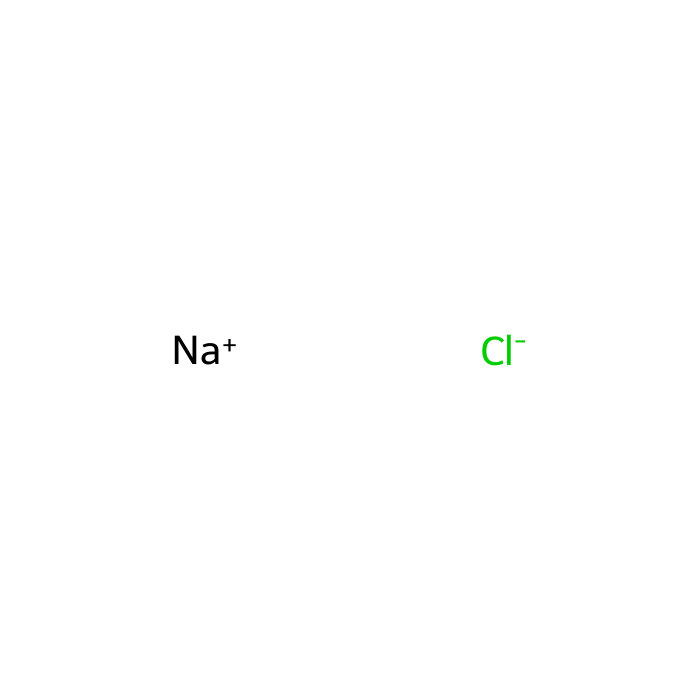
[Na+].[Cl-]
IUPAC Name
sodium;chloride
InChIKey
FAPWRFPIFSIZLT-UHFFFAOYSA-M
INCHI
1S/ClH.Na/h1H;/q;+1/p-1
Isomeric SMILES
[Na+].[Cl-]
WGK Germany
1
RTECS
VZ4725000
Molecular Weight
58.44
Beilstein
3534976

Advanced Data

Taxonomic Classification

Taxonomy Tree

KingdomInorganic compounds
SuperclassMixed metal/non-metal compounds
ClassAlkali metal salts
SubclassAlkali metal chlorides
Intermediate Tree Nodes Not available
Direct ParentAlkali metal chlorides
Alternative Parents Inorganic sodium salts  Inorganic chloride salts  
Molecular FrameworkNot available
Substituents Alkali metal chloride - Inorganic chloride salt - Inorganic sodium salt - Inorganic salt
DescriptionThis compound belongs to the class of inorganic compounds known as alkali metal chlorides. These are inorganic compounds in which the largest halogen atom is Chlorine, and the heaviest metal atom is an alkali metal.
External Descriptors inorganic chloride - inorganic sodium salt
3D Structure
Interactive Chemical Structure Model


Associated Targets(Human)
CA2 Tclin Carbonic anhydrase II (17698 Activities)
Activity TypeRelationActivity valueUnitsAction TypeJournalPubMed IddoiAssay Aladdin ID
CA1 Tclin Carbonic anhydrase I (13240 Activities)
Activity TypeRelationActivity valueUnitsAction TypeJournalPubMed IddoiAssay Aladdin ID
ST14 Tchem Matriptase (677 Activities)
Activity TypeRelationActivity valueUnitsAction TypeJournalPubMed IddoiAssay Aladdin ID
Associated Targets(non-human)
Carbonic anhydrase (69 Activities)
Activity TypeRelationActivity valueUnitsAction TypeJournalPubMed IddoiAssay Aladdin ID
Colletotrichum musae (107 Activities)
Activity TypeRelationActivity valueUnitsAction TypeJournalPubMed IddoiAssay Aladdin ID
Trypanosoma cruzi (99888 Activities)
Activity TypeRelationActivity valueUnitsAction TypeJournalPubMed IddoiAssay Aladdin ID
Mus musculus (284745 Activities)
Activity TypeRelationActivity valueUnitsAction TypeJournalPubMed IddoiAssay Aladdin ID
Fusarium verticillioides (912 Activities)
Activity TypeRelationActivity valueUnitsAction TypeJournalPubMed IddoiAssay Aladdin ID
Lasiodiplodia theobromae (193 Activities)
Activity TypeRelationActivity valueUnitsAction TypeJournalPubMed IddoiAssay Aladdin ID
Astrosclerin-3 (80 Activities)
Activity TypeRelationActivity valueUnitsAction TypeJournalPubMed IddoiAssay Aladdin ID
Musa acuminata AAA Group (20 Activities)
Activity TypeRelationActivity valueUnitsAction TypeJournalPubMed IddoiAssay Aladdin ID
Mechanisms of Action
Certificates (CoA,COO,BSE/TSE and Analysis Chart)
C of A & Other Certificates(BSE/TSE, COO):
Analytical Chart:

Find and download the COA for your product by matching the lot number on the packaging.

4 results found

Lot NumberCertificate TypeDateItem
H2520009H2520009Certificate of AnalysisDec 26, 2025 S433740
K2507727K2507727Certificate of AnalysisNov 27, 2025 S433740
B2513299B2513299Certificate of AnalysisFeb 20, 2025 S433740
L2312130L2312130Certificate of AnalysisDec 22, 2023 S433740
Chemical and Physical Properties
Melt Point(°C)800 °C
Molecular Weight58.440 g/mol
XLogP3
Hydrogen Bond Donor Count0
Hydrogen Bond Acceptor Count1
Rotatable Bond Count0
Exact Mass57.9586 Da
Monoisotopic Mass57.9586 Da
Topological Polar Surface Area0.000 Ų
Heavy Atom Count2
Formal Charge0
Complexity2.000
Isotope Atom Count0
Defined Atom Stereocenter Count0
Undefined Atom Stereocenter Count0
Defined Bond Stereocenter Count0
Undefined Bond Stereocenter Count0
The total count of all stereochemical bonds0
Covalently-Bonded Unit Count2
Documents & Articles
ADC Conjugation by DTT Reduction with Maleimide Drug Linker
UltraBio™: Defining Excellence in Molecular Biology Applications
Molecular Biology Grade
Comparing Guanidine Hydrochloride and Urea for Inclusion-Body Solubilization
Buffer exchange of a sample using a dialysis bag
Professional Guide to Streptavidin-Modified Proteins
Common Types of Buffer Solutions
Buffer Additives to Prevent Protein Precipitation
Why Did My Ni-Agarose Beads Turn Black or Brown?
Why Does Protein A Keep Leaching?
How to Optimize Buffer Components for Ni-Agarose Beads
Stripping, Cleaning, and Metal Recharging Workflow for Ni²⁺–Agarose Resins
Salting-In and Salting-Out: “Salt” Strategies in Protein Purification
Differences Between Transformation and Transfection
Eight Common Lysis Buffers
How should laboratory strains be preserved?
How to Choose the Best Protein Purification Technique
FAQ on Molecular Interaction Assays
Differences Among Antibodies for WB/FC/IP/ChIP/IF/IHC
His-Tagged Protein Purification
GST-Tagged Protein Purification
7 Types of DNA Ligases: Functions and Features
What is Ion Exchange Chromatography Used For? 4 Important Applications for Protein Purification
Mag-Fluo-4 AM Magnesium/Calcium Ion Fluorescent Probe: Properties, Experimental Use, and Aladdin Metal Ion Fluorescent Probe Selection Guide
Fundamentals and Applications of Etching Solutions: Using Metallic Copper / PCB Etching as an Example
His-Tag Protein Purification: Common Troubleshooting Questions and Practical Solutions
RNA Pull-Down Standard Operating Procedure (SOP)
How to Purify Proteins by Ion-Exchange Chromatography Under Denaturing Condition
Electrophoretic Mobility Shift Assay (EMSA) Standard Operating Procedure (SOP)
Installing a Redox Switch on Biomolecules: Principles, Conjugation Essentials, and an Application Guide for ATTO MB2 NHS ester
Calcium Gluconate: Physicochemical Properties, Pharmacopoeial Quality Control, and Application Guidelines
Practical Guide to Sodium Carboxymethyl Cellulose (CMC-Na): Thickening/Stabilizing Mechanisms, Key Controls for Solution Preparation, and Selection Navigation (including Table 1 and Tables A–C)
A Review of Ten Commonly Used Techniques for Detection, Quantification, and Interaction Analysis in Nucleic Acid Research
Selection of Common Research Salts: A Task Map for Alkali Metal Salts & Alkaline Earth Metal Salts (with Product Tables 1–6)
Perovskite PV/PeLED Precursor Guide: Selecting Metal Halide Salts, Key Conditions, and Reproducible Performance (including Product Tables 1–4 and a Selection Navigation Guide)
Protein Tags Demystified: Classification, Properties, and Suitable Experimental Applications
Recent Progress in Types, Mechanisms, and Food Applications of In Vitro Digestion Models
Proteinase K: Frequently Asked Questions
Methodological essentials for mineralization visualization: Alizarin Red S staining vs. Von Kossa silver staining
Recent Advances in Methods for Measuring Plant Protein-Related Indices and Application-Oriented Selection
Phycocyanin: A Review of Sources, Structural Features, Production Processes, Applications, and Claimed Benefits
Acid Phosphatase: Dephosphorylation Reactions in Acidic Microenvironments and Their Research, Assay, and Detection Applications
Diaphorase: NAD(P)H-Dependent Electron-Transfer Activity and Its Applications in Detection and Research
Haptoglobin (Hp): A Key Carrier in the Free Hemoglobin Clearance–Detoxification Axis, with Assays and Applications
Angiotensin-Converting Enzyme (ACE): A Review of Molecular Features, Catalytic Functions, and Research and Translational Applications
Chymosin: A Review of Molecular Features, Coagulation Kinetics, and Activity Evaluation
Micrococcal Nuclease (MNase): A Technical Review of Enzymatic Properties, Reaction Control, and Research and Biomanufacturing Applications
Hemicellulases: A Review of Substrate Specificity, Catalytic Systems, and Research and Industrial Applications
Phytase: Enzymological Properties, Mechanism of Action, and Applications in Feed and Food
Chlorophyll: Structural Features, Physicochemical Properties, and Key Points for Research and Industrial Applications
Chitinases: Substrate-Specific Degradation Mechanisms, Enzymatic Properties, and Application Directions
Paeonol: Physicochemical Features, Uses, and Key Points for Research Applications
Research Value of Polyelectrolyte Multilayers: Layer-by-Layer Design of Interfacial Composition, Mass Transport, and Function
The Positioning of pNPP in ALP Testing: Quantitative Detection Logic, Application Scenarios, and Selection Criteria
Selection Strategy for PBS, TBS, PBST, and TBST Washing Systems in IHC
Why Fluorocarbon Resins Are Weatherable: Structural Stability, Low Surface Energy, and Coating Film Appearance Retention
Failure Mechanisms, Application Limitations, and Systematic Improvement Directions for Polyester Coatings
Capable of Swelling, Adsorption, and Cation Exchange: What Makes Montmorillonite Clay Different?
How Should Montmorillonite Be Rationally Modified? Organic Modification, Inorganic Modification, and Application-Oriented Selection and Validation
Selection and Formulation Design Guidelines for Phenolic Resins in Coatings: Applicable Scenarios, Application Limitations, and Performance Verification
Why LABSA (Sulfonic Acid) Is Commonly Used in Household Cleaning Formulations: Neutralization Mechanism, Detergency Action, and Formulation Application Points
Application of Fatty Acid Methyl Ester Sulfonate (MES) in Household Detergent and Cleaning Formulations: Detergency, Hard-Water Tolerance, and Selection Criteria
K12 (Sodium Lauryl Sulfate/SLS) Is More Than a Foaming Agent: Structure, Properties, and Applications in Personal Care and Household Care Formulations
From Structure to Rheology: How Carbomer Forms Gel Structures and Enables Thickening, Suspension, and Auxiliary Emulsion Stabilization
Thickening, Suspension, Auxiliary Stabilization, and Agglomeration Mechanisms of Xanthan Gum in Personal Care Formulations: From Molecular Structure to Processing Applications
Why Can 6501 (Cocamide DEA) Stabilize Foam and Build Viscosity? Structural Mechanism, 1:1/1:1.5 Differences, and Application Selection
Practical Guide to TSA Tyramide Signal Amplification: How to Select Reagents, Optimize the Workflow, and Reduce Background When Detection Signals Are Weak for Low-Abundance Targets
AES (Fatty Alcohol Polyoxyethylene Ether Sulfate) in Personal and Home-Care Cleansing Formulations: An Analysis of Structure, Performance, and Low-Temperature Flowability
Signal Transduction Mechanism of Graphene Biosensors: From Molecular Recognition to Electrical/Optical Signal Readout and Materials Selection
Understanding CAPB from Its Structure: How Cocamidopropyl Betaine Improves Foam, Enhances Mildness, and Supports Thickening
What Is Synthetic Biology? The Industrialization Pathway from Upstream Reagent Toolchains to Biomanufacturing Applications
What Are the Differences Among Sodium Dodecylbenzenesulfonate/SDBS, LAS, and Sodium α-Olefin Sulfonate/AOS: A Comparative Overview of Synthesis, Structure, Mechanism of Action, and Formulation Selection
Analysis of the Foaming Performance Differences Between K12 and AOS: Structure, Acid–Base Stability, and Formulation Selection
Mechanisms and Troubleshooting of Foam Reduction in Personal and Household Care Formulations: Film Rupture, Weak Interfacial Films, Insufficient Surfactant Supply, and Phase-State Disturbance
Why Are Daily Chemical Products Prone to Viscosity Thinning in Summer? Core Mechanisms, Troubleshooting Methods, and Solutions
Exosome-Related Ingredients in Skincare Products: Sources and Preparation, Quality Control, Evidence of Efficacy, and Safety Assessment
Discovery and Structural Optimization of the Noncovalent 3CL Protease Inhibitor S-217622
Moisturizing Mechanisms of Tremella fuciformis Polysaccharides: From Polysaccharide Structure and Hydration Rheology to Dynamic Film Formation on the Skin Surface
Multilevel Moisturizing Mechanisms of Sodium Hyaluronate and Its Derivatives: Molecular Weight Modulation, Crosslinking, Acetylation, and Major Sites of Action
Phase-Partitioning Principles, System Differences, and Application Selection in Phenol-Based DNA and RNA Extraction
Why Primary and Secondary Amines Have Difficulty Participating Directly in the Classical Mitsunobu Reaction: Mechanism, Inversion of Configuration, and Reaction Scope of BEHT-Mediated Alcohol Amination
Differences Between Animal-Derived Collagen and Recombinant Collagen in Skincare: Sequence and Structure, Safety, Skin Effects, and Evidence Evaluation
3,3-Spiro-α-Proline Building Blocks: Structural Features, Complementary Synthetic Routes, and Multigram-Scale Preparation
Citations of This Product
Solution Calculators
Reviews

Customer Reviews

Application Protocols

No manufacturer protocols are provided for this item. As a general laboratory reagent, sodium chloride solution is incorporated into many standard procedures; a few literature-style examples are offered for context (not item-specific, adjust to your needs):

  • Preparing a working saline wash: Combine buffer base (e.g., 20 mM Tris-HCl, pH 7.5) with 150 mM NaCl; filter sterilize (0.2 µm) if sterility is required. Store at room temperature or 2–8 °C per buffer stability.
  • Brine wash for extraction: Prepare a saturated NaCl solution separately. After aqueous/organic extraction, add an equal volume of brine to the organic layer, shake, vent, and separate. Repeat as needed to reduce water carryover.
  • Ion-exchange elution: Prepare elution buffers with step or linear gradients from low salt (e.g., 50 mM NaCl) to high salt (e.g., 1 M NaCl) in your chosen buffer (pH optimized for your analyte). Monitor conductivity to track gradient.

Important: The exact concentration and any sterility/endotoxin attributes of this catalog item are not specified; consult the CoA/Spec Sheet and adapt protocols accordingly. For regulated applications, use validated, traceable solutions.

Biological Roles

Literature/general overview: Sodium chloride is fundamental to biology primarily via its constituent ions.

  • Osmotic balance and volume regulation
    • Na+ and Cl− are the dominant extracellular ions in most vertebrates, setting osmolarity and influencing cell volume through aquaporins and ion transporters.
  • Electrochemical gradients
    • Na+ gradients across membranes drive secondary active transport (e.g., glucose/Na+ symport) and contribute to action potentials in excitable tissues (with K+ and Cl− fluxes). While these are physiological concepts, laboratory buffers often mimic aspects of these gradients for in vitro assays.
  • Protein and nucleic acid interactions
    • Ionic strength modulates macromolecular stability, binding specificity, and aggregation. NaCl screens electrostatics, stabilizing duplex DNA and influencing protein–protein/ligand interactions; excessive salt can promote salting-out via Hofmeister series effects.
  • Enzymology
    • Many enzymes exhibit salt-dependent activity profiles; moderate NaCl can reduce nonspecific adsorption to surfaces and matrices, while high concentrations can inhibit or denature sensitive enzymes.
  • Microbiology/media formulation
    • NaCl defines tonic strength in many media; in selective media, altered NaCl can impose osmotic stress for phenotype selection (e.g., halotolerance studies).

Note: The present product is for research use only. No clinical or in vivo use is implied. The exact concentration, sterility, and endotoxin levels for this item are not specified; consult the CoA/Spec Sheet to assess suitability for specific biological assays.

Buffer Applications

This product is not a buffer; sodium chloride provides ionic strength but essentially no buffering capacity near neutral pH (literature). It is commonly included in buffer formulations to adjust tonicity and modulate macromolecular interactions.

Practical, literature-based examples (not item-specific):

  • Tris-NaCl buffers (TBS): Tris base/HCl (typically 10–50 mM) with 100–200 mM NaCl used for antibody washes and protein blotting; NaCl reduces nonspecific binding.
  • PBS (phosphate-buffered saline): Phosphate buffer (10 mM) with ~137 mM NaCl and ~2.7 mM KCl; used for general washing and dilution when buffering is needed. Choose saline alone when phosphate may interfere (e.g., metal-binding studies).
  • SSC/SSPE (nucleic acids): Saline–sodium citrate buffers use Na+ to control hybridization stringency. Adjust salt concentration to tune stringency during washes.
  • IEC (ion-exchange chromatography) buffers: Start in low-salt (e.g., 0–50 mM NaCl) and elute with gradients up to 1 M NaCl to displace bound analytes.

Preparation and checks (literature/general):

  • Prepare with high-purity water; verify conductivity or chloride content when molarity is critical.
  • Filter sterilize (0.2 µm) where sterility is required. Confirm pH with a calibrated meter after adding salts and before final volume adjustments.

Note: For this catalog item, concentration, pH, and sterility are not specified; refer to CoA/Spec Sheet.

Green Alternatives

Context: Sodium chloride solution is generally benign, with low toxicity and minimal environmental persistence beyond salinity impacts. “Greener” considerations focus on minimizing resource use, avoiding unnecessary buffering components, and ensuring compatibility with downstream processes (literature/general).

Comparison considerations:

  • NaCl solution vs PBS (phosphate-buffered saline)
    • Greener when: Buffering is unnecessary and phosphate release to wastewater should be minimized.
    • Trade-off: No pH buffering; process may require pH control separately.
  • NaCl solution vs KCl solution
    • Greener when: Sodium is less problematic than potassium in specific effluent limits (context-dependent). Both salts are low-hazard; choose based on biological relevance and waste streams.
  • NaCl solution vs proprietary “stabilized” saline mixes
    • Greener when: Additives (e.g., preservatives, chelators) would complicate waste disposal or interfere with downstream enzymology. Pure NaCl solution minimizes chemical footprint.

Operational green tips (literature/general):

  • Prepare only the volume needed and store appropriately to reduce waste from expired solutions.
  • Use high-purity water to avoid repeat preparations and reduce failed experiments.
  • Where feasible, regenerate containers (clean/sterilize) or select recyclable packaging compatible with your QA system.
  • For extraction workups, consider mechanical emulsion-breaking (centrifugation) before resorting to brine to reduce salt load in aqueous waste.

Note: This catalog item’s additive profile and concentration are not specified; review the CoA/Spec Sheet to align with your green chemistry targets.

Pharmaceutical Uses

No therapeutic claims are made; this product is for research use only. The following are literature/general formulation roles of sodium chloride solutions in pharmaceutical and bioprocess contexts (not specific to this item):

  • Excipient/tonicity adjuster: NaCl is widely used to adjust osmolality in aqueous formulations to improve physical stability and compatibility of drug products and biologics. Typical ranges target isotonicity (~0.9% w/v), but exact values are formulation-dependent.
  • Process solutions: Employed in cleaning, rinsing, and hold solutions where defined ionic strength facilitates protein handling or column regeneration in downstream processing.
  • Chromatography: Used in binding/elution buffers for ion-exchange and hydrophobic interaction chromatography; gradients up to high salt (e.g., 0.5–1.5 M) are common.
  • Compatibility notes: Chloride can interact with certain APIs or excipients (e.g., metal-catalyzed oxidation or precipitation of Ag+ as AgCl). Assess chloride sensitivity during preformulation.
  • Standards and QC: NaCl solutions of known conductivity/molarity are used to calibrate instrumentation (e.g., conductometers) supporting GMP labs; traceability is required for regulated use.

Important: Pharmacopoeial compliance (USP/EP/JP, particulate/endotoxin limits, sterility, container–closure) and exact concentration specifications are not provided for this item; consult the CoA/Spec Sheet if considering use in development labs. Not for human or veterinary use.

Physical Properties

Item-specific specifications for this solution (e.g., exact NaCl concentration, pH, conductivity, density, refractive index) are not specified for this item; refer to CoA/Spec Sheet.

Literature/general properties (for reference only; depend on concentration):

  • Appearance: Clear, colorless aqueous solution when properly prepared from high-purity NaCl and water.
  • Solute (NaCl) properties (literature)
    • Molecular weight: 58.44 g/mol
    • Solubility in water: ~359 g/L at 25 °C; increases with temperature.
    • LogP: Not applicable; ionic compound (practically insoluble in nonpolar solvents).
  • Aqueous solution properties (typical literature ranges)
    • Density: Increases with salinity; e.g., 0.9% w/v (~154 mM) at 20–25 °C has density ~1.005–1.006 g/mL; saturated brine ~1.2 g/mL at 25 °C.
    • Electrical conductivity: On the order of 15–20 mS/cm for ~0.15 M at 25 °C; rises with concentration (nonlinearly).
    • Osmolality: ~308 mOsm/kg for ~0.9% w/v (isotonic) solution.
    • Freezing point: Depression with salinity; ~−0.54 °C for ~0.9% w/v; eutectic brine much lower.
    • Boiling point: Slight elevation relative to water; magnitude depends on molality.
  • pH: Near neutral for pure NaCl solutions prepared in CO2-free water; absorbed CO2 can shift pH slightly acidic. Exact pH depends on water quality and gas equilibration (literature).

Practical note: For analytical work, verify concentration-dependent properties (conductivity, density, refractive index) by measurement or the item’s CoA.

Quality & Grades

Item-specific quality designations (from Product Data):

  • UltraBio™
  • Suitable for molecular biology
  • Ultra pure

What these grades generally imply (literature/general guidance; not a specification):

  • UltraBio™/Ultra pure: Typically indicates very low levels of ionic, organic, and particulate contaminants, and preparation using high-purity NaCl and water under controlled conditions. For molecular biology, low nuclease (RNase/DNase) and protease activities are expected; microbial bioburden and endotoxin may be controlled depending on the manufacturer’s process. Exact limits are not specified for this item; refer to CoA/Spec Sheet.
  • Suitable for molecular biology: Implies compatibility with nucleic acid and protein workflows where trace contamination (e.g., heavy metals, organics) can interfere with enzymes, PCR, ligation, or sequencing library prep. May be filtered through 0.2 µm and packaged to minimize contamination.

Verification and QC use-cases:

  • Enzymatic tolerance: Assess via control reactions (e.g., PCR with a standard template) to confirm absence of inhibitory contaminants in your workflow.
  • Conductivity and concentration: Confirm by conductivity or chloride titration (e.g., silver nitrate/Volhard) when exact molarity is critical.

Note: Concentration, pH, UV absorbance background, endotoxin, and microbial/particle specifications are not specified for this item; consult the CoA/Spec Sheet for actual release criteria.

Reaction & Applications

As an aqueous electrolyte, sodium chloride solution is primarily used to control ionic strength, osmotic balance, and activity coefficients rather than to participate directly in chemical transformations. Key laboratory applications (literature/general):

  • Biomolecular workflows
    • DNA/RNA handling: Addition of Na+ and Cl− screens electrostatic repulsion among phosphate backbones, influencing hybridization, annealing temperatures, and stringency. Common wash and dilution matrices use ~0.1–0.5 M NaCl depending on context. Exact values must be chosen per protocol.
    • Protein science: Modulates solubility via Hofmeister effects; NaCl can reduce nonspecific binding, adjust column binding/elution (e.g., ion-exchange chromatography), and tune aggregation/precipitation behavior. Typical gradients range from 0 to 1 M.
  • Workups and separations
    • Brine washes: A saturated NaCl solution (prepared separately) helps to “salt out” water from organic layers and collapse emulsions during liquid–liquid extraction.
    • Phase behavior: NaCl raises the critical salt concentration for surfactant micellization and affects aqueous biphasic polymer systems (e.g., PEG–dextran partitioning).
  • Analytical chemistry
    • Ionic strength adjustment buffers (ISAB) for potentiometric measurements (e.g., ISEs) often employ NaCl to maintain constant ionic strength, improving measurement precision.
    • Conductivity standards may use NaCl solutions of known molarity; verify against traceable standards when needed.
  • General wet-chemical uses
    • Chloride as a ligand: In some coordination equilibria, Cl− can influence speciation; use cautiously where chloride-sensitive metals or catalysts are present.

Note: The item’s exact concentration and sterility are not specified; adjust or verify to meet protocol requirements.

Reaction Conditions

Because sodium chloride solution functions primarily as an electrolyte or workup aid, conditions are application-specific. The following literature/general ranges are provided for planning; they are not item-specific specifications:

  • Ionic strength modulation in protein/nucleic-acid buffers
    • Typical NaCl concentrations: 50–200 mM for routine washes and enzyme storage; 300–1000 mM for reducing nonspecific interactions or for ion-exchange elutions.
    • Temperature: Usually ambient (20–25 °C); colder temperatures can reduce microbial growth and may stabilize biomolecules. Always check solubility and precipitation behavior of other buffer components when changing temperature.
  • DNA/RNA hybridization/stringency
    • Washes commonly step from high salt (e.g., 2×–5× SSC equivalents) to lower salt (0.1×–0.5× SSC) with temperature increases to enhance stringency. Na+ concentration is the dominant contributor.
  • Liquid–liquid extraction (brine wash)
    • Use saturated NaCl solution to break emulsions and pre-dry organic layers. Vigorously mix and allow full phase separation; repeat as necessary. Avoid prolonged contact with chloride-sensitive substrates.
  • Potentiometry/conductivity
    • Conductivity standards rely on precisely prepared NaCl molarities (e.g., 0.01 M at 25 °C has well-tabulated κ). Use NIST-traceable standards for calibration.

Practical notes:

  • Degassing: Generally unnecessary; however, in CO2-sensitive buffers, equilibrate under controlled atmosphere to maintain pH.
  • Sterility: For molecular biology, filter sterilize through 0.2 µm and work aseptically when protocols require it.

Reminder: The exact concentration, pH, and sterility of this item are not specified; consult the CoA/Spec Sheet.

Safety & Handling

Authoritative hazard classification for this specific item is not specified; consult the product SDS for definitive information.

General safety information (literature/good laboratory practice):

  • GHS/Classification: Sodium chloride solutions at typical laboratory concentrations are often not classified as hazardous. However, classification can vary with concentration and impurities. Always review the SDS and institutional policies.
  • Primary hazards: Low inherent toxicity; may cause eye or skin irritation upon prolonged contact. Large spills can affect conductivity/corrosion on equipment.
  • PPE: Use standard laboratory PPE—lab coat, safety glasses or face shield, and appropriate chemically resistant gloves (e.g., nitrile). Avoid contact with eyes and prolonged skin exposure.
  • Handling: Work on clean benches to prevent microbial contamination (especially for molecular biology use). Use sterile technique if sterility is required. Avoid introducing metal ions or detergents if downstream applications are sensitive.
  • Incompatibilities: Strong dehydrating agents, reactive silver salts (precipitation of AgCl), and strong acids/bases only in the sense of altering pH or ionic strength. Do not mix with reactive halogenation reagents or where chloride can be a nucleophile if chloride-sensitive chemistry is occurring nearby.
  • First aid (overview; refer to SDS): Rinse eyes/skin with water for several minutes if contacted. If swallowed in laboratory context, rinse mouth with water; seek medical attention as per institutional policy.
  • Storage conditions (from Product Data): Room temperature.
  • Environmental: Avoid excessive release to drains; high-salinity effluent can stress biological wastewater treatment (literature).
Solvent Selection

This product is itself an aqueous electrolyte solution rather than a solvent choice for dissolving other compounds. Selection considerations (literature/general):

  • Polarity and miscibility: Completely miscible with water; not miscible with nonpolar solvents. The presence of NaCl increases ionic strength and can influence solvation of biomolecules, micelle formation, and phase behavior of aqueous biphasic or extraction systems.
  • When to choose plain water vs saline:
    • Choose NaCl solution to set defined ionic strength or osmolarity (e.g., washing steps for nucleic acids/proteins, maintaining membrane integrity of cells in non-biological tests).
    • Choose pure water when ionic strength must be minimized (e.g., certain mass spectrometry ionization preparations) or chloride-sensitive chemistries are performed.
  • Comparisons (literature/general)
    • NaCl solution vs PBS: PBS adds buffering (phosphate) and similar ionic strength; use PBS when pH control is needed. Use NaCl solution when buffering ions could interfere (e.g., phosphate-sensitive metal-dependent enzymes or precipitation with Ca2+/Mg2+).
    • NaCl solution vs KCl solution: K+ may better mimic intracellular conditions in some biophysical assays; Na+ is more common for general wash steps and nucleic acid manipulations.
  • Extraction/brine usage: Saturated NaCl (“brine,” prepared separately) is commonly used to break emulsions and pre-dry organic layers. This catalog item’s concentration is not specified—prepare brine as needed if your workflow requires saturation.

Note: For applications sensitive to trace metals or organics, pair with high-purity water and materials to maintain the intended quality.

Storage & Reconstitution
  • Storage conditions (from Product Data): Room temperature.
  • Container considerations (literature/general): Store tightly closed to prevent evaporation and contamination. For molecular biology workflows, maintain aseptic handling and minimize repeated opening. Use chemically compatible containers (e.g., HDPE or borosilicate glass) with low extractables.
  • Light/air sensitivity: NaCl itself is not light-sensitive; however, minimize airborne particulate and CO2 exposure if solution composition (pH/ionic strength of buffers combined with NaCl) could drift over time.
  • Stability (literature/general): High-purity saline is typically stable for months at room temperature if uncontaminated. Microbial growth is possible, particularly at low salt concentrations; use sterile technique or add preservatives only if compatible with your application.
  • Reconstitution: Not applicable—this product is supplied as a solution. If any crystallization or precipitation is observed (e.g., due to evaporation or low temperature), redissolve by gentle warming to ambient temperature and mixing; verify concentration if precise molarity is required.
  • Shipping: Not specified for this item; consult logistics documents if temperature control is required by your process.
  • Before use checks: Visually inspect for clarity/particulates. For critical work, confirm concentration by conductivity or titration, and verify absence of microbial contamination where sterility matters.

Note: Exact concentration, pH, sterility, and additive profile are not specified for this item; refer to the CoA/Spec Sheet for authoritative details.

Structure & Identity

Brief overview: Sodium chloride solution is an aqueous solution of the inorganic salt NaCl; the exact concentration is not specified for this catalog item.

  • Item-specific identifiers (from Product Data)
    • CAS: 7647-14-5
    • CID (PubChem): 5234
    • InChIKey: 77712 (as provided)
    • Grade/Designation: UltraBio™, Suitable for molecular biology; Ultra pure
  • Core chemical entity (literature/general)
    • Molecular formula (solute): NaCl (sodium chloride)
    • Molecular weight (solute): 58.44 g/mol (literature)
    • SMILES (solute, dissociated form): [Na+].[Cl-] (literature)
    • InChI (solute, representative): InChI=1S/ClH.Na/h1H;/q;+1/p-1 (literature)
  • Structural features (literature/general)
    • In solution, NaCl exists as solvated ions: Na+ (sodium cation) and Cl− (chloride anion), each hydrated by shells of water molecules via ion–dipole interactions.
    • No stereocenters or covalent functional groups; purely ionic character.
    • Extended 3D hydration structure depends on concentration and temperature; at infinite dilution, primary hydration numbers are typically ~4–6 for Na+ and ~6–8 for Cl− (literature ranges).
  • 2D description in words (literature/general)
    • A simple binary electrolyte comprised of monatomic ions: a small, hard Lewis acid (Na+) and a soft, polarizable halide base (Cl−), dispersed in water.

Note: The concentration, pH, and any additives/stabilizers are not specified for this item; refer to CoA/Spec Sheet.

Synthetic Utility

In synthetic and preparative chemistry, aqueous sodium chloride solutions are used operationally rather than as reagents in bond-forming steps. Literature/general utilities include:

  • Liquid–liquid extraction workups
    • Brine washes: Saturated NaCl solution (prepared separately) reduces water solubility in organic solvents, collapses emulsions, and preliminarily dries the organic phase prior to desiccant use. Particularly useful after aqueous basic or acidic washes.
  • Phase and solubility control
    • “Salting out” effects tailor distribution coefficients of moderately polar solutes, improving phase disengagement and recovery yields.
  • Electrochemistry
    • Background electrolyte for aqueous electrochemical cells when chloride compatibility exists; note that chloride can be oxidized at anodes to chlorine/hypochlorite under certain conditions—select electrodes and potentials accordingly.
  • Catalysis/coordination equilibria
    • Chloride ligation affects speciation of transition-metal complexes (e.g., Pd, Pt, Ru); adding NaCl can shift equilibria toward chloro-complexes or compete with other anions.
  • Analytical/sample prep
    • Ionic strength adjustment prior to headspace GC (salting out VOCs) and potentiometric ion-selective electrode measurements (ISAB) often uses NaCl.

Caveats:

  • Chloride-sensitive transformations (e.g., certain oxidations, diazonium reactions, Ag/mercury chemistry) may be inhibited or side-react with chloride; avoid NaCl in these contexts.
  • For organic synthesis, verify that aqueous waste salinity is acceptable for your facility’s disposal limits.

Note: The concentration of this catalog item is not specified; prepare brine or target molarities as required.

Target Specificity

Not applicable. This product is a chemical solution (sodium chloride in water), not a biological affinity reagent or antibody. No target, epitope, clone, or species specificity data are associated with this item.

Shall we send you a message when we have discounts available?

Remind me later

Thank you! Please check your email inbox to confirm.

Oops! Notifications are disabled.